When a drivetrain component fails completely, the diagnosis is usually straightforward. A snapped clutch fork, a shattered friction disc, or a blown slave cylinder leaves you stranded with a pedal on the floor or a car that refuses to move. However, intermittent clutch problems are the bane of both DIY mechanics and seasoned transmission specialists. A clutch that slips only on steep inclines, a pedal that feels spongy only in stop-and-go traffic, or a drivetrain that chatters exclusively at 2,200 RPM requires a deep understanding of system dynamics to troubleshoot effectively.
The Baseline: How Does a Manual Clutch Work?
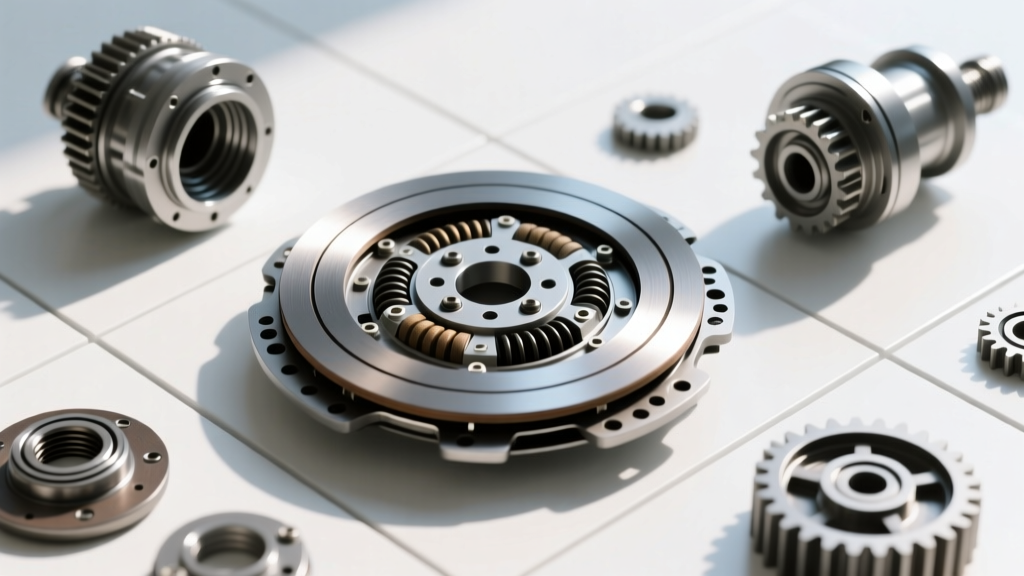
To accurately diagnose erratic behavior, we must first answer a fundamental question: how does a manual clutch work under normal conditions? The manual clutch assembly is a mechanically actuated, hydraulically controlled friction coupling situated between the engine's flywheel and the transmission's input shaft.
When your foot is off the pedal, the diaphragm spring of the pressure plate exerts massive clamping force (often exceeding 2,500 lbs of pressure) against the friction disc, locking it to the flywheel. Engine torque is transferred directly into the gearbox. When you depress the pedal, hydraulic pressure pushes the clutch slave cylinder (CSC), which actuates the release bearing. This bearing presses against the fingers of the diaphragm spring, pivoting it and pulling the pressure plate away from the friction disc. This breaks the mechanical lock, allowing the input shaft to stop spinning so you can change gears. When this sequence is interrupted by thermal expansion, hydraulic aeration, or mechanical resonance, intermittent faults occur.
The Ghost in the Machine: Defining Intermittent Clutch Symptoms
Intermittent failures rarely stem from worn friction material. Instead, they are usually the result of environmental variables—heat, RPM harmonics, and fluid dynamics—interacting with marginal components. Below are the three most common culprits of ghost-in-the-machine clutch diagnostics.
1. Thermal Hydraulic Bypass (The 'Hot Weather' Disengagement Ghost)
One of the most frustrating intermittent issues is a clutch that disengages perfectly when cold but begins to drag or fail to disengage after 45 minutes of stop-and-go driving. This is almost always caused by internal seal bypass within the Clutch Master Cylinder (CMC).
As modern engine bays run hotter to meet stringent 2026 emissions standards, the firewall-mounted CMC is subjected to extreme thermal soak. The internal rubber cups inside the CMC (often manufactured by FTE Automotive or Sachs) can harden or develop micro-abrasions on the cylinder bore. When the DOT 4 fluid heats up and its viscosity drops, the fluid bypasses the internal seal rather than traveling down the hard line to the slave cylinder. Because the bypass only happens when the fluid is hot and thin, the pedal feels normal in the morning but sinks to the floor or fails to release the clutch during a hot afternoon commute. Furthermore, if the CMC pushrod clearance is not set to the OEM specification of 0.1mm to 0.5mm, the fluid return port remains blocked. As the fluid expands from heat, it has nowhere to go, resulting in intermittent clutch drag that mimics a warped pressure plate.
2. Dual-Mass Flywheel (DMF) Resonance and Hot-Spotting
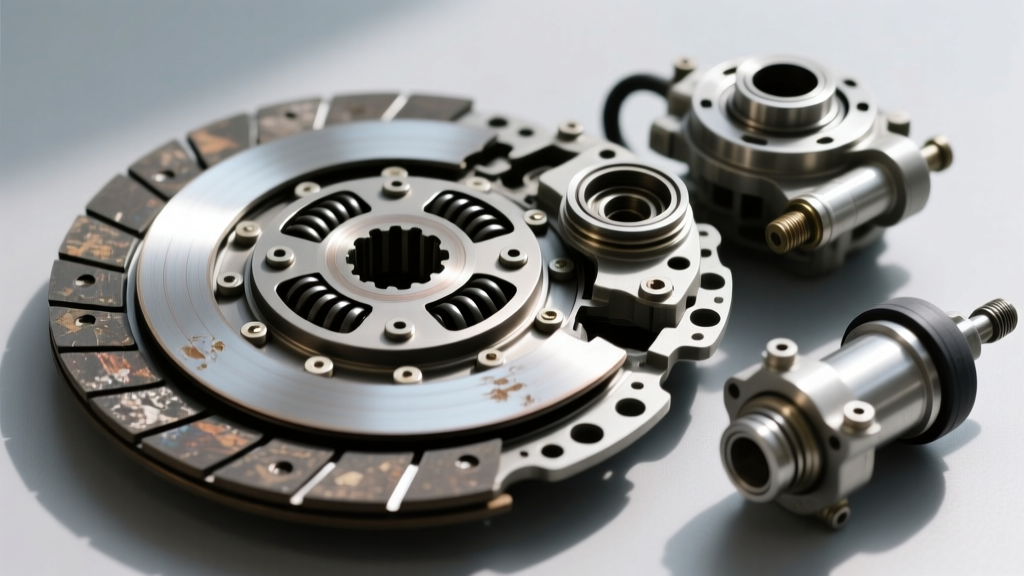
If you are diagnosing a vehicle equipped with a Dual-Mass Flywheel (DMF)—standard on most modern diesel and high-torque gasoline applications—you are dealing with a complex torsional dampening system. According to engineering data from the Schaeffler Group, the primary and secondary masses of a DMF are separated by a series of heavy-duty arc springs and friction rings.
Intermittent chatter or vibration that only occurs between 1,800 and 2,400 RPM under light load is a classic sign of failing DMF arc springs or degraded internal grease. As the internal grease breaks down and carbonizes from heat cycling, the springs begin to bind and release erratically. This creates a localized 'hot spot' on the secondary mass. The clutch will engage smoothly at high RPMs or when completely cold, but will shudder violently during the specific resonant frequency where the internal springs fail to dampen the engine's firing pulses.
3. Release Bearing Bind on the Input Shaft Sleeve
The release bearing rides on a machined sleeve on the transmission's input shaft. If this sleeve lacks proper lubrication, or if dissimilar metals cause galvanic corrosion, the bearing will bind. This results in an intermittent 'notchy' pedal feel or a clutch that hangs slightly when released, causing a brief scrape of synchros during 2nd-to-3rd gear shifts. This issue is highly dependent on ambient humidity and temperature, making it notoriously difficult to replicate on a cold lift in the shop.
Diagnostic Data Matrix: Intermittent vs. Catastrophic Failures
Use the following matrix to differentiate between a component that is wearing out uniformly and one that is failing based on environmental triggers.
| Symptom Presentation | Environmental Trigger | Probable Root Cause | Primary Component to Inspect |
|---|---|---|---|
| Pedal sinks to floor after 30+ mins | High ambient / underhood heat | Internal CMC seal bypass due to thermal fluid thinning | Clutch Master Cylinder (CMC) bore |
| Chatter only at 1,800-2,400 RPM | Specific torsional load / light throttle | DMF arc spring bind or degraded dampening grease | Dual-Mass Flywheel (LuK / Sachs) |
| Clutch drags when hot, fine when cold | Fluid thermal expansion | Zero pushrod clearance blocking CMC return port | CMC Pushrod adjustment / Pedal stop |
| Notchy pedal return, synchro scrape | High humidity / cold mornings | Galvanic corrosion on input shaft sleeve | Transmission Input Shaft & Release Bearing |
| Slipping only on steep inclines | High torque demand / low vehicle speed | Oil contamination or localized friction disc glazing | Friction Disc & Rear Main Seal |
Precision Troubleshooting: Specs and Measurements
Diagnosing intermittent clutch problems requires moving beyond 'pumping the pedal' and utilizing precision measurement tools. Follow these expert-level diagnostic steps:
Step 1: Verify Pedal Freeplay and Pushrod Clearance
Measure the clutch pedal freeplay at the center of the pedal pad. Most modern manual transmissions (including the Honda K20C1 and Ford Mustang MT-82) require between 12mm and 25mm (0.5 to 1.0 inch) of freeplay before the release bearing contacts the diaphragm spring fingers. If freeplay is zero, the release bearing is constantly spinning under load, leading to premature bearing failure and intermittent heat-induced drag.
Next, check the CMC pushrod clearance. Disconnect the hard line and use a feeler gauge between the master cylinder piston and the pushrod. You must have 0.1mm to 0.5mm of clearance. If the pushrod is pre-loading the piston, the fluid return port is blocked. As the DOT fluid heats up and expands, it will actuate the slave cylinder slightly, causing the clutch to slip intermittently under heavy load.
Step 2: Advanced Hydraulic Bleeding and Fluid Analysis
Standard gravity bleeding often fails to remove air trapped in the complex routing of modern hydraulic lines, particularly where the slave cylinder is mounted concentrically inside the bell housing (CSC). Air bubbles compress when hot, leading to a spongy pedal that only appears after the fluid temperature rises. Use a reverse-bleeding technique: inject DOT 4 Class 6 low-viscosity fluid (such as Bosch ESI6 or Motul RBF 660) from the slave cylinder bleeder valve UP into the master cylinder reservoir. This forces micro-bubbles out in the direction of their natural buoyancy.
Step 3: Input Shaft Sleeve Preparation
If you are replacing a clutch kit to solve an intermittent binding issue, the input shaft sleeve must be addressed. Do not use standard lithium grease, which will melt and migrate onto the friction disc, causing catastrophic slipping. Apply a microscopic layer of high-temperature molybdenum disulfide (moly) paste—such as Toyota Genuine Part #00294-12011 or equivalent—to the sleeve. This prevents the release bearing from binding during the thermal expansion cycles of the aluminum bell housing.
Component Replacement Realities and Costs
When intermittent diagnostics confirm a hard part failure, understanding the 2026 market costs and torque specifications is vital for a lasting repair. For comprehensive diagnostic flowcharts, the AA1Car Automotive Library remains an excellent reference for secondary verification.
- Clutch Master Cylinder (CMC): Replacement costs range from $150 to $350 for OEM-equivalent units (FTE, Sachs). Labor is typically 1.5 hours. Always replace the hard line if it features an integrated quick-connect that has become brittle from heat cycles.
- Dual-Mass Flywheel (DMF) Conversion vs. Replacement: A genuine LuK DMF replacement kit (including flywheel, pressure plate, disc, and CSC) costs between $650 and $1,200 in parts alone. While aftermarket 'Solid Flywheel Conversion Kits' are cheaper ($350-$500) and eliminate the DMF as a future failure point, they will transfer torsional vibration directly into the transmission, potentially causing premature synchro wear and gear rattle.
- Torque Specifications: Never guess on flywheel and pressure plate hardware. For example, GM LS-series flywheel bolts require 74 lb-ft with medium-strength threadlocker. Honda K-Series applications often require a torque-to-yield procedure (e.g., 76 lb-ft plus an additional 90-degree turn). Pressure plate bolts must be torqued in a star pattern, typically in 3-step increments (e.g., 11 lb-ft, then 18 lb-ft, then 25 lb-ft) to prevent warping the clutch cover, which causes intermittent engagement shudder.
Final Diagnostic Thoughts
Intermittent clutch problems are rarely random; they are highly predictable responses to thermal, mechanical, and hydraulic variables. By understanding the baseline physics of the system, verifying exact clearances, and respecting the complex dynamics of modern dual-mass flywheels and concentric slave cylinders, you can isolate the ghost in the machine and execute a permanent, OEM-quality repair.