The Misdiagnosed Slip: When Cooling Components Mimic Drivetrain Failure
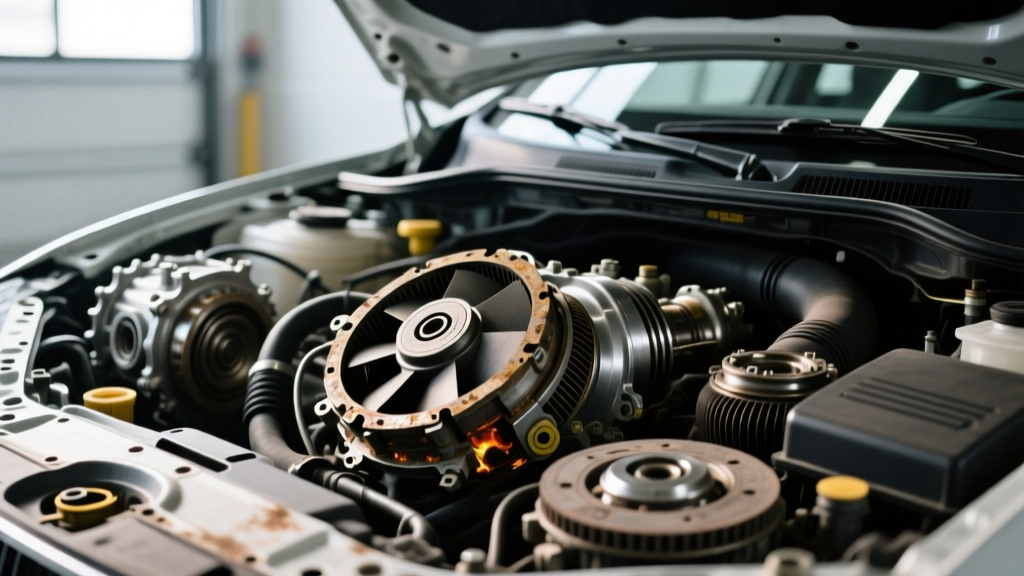
Intermittent clutch problems are the bane of diagnostic technicians and DIY mechanics alike. A manual transmission that slips only on steep inclines, or an automatic that flares between 3rd and 4th gear exclusively when the engine reaches full operating temperature, often leads to unnecessary and expensive transmission teardowns. However, a frequently overlooked culprit in these scenarios is the car fan clutch. While technically an engine cooling component, a failing viscous or electromagnetic fan clutch creates severe parasitic drag and electrical anomalies that perfectly mimic transmission clutch failure.
In this comprehensive diagnostic guide, we will explore how to differentiate between a true internal transmission clutch fault and the parasitic drag or electrical interference caused by a defective car fan clutch. By understanding the mechanical and electrical crossover between the cooling system and the drivetrain, you can save thousands of dollars in misdiagnosed repairs.
The Physics of Parasitic Drag: Viscous Fan Clutch Lock-Up
A standard silicone-driven viscous fan clutch relies on a bimetallic coil, a valve arm, and a shear plate submerged in silicone fluid. When the air temperature crossing the radiator rises, the coil expands, opening the valve and allowing fluid to transfer torque from the water pump shaft to the fan blades.
When this internal mechanism degrades, or when the silicone fluid breaks down due to age and heat cycling, the fan clutch can intermittently lock up. According to engineering data from Hayden Automotive, a locked 2.5-inch fan clutch can draw upwards of 28 to 35 horsepower directly from the crankshaft at 3,000 RPM.
How Drag Mimics Clutch Slip
To the driver, this massive parasitic drag feels exactly like a slipping transmission clutch. When merging onto a highway, the engine roars, RPMs climb rapidly, but vehicle acceleration is severely muted. The driver assumes the manual friction disc is worn or the automatic clutch pack is burning. In reality, the transmission is holding the gear perfectly, but the engine is being artificially choked by a locked cooling fan. This is especially prevalent in heavy-duty applications, such as GM Silverado trucks using the Hayden 2739 or Ford Super Duty trucks utilizing the Motorcraft YC2Z-8A613-AA.
Electromagnetic Fan Clutches and TCM Electrical Interference
In modern vehicles equipped with advanced transmissions like the ZF 8HP70 or the GM 6L80, the cooling fan is often an electromagnetic, Pulse Width Modulated (PWM) controlled unit. The Engine Control Module (ECM) dictates fan speed by sending a variable duty-cycle signal to the fan clutch solenoid.
The Shared Ground Vulnerability
The fan clutch solenoid draws significant current, especially during high-load cooling events (e.g., towing a trailer up a 6% grade in 95-degree weather). If the wiring harness chafes near the radiator support, or if the internal solenoid coil begins to short, an intermittent voltage drop occurs. Because the fan clutch PWM circuit often shares a 12V ignition feed or a common chassis ground node (such as G103 on GM trucks) with the Transmission Control Module (TCM), the voltage drop causes the TCM to momentarily reset or miscalculate line pressure.
This results in a sudden loss of hydraulic pressure to the transmission's internal clutch packs, causing a violent, intermittent slip or flare. The TCM will often set codes like P0733 (Gear 3 Incorrect Ratio) or P0734 (Gear 4 Incorrect Ratio), leading technicians to falsely condemn the transmission's internal mechatronic unit or clutch pack seals.
Diagnostic Matrix: Isolating the Fault
Use the following matrix to quickly isolate whether your intermittent clutch problem originates in the drivetrain or the cooling system.
| Symptom Profile | Primary Suspect | Definitive Isolation Test |
|---|---|---|
| RPM flare under heavy load; engine sounds strained; no shift codes present. | Viscous Car Fan Clutch (Parasitic Drag) | Cold/Hot Spin Test & Newspaper Roll Test |
| Harsh 3-4 shift flare; TCM reset; U-codes or P073X codes present. | Electromagnetic Fan Clutch (PWM Short) | Oscilloscope PWM Duty Cycle & Voltage Drop Test |
| Slip only at high fluid temps; normal engine power; adaptive shift codes. | Internal Transmission Clutch Pack / Valve Body | Transmission Line Pressure Gauge Test |
| Pedal sinking to floor; intermittent engagement; fluid loss. | Hydraulic Master/Slave Cylinder Bypass | Clutch Pedal Depressor Test & Fluid Level Check |
Step-by-Step Diagnostic Protocol
Before dropping a transmission or replacing a dual-mass flywheel, execute these non-invasive tests to rule out the car fan clutch.
1. The Cold vs. Hot Spin Test (Viscous Units)
With the engine completely cold (sitting overnight), attempt to spin the fan blades by hand. A properly functioning viscous clutch should offer slight resistance but turn smoothly. Start the engine and let it idle for 60 seconds; the fan should disengage and spin freely. Next, take the vehicle for a 15-mile drive to reach full operating temperature. Shut the engine off and immediately attempt to spin the fan. If the fan is locked solid and refuses to turn, the internal shear plate has jammed, confirming severe parasitic drag.
2. The Oscilloscope PWM Test (Electromagnetic Units)
For electronic fan clutches, back-probe the PWM signal wire at the fan shroud connector using an automotive oscilloscope. Command the fan to 80% duty cycle via a bi-directional scan tool. You should see a clean, square-wave 12V signal. If the signal shows intermittent drops to 0V, or if the amperage draw on the ground circuit spikes above 2.5 amps, the fan clutch solenoid is internally shorting. This short is likely dragging down the TCM reference voltage.
3. Line Pressure Verification
If the fan clutch passes all mechanical and electrical tests, you must verify the transmission. Install a 300 PSI transmission line pressure gauge. For a GM 6L80, base line pressure at idle in Drive should be around 55-65 PSI, spiking to 220+ PSI at wide-open throttle. If line pressure drops precisely when the RPM flare occurs, the fault lies within the transmission pump, the pressure regulator valve bore, or the clutch pack seals.
When It Actually Is the Transmission: True Intermittent Faults
If you have definitively ruled out the car fan clutch, your diagnosis must pivot to the actual drivetrain components. Intermittent clutch problems usually stem from one of three areas:
- Hydraulic Bypass (Manual Transmissions): Internal concentric slave cylinders, such as those found in Ford MT82 applications, are prone to internal seal bypassing when the fluid heats up. The fluid sneaks past the piston seal rather than pushing the clutch fork, resulting in intermittent disengagement issues.
- Valve Body Bore Wear (Automatics): In the ubiquitous 4L60E and 6L80 transmissions, the aluminum valve body bores wear out where the steel pressure regulator valves oscillate. This causes intermittent debris to jam the boost valve, leading to erratic clutch pack application. As detailed in Sonnax Transmission Resources, installing a Zip Valve repair kit with an anodized aluminum sleeve permanently resolves this hydraulic leak.
- Dual-Mass Flywheel (DMF) Fatigue: Intermittent clutch chatter upon takeoff, especially in diesel applications, is often misdiagnosed as a warped pressure plate. In reality, the internal torsional springs of the DMF have fatigued, failing to dampen engine harmonics and causing the friction disc to bounce off the flywheel surface.
Replacement Realities and Torque Specifications
If your diagnostic protocol confirms a failed car fan clutch, proper replacement is critical to avoid collateral damage to the water pump.
The fan clutch hub nut is almost universally a reverse (left-hand) thread. Attempting to turn it counter-clockwise will snap the water pump shaft. Use a specialized spanner wrench (such as the Lisle 43300) and a strap wrench on the water pump pulley. When installing the new car fan clutch, the hub nut must be torqued to exactly 40 to 45 lb-ft (verify with your specific OEM service manual). Over-torquing can crack the water pump impeller snout, leading to catastrophic coolant loss and engine seizure.
2026 Cost Analysis
Understanding the financial stakes highlights why proper diagnosis is vital. A premium OEM-equivalent electromagnetic fan clutch assembly for a modern heavy-duty truck typically ranges from $350 to $550 for the part, with 1.5 hours of labor. Conversely, misdiagnosing this as an internal ZF 8HP clutch pack failure will result in a transmission removal, mechatronic sleeve replacement, and clutch pack rebuild, easily exceeding $3,800 to $5,200 at current 2026 labor rates. Always verify the cooling system's parasitic load and electrical integrity before condemning the transmission.