Decoding the Hybrid Drivetrain: Beyond the Standard Powertrain
As we navigate the automotive landscape of 2026, hybrid vehicles have transitioned from niche eco-options to mainstream powertrain dominance. However, maintaining these systems requires a fundamental shift in how technicians and DIY enthusiasts approach service intervals. When you first examine a hybrid drivetrain diagram, the immediate difference from a traditional internal combustion engine (ICE) layout is the integration of high-voltage electric motor-generators (MGs) directly into the transaxle assembly. This power-split architecture eliminates traditional torque converters, starter motors, and accessory drive belts, replacing them with complex planetary gearsets and sophisticated inverter cooling loops.
Preventive maintenance on a hybrid drivetrain is not just about changing fluids; it is about managing thermal loads, preserving dielectric insulation, and ensuring the seamless mechanical handshake between the ICE and the electric traction motors. According to the U.S. Environmental Protection Agency (EPA), the longevity of hybrid systems heavily relies on the strict adherence to specialized cooling and lubrication protocols. This guide breaks down the exact specifications, torque values, and diagnostic procedures required to keep modern hybrid drivetrains operating flawlessly.
Anatomy of a Power-Split Drivetrain Diagram
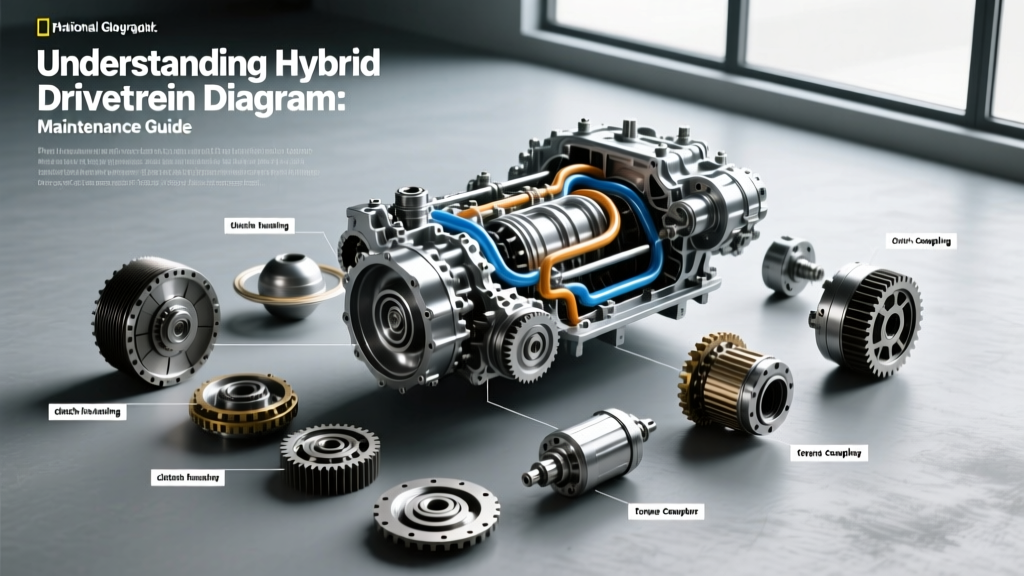
To perform effective preventive maintenance, you must understand the mechanical layout. Looking at a Toyota Hybrid System (THS) or a Ford Powersplit drivetrain diagram, you will identify three primary rotating components connected via a planetary gearset:
- Motor-Generator 1 (MG1): Acts as the starter for the ICE, controls the continuously variable transmission (eCVT) ratio by varying its speed, and generates electricity to power MG2 or charge the high-voltage (HV) battery.
- Motor-Generator 2 (MG2): The primary traction motor responsible for low-speed electric driving and providing torque assist during heavy acceleration.
- Planetary Gearset (Power-Split Device): The mechanical heart of the drivetrain. The ring gear is connected to MG2 and the final drive, the sun gear to MG1, and the planetary carrier to the ICE.
Because MG1 can routinely spin at speeds exceeding 10,000 RPM to regulate the eCVT ratio, the transaxle fluid is subjected to extreme rotational shear and high-frequency electrical thermal loads. This makes fluid maintenance far more critical than in a conventional automatic transmission.
Transaxle Fluid Maintenance: Specifications and Procedures
Unlike traditional automatics that use a pressurized hydraulic pump and clutch packs, hybrid eCVTs rely on splash lubrication and targeted oil galleries to cool the stator windings of the motor-generators. The fluid must possess high dielectric strength to prevent short circuits within the motor housings, alongside robust anti-wear additives for the planetary gears and differential bearings.
Toyota P610 / P710 Transaxle Service Protocol
For the ubiquitous Toyota Prius, RAV4 Hybrid, and Camry Hybrid platforms utilizing the P610 (Gen 3/4) or P710 (Gen 5) transaxles, the specified fluid is Toyota Genuine ATF WS (World Standard). While Toyota often labels this fluid as 'lifetime' under normal driving conditions, severe duty cycles—including frequent regenerative braking, towing, and extreme ambient temperatures—necessitate a drain and fill every 60,000 miles.
Capacity & Hardware:
- Fluid Capacity: 3.7 quarts (3.5 liters) for a standard drain and fill.
- Drain Plug Torque: 40 N·m (29 ft·lbf).
- Fill Plug Torque: 40 N·m (29 ft·lbf).
- Crush Washer Part Number: 90430-18008 (18mm inner diameter). Always replace these aluminum washers to prevent casing thread stripping.
Expert Tip: There is no traditional spin-on filter in these transaxles. Instead, an internal mesh strainer protects the oil pickup. If you find heavy metallic glitter on the magnetic drain plug, the transaxle must be dropped and split to clean the strainer and inspect the MG2 reduction gear bearings.
Ford HF35 / HF45 Transaxle Service Protocol
Ford’s hybrid lineup (Escape, Maverick, F-150 PowerBoost) utilizes the HF35 and HF45 eCVTs. These require Motorcraft MERCON LV or the newer MERCON ULV depending on the model year. The HF35 requires approximately 5.7 quarts for a pan-drop service. Proper fluid level verification requires checking the overflow plug with the fluid temperature between 85°C and 93°C (185°F - 200°F), monitored via an OBD2 bidirectional scan tool.
Comparative Fluid & Torque Data Chart
| Transaxle Model | OEM Fluid Specification | Drain & Fill Capacity | Drain Plug Torque | Service Interval (Severe) |
|---|---|---|---|---|
| Toyota P610 / P710 | Toyota ATF WS | 3.5 Liters (3.7 Qt) | 40 N·m (29 ft-lb) | 60,000 Miles |
| Ford HF35 | Motorcraft MERCON LV | 5.4 Liters (5.7 Qt) | 38 N·m (28 ft-lb) | 60,000 Miles |
| Honda i-MMD (2-Motor) | Honda ATF DW-1 / HCF-2 | 3.8 Liters (4.0 Qt) | 44 N·m (32 ft-lb) | 30,000 - 60,000 Miles |
| Hyundai/Kia TMED (6AT) | Hyundai SP-IV / ATF RED-1 | 7.5 Liters (7.9 Qt)* | 45 N·m (33 ft-lb) | 60,000 Miles |
*Note: Hyundai/Kia TMED (Transmission Mounted Electrical Device) hybrids use a modified conventional 6-speed automatic with an integrated clutch and MG, requiring a larger fluid volume and periodic filter replacement.
Inverter and Motor-Generator Cooling System Maintenance
A critical, often overlooked aspect of hybrid drivetrain maintenance is the inverter cooling circuit. When reviewing a comprehensive drivetrain diagram, you will notice a dedicated low-temperature coolant loop separate from the high-temperature ICE radiator loop. This loop cools the power inverter (which converts DC battery power to AC for the motors) and the stator jackets of MG1 and MG2.
Coolant Specifications and Bleeding Procedures
Using the wrong coolant chemistry can lead to the degradation of the inverter's internal power modules (IGBTs) due to poor heat transfer or galvanic corrosion. Toyota specifies Toyota Super Long Life Coolant (SLLC) (Pink, pre-mixed 50/50). Honda and Ford utilize their respective proprietary low-silicate, phosphate-free formulations.
The Bleeding Challenge: Because the hybrid water pump is electrically driven and not tied to the ICE crankshaft, simply squeezing hoses or revving the engine will not burp the system. Technicians must use an OEM-level bidirectional scan tool (such as Toyota Techstream or Ford FDRS) to command the electric inverter water pump to cycle at maximum RPM while the system is in 'Maintenance Mode' (forcing the ICE to run or allowing HV system operation with the hood open). Failure to properly bleed this system will result in an air pocket inside the inverter, leading to immediate IGBT thermal shutdown and a catastrophic inverter failure—a repair costing between $2,500 and $4,500.
High-Voltage Cable and Resolver Sensor Inspections
Preventive maintenance extends beyond fluids to the electrical integrity of the drivetrain. The thick orange HV cables connecting the battery, inverter, and transaxle must be visually inspected for chassis chafing, rodent damage, and connector seal degradation during every undercarriage service.
Insulation Resistance Testing (Megger Test)
According to SAE International standards for hybrid vehicle safety and maintenance, periodic insulation resistance testing is recommended for high-mileage hybrids or vehicles that have experienced underbody impacts. Using a specialized megohmmeter (set to 500V DC), technicians measure the resistance between the HV cable phases and the chassis ground. Readings below 1 Megohm indicate moisture ingress or enamel breakdown inside the MG stators, requiring immediate cable or motor replacement before a ground-fault code (e.g., Toyota P0A09) disables the vehicle.
Motor Resolver Calibration
If a hybrid vehicle exhibits a low-speed shudder or hesitation that mimics a torque converter issue, the culprit is rarely mechanical. The motor resolvers (rotary position sensors inside the transaxle that tell the inverter the exact rotor angle of MG1 and MG2) can lose calibration due to software glitches or minor sensor degradation. Using an OEM scan tool to perform a 'Motor Resolver Offset Learning' procedure takes less than five minutes and often restores factory-smooth drivetrain operation without turning a single wrench.
Cost-Benefit Analysis: Prevention vs. Replacement
The financial argument for strict adherence to hybrid drivetrain maintenance is undeniable. Consider the following real-world aftermarket and OEM pricing averages for 2026:
- Transaxle Fluid Drain & Fill: $120 - $180 (Prevents MG bearing wear and gear pitting).
- Inverter Coolant Flush & Bleed: $180 - $250 (Prevents $3,500+ inverter thermal failures).
- MG2 Stator / Transaxle Assembly Replacement: $3,500 - $6,000 (Required if dielectric fluid breakdown causes internal shorting).
- HV Battery Blower Fan Cleaning: $100 - $150 (While technically part of the battery system, a clogged blower fan causes battery overheating, which restricts the power output requested from the drivetrain MGs, leading to premature motor heat soak).
By investing roughly $300 every 60,000 miles into the transaxle and inverter cooling loops, owners effectively eliminate the most common thermal and mechanical failure points of the hybrid power-split device.
Final Diagnostic Recommendations
Whenever diagnosing a drivetrain concern on a hybrid platform, always reference the OEM-specific drivetrain diagram and service manual available through portals like Toyota TechInfo or the equivalent manufacturer database. Never assume a traditional transmission diagnostic tree applies. Hybrid drivetrains rely on software logic, thermal management, and high-voltage isolation just as much as they rely on gear mesh and bearing clearances. Treat the fluids as dielectric insulators, respect the thermal limits of the inverter, and your hybrid drivetrain will easily surpass the 250,000-mile mark with minimal degradation.