Decoding the Honda Odyssey Drivetrain: The FWD Benchmark
When evaluating the architecture of modern family haulers, the Honda Odyssey drivetrain remains the definitive benchmark for front-wheel-drive (FWD) packaging and efficiency. Since its inception, the Odyssey has utilized a transverse engine layout, sending power exclusively to the front wheels via a transaxle and a pair of constant velocity (CV) half-shafts. As of 2026, with millions of these vehicles operating globally, understanding the mechanical nuances of this FWD setup—and how it compares to all-wheel-drive (AWD) and rear-wheel-drive (RWD) alternatives—is critical for technicians and owners alike.
This model-specific repair guide breaks down the mechanical realities of the Odyssey’s FWD configuration, contrasting its maintenance profile, failure modes, and packaging advantages against the AWD systems found in competitors like the Toyota Sienna, and the traditional RWD layouts still utilized in commercial vans like the Ford Transit.
The Layout Showdown: FWD vs. AWD vs. RWD in Family Haulers
Choosing a drivetrain layout dictates everything from interior cabin space to long-term maintenance costs. Below is a comparative analysis of how these three distinct configurations perform in the versatile multi-purpose vehicle (VMP) segment.
| Layout Type | Prime Example | Core Drivetrain Components | Avg. Annual Maintenance | Cabin Intrusion |
|---|---|---|---|---|
| FWD | USDM Honda Odyssey | Transaxle, 2 CV Axles, Intermediate Shaft | $150 - $350 | None (Flat floor) |
| AWD | Toyota Sienna / JDM Odyssey | Transaxle, PTU, Propeller Shaft, Rear Diff | $450 - $800 | Moderate (Rear diff hump) |
| RWD | Ford Transit / Cargo Vans | Longitudinal Trans, Driveshaft, Solid Axle | $600 - $1,100 | Severe (Trans tunnel) |
Why FWD Dominates the Odyssey Platform
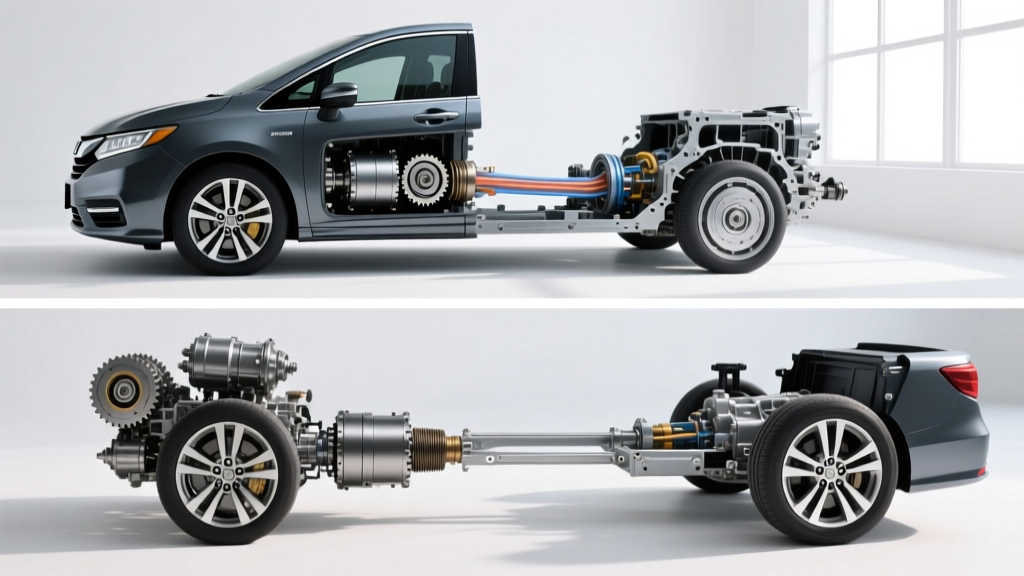
The Honda Odyssey’s FWD layout mounts the engine and transmission transversely. This eliminates the need for a longitudinal transmission tunnel, allowing for the Odyssey’s signature ultra-low, flat floor and expansive interior volume. From a repair standpoint, FWD systems are generally more accessible. The transaxle, differential, and CV axles are all consolidated in the engine bay or directly behind the subframe, reducing the number of moving parts and eliminating the parasitic drivetrain loss associated with AWD and RWD systems.
Model-Specific Repair Guide: Honda Odyssey FWD Drivetrain
Maintaining the Honda Odyssey drivetrain requires adherence to precise OEM specifications. Below are the most critical service procedures and torque specifications for the modern Odyssey (2018-present).
CV Axle and Intermediate Shaft Service
To mitigate torque steer—a common issue in high-horsepower FWD applications—Honda utilizes an intermediate shaft on the passenger side. This ensures both front CV axles are of equal length, maintaining identical operating angles under suspension compression.
- Part Number (Front Axle Assembly): Honda OEM 44305-T6A-A00 (Left) / 44305-T6A-A50 (Right).
- Spindle Nut Torque: 258 lb-ft (350 Nm). Always use a new staked spindle nut upon reinstallation.
- Intermediate Shaft Bearing Bracket Bolts: 33 lb-ft (44 Nm). Failure to torque these correctly results in severe drivetrain vibration under load.
- Lower Ball Joint Pinch Bolt: 44 lb-ft (60 Nm).
Common Failure Mode: The outboard CV joint boots on the Odyssey are prone to tearing around 90,000 miles due to heat exposure from the nearby catalytic converter. If caught early, a boot kit ($35-$50) can save the $600+ cost of a complete axle replacement.
Transmission Fluid Service: ZF 9-Speed vs. Honda 10-Speed
The Odyssey’s drivetrain is mated to one of two distinct transmissions depending on the model year and trim, each requiring vastly different service protocols.
1. ZF 9HP (9-Speed Automatic - 2018-2020 Models)
Sourced from ZF Friedrichshafen, this 9-speed transaxle is highly sensitive to fluid degradation. As of 2026, many of these units are experiencing harsh 4-5 and 8-9 upshifts due to neglected fluid intervals.
- Required Fluid: ZF LifeguardFluid 8 (Do not use generic multi-vehicle ATFs).
- Drain and Fill Capacity: Approximately 3.8 Liters (4.0 Quarts).
- Level Check Procedure: The fluid level must be checked with the vehicle perfectly level on a lift. Using the Honda Diagnostic System (HDS), monitor the ATF temperature PID. The fluid must be between 40°C and 50°C (104°F - 122°F). Remove the check plug on the transmission pan; fluid should drip out. Torque the check plug to 11 lb-ft (15 Nm).
2. Honda 10PA (10-Speed Automatic - 2020+ Models)
Honda’s in-house 10-speed transaxle replaced the ZF unit to improve shift logic and reliability.
- Required Fluid: Honda ATF Type 2.0 (or ULTF for newer iterations).
- Drain and Fill Capacity: Approximately 3.4 Liters (3.6 Quarts).
- Service Interval: Every 30,000 miles under severe driving conditions (towing, mountainous terrain).
What the Odyssey Avoids: AWD and RWD Failure Points
While AWD and RWD layouts offer distinct traction and towing advantages, they introduce complex failure points that the Honda Odyssey drivetrain completely avoids.
The AWD Power Transfer Unit (PTU) Tax
AWD minivans, such as the Toyota Sienna or the Japan-market AWD Odyssey, utilize a Power Transfer Unit (PTU) bolted to the transaxle to route torque to the rear differential via a propeller shaft. The PTU contains a small reservoir of 75W-85 gear oil. Because the PTU is mounted inches away from the exhaust crossover pipe, extreme thermal cycling bakes the gear oil, leading to sludge buildup and eventual PTU bearing seizure. Replacing a failed PTU often exceeds $1,800. By sticking to a FWD layout, the USDM Honda Odyssey eliminates the PTU, the rear differential, and the propeller shaft, saving owners thousands in potential drivetrain repairs over a 150,000-mile lifecycle.
The RWD Driveshaft and NVH Penalty
Traditional RWD layouts, still found in commercial platforms like the Ford Transit or Mercedes-Benz Sprinter, utilize a longitudinal engine and a multi-piece steel or aluminum driveshaft. This requires universal joints (U-joints) and a center support bearing.
- NVH Intrusion: When a RWD center support bearing fails, it introduces a 20-40 Hz resonance directly into the vehicle chassis, causing severe cabin vibration that mimics a misfire.
- Packaging Loss: The longitudinal transmission and the physical clearance required for the driveshaft’s articulation necessitate a massive transmission tunnel, destroying the flat-floor utility that defines the minivan segment.
- Maintenance: RWD systems require periodic greasing of slip yokes and U-joints (e.g., Spicer 1310 series), whereas the Odyssey’s sealed CV joints are maintenance-free until the boot fails.
For further engineering insights on drivetrain packaging, the ZF Aftermarket technical portal provides extensive documentation on how transverse FWD transaxles manage thermal loads compared to longitudinal RWD setups.
Drivetrain Vibration Diagnostic Matrix
When diagnosing NVH (Noise, Vibration, and Harshness) issues in the Honda Odyssey drivetrain, technicians should use the following matrix to isolate FWD-specific faults:
- Vibration under heavy acceleration only: Inspect the inner CV joint tripod bearings. Wear in the inner joint housing causes a lateral shudder that is only present under load.
- Clicking noise during low-speed, full-lock turns: Classic symptom of outboard CV joint failure. Inspect the axle boot for grease slinging on the inside of the front wheel.
- High-frequency hum (60-80 mph) that changes with coasting vs. load: Check the intermediate shaft support bearing. If the bearing bracket is loose or the bearing is pitted, it will resonate through the subframe.
- Shudder at 30-50 mph under light throttle: Often misdiagnosed as a drivetrain issue, this is frequently torque converter clutch (TCC) shudder. Perform a 3x drain-and-fill of the transmission fluid before condemning the torque converter.
Final Verdict: The FWD Advantage
The Honda Odyssey drivetrain proves that a well-engineered FWD layout remains the superior choice for the unibody family hauler. By avoiding the thermal vulnerabilities of AWD Power Transfer Units and the spatial compromises of RWD driveshafts, Honda has delivered a platform that maximizes interior volume while minimizing long-term drivetrain maintenance. For technicians and DIYers, adhering to strict fluid specifications—particularly regarding the ZF 9HP and Honda 10PA transaxles—and utilizing precise torque values during CV axle service will ensure these FWD systems reliably surpass the 200,000-mile mark.