The Core Debate: Acura TLX Drivetrain (SH-AWD) vs. Traditional 4WD
When enthusiasts and daily drivers alike discuss all-weather capability, the terms 'AWD' and '4WD' are often used interchangeably. However, from a preventive maintenance and mechanical engineering standpoint, they are entirely different beasts. If you own a modern luxury sport sedan, understanding your specific Acura TLX drivetrain architecture is critical to avoiding catastrophic failure. The TLX utilizes Acura's renowned Super Handling All-Wheel Drive (SH-AWD), a sophisticated torque-vectoring system that shares almost zero mechanical DNA with a traditional truck-based 4WD setup.
In this comprehensive 2026 preventive maintenance guide, we will dissect the mechanical differences between the Acura TLX's SH-AWD system and traditional 4WD layouts. More importantly, we will provide exact fluid specifications, torque values, and service intervals to keep your drivetrain operating flawlessly.
Mechanical Architecture: How SH-AWD Differs from 4WD
To maintain a drivetrain properly, you must first understand how it distributes power. The maintenance requirements of a system are directly tied to its internal friction points, clutch packs, and gear sets.
The Acura TLX SH-AWD Layout
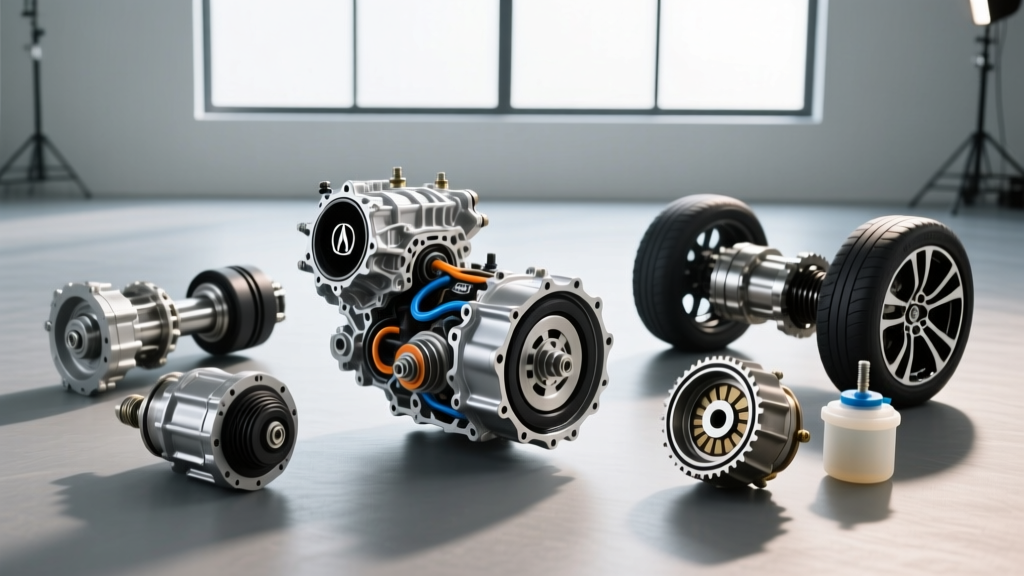
The Acura TLX (equipped with the 10-speed automatic transmission) uses an active, full-time AWD system. According to Car and Driver's technical teardowns, SH-AWD doesn't just send power to the rear wheels; it actively overdrives the outside rear wheel during cornering using a rear-mounted acceleration device and twin direct electromagnetic clutch packs. There is no mechanical center differential or locking transfer case. Instead, a Power Transfer Unit (PTU) bolts directly to the front of the transmission, sending up to 70% of available torque rearward via a carbon-fiber or steel driveshaft.
Traditional Part-Time and Full-Time 4WD
Conversely, traditional 4WD systems (found in vehicles like the Jeep Wrangler or heavy-duty pickups) utilize a chain-driven transfer case that mechanically locks the front and rear driveshafts together. This forces a 50/50 torque split. Because the front and rear axles cannot rotate at different speeds in '4-High' or '4-Low' modes without binding, these systems require heavy-duty gear oils, manual or electronic locking hubs, and robust shift forks that are entirely absent in the TLX.
Preventive Maintenance Matrix: TLX Drivetrain vs. 4WD Systems
The fluids and intervals required for these two layouts are vastly different. Using the wrong fluid or applying 4WD maintenance logic to an Acura TLX drivetrain will result in immediate clutch-pack degradation.
| Component | Acura TLX (SH-AWD) | Traditional 4WD (Truck/SUV) |
|---|---|---|
| Transfer Case / PTU Fluid | Honda ATF Type 3.1 or DPSF-II | ATF+4 or Mobil 424 |
| Rear Differential Fluid | Honda Dual Pump Fluid II (DPSF-II) | 75W-90 or 75W-140 GL-5 Gear Oil |
| Front Differential Fluid | Integrated into Transmission | 75W-90 GL-5 Gear Oil |
| Service Interval (Severe) | 30,000 - 45,000 miles | 30,000 - 60,000 miles |
| Avg. Dealer Cost (Rear/PTU) | $250 - $350 combined | $400 - $600 combined |
Step-by-Step TLX Drivetrain Maintenance Guide
While Acura's official maintenance minder system may not explicitly prompt a PTU or rear differential fluid change until much later, drivetrain specialists and forums like Bob Is The Oil Guy strongly recommend a 30,000-mile interval for severe driving (city traffic, track days, or harsh winters). Here is the exact procedure and specification sheet for the 2021-2026 TLX 10AT models.
1. Power Transfer Unit (PTU) Service
The PTU is bolted to the 10-speed automatic and is notorious for running hot due to its proximity to the exhaust and transmission. Heat degrades the fluid's shear stability, leading to bearing whine and eventual PTU failure.
- Fluid Specification: Honda Genuine ATF Type 3.1 (Part No. 08200-9011) for most 10AT applications. Note: Always verify via Acura TechInfo using your specific VIN, as early ZF 9-speed models utilized different specs.
- Capacity: Approximately 0.8 Liters (0.85 Quarts).
- Procedure: Remove the 18mm drain plug. Allow the fluid to drain completely. Inspect the magnetic drain plug for excessive metal shavings (a fine grey paste is normal; large chunks indicate bearing failure). Reinstall the drain plug with a new crush washer.
- Torque Spec: 29 lb-ft (39 Nm).
- Refill: Pump fluid through the 18mm fill hole until it weeps out. Torque fill plug to 33 lb-ft (44 Nm).
2. SH-AWD Rear Differential Service
The rear differential houses the twin electromagnetic clutch packs responsible for torque vectoring. These clutches are highly sensitive to fluid friction modifiers. Using standard 75W-90 gear oil will cause the clutches to chatter, overheat, and trigger a drivetrain malfunction warning on your dash.
- Fluid Specification: Honda Genuine Dual Pump Fluid II (DPSF-II), Part No. 08200-9007. Do not substitute this with aftermarket 'equivalents' unless they explicitly meet Honda DPSF-II certification.
- Capacity: 2.6 Liters (2.74 Quarts).
- Procedure: Level the vehicle. Remove the 18mm drain plug. Once drained, clean the magnetic plug. Reinstall with a new 18mm aluminum crush washer.
- Torque Spec: 29 lb-ft (39 Nm) for the drain plug.
- Refill: Use a fluid pump to transfer exactly 2.6L of DPSF-II into the fill hole. Reinstall the fill plug with a new crush washer and torque to 33 lb-ft (44 Nm).
Expert Tip: When servicing the SH-AWD rear differential, always perform a 'fluid reset' procedure using an OBDII bi-directional scanner (like the Autel MaxiCOM or Foxwell NT530). This recalibrates the clutch-pack wear index in the AWD control module, ensuring smooth torque distribution.
Contrasting 4WD Maintenance: What TLX Owners Avoid
By driving a TLX, you bypass several high-wear maintenance items inherent to traditional 4WD systems. In a part-time 4WD truck, the front differential requires heavy 75W-140 GL-5 gear oil changes, and the transfer case relies on a physical shift fork and actuator motor to engage the front driveshaft. These actuators frequently seize due to moisture intrusion, and the internal chains stretch over time, causing 'popping' out of 4WD under heavy load.
Furthermore, 4WD systems require periodic front axle U-joint and CV axle servicing, as well as transfer case encoder motor replacements. The TLX's SH-AWD system eliminates the low-range gearing, the mechanical locking hubs, and the heavy chain-driven transfer case, trading brute-force mechanical lockup for electronic precision. However, this precision demands strict adherence to OEM fluid chemistry.
Common Failure Modes and Warning Signs
Even with rigorous preventive maintenance, drivetrain components can exhibit wear. Watch for these specific indicators:
- SH-AWD Warning Light / 'Drivetrain Malfunction': Often caused by degraded DPSF-II fluid losing its friction-modifying properties, leading to clutch slip. A fluid flush and module reset resolves this in 60% of cases.
- PTU Whine or Grinding: Indicates bearing wear inside the Power Transfer Unit. If caught early, a fluid change with a high-quality synthetic alternative (if out of warranty) may quiet it, but replacement PTUs cost between $1,800 and $2,500.
- Rear Differential Chatter on Tight Turns: A classic symptom of neglected DPSF-II fluid. The electromagnetic clutches are failing to modulate slip properly.
- Vibration at Highway Speeds: Check the carbon-fiber or steel driveshaft connecting the PTU to the rear diff. Center support bearing wear or damaged U-joints will cause a distinct harmonic vibration between 60-80 mph.
Expert Verdict: Protecting Your Investment
The Acura TLX drivetrain is a masterpiece of modern torque-vectoring engineering, but it is not maintenance-free. Understanding the fundamental differences between your SH-AWD system and a traditional 4WD layout is the first step in protecting your vehicle. By abandoning the 'lifetime fluid' myth and committing to 30,000-mile intervals using exact OEM fluids like DPSF-II and ATF Type 3.1, you ensure that your TLX continues to deliver unparalleled grip and handling for hundreds of thousands of miles. Keep your torque specs precise, your crush washers fresh, and your OBDII scanner ready for module resets.