The Honda K-Series Clutch Pedal Epidemic
As we navigate the 2026 used car and enthusiast market, the 8th and 9th generation Honda Civic Si, Acura TSX, and countless K-swapped chassis remain dominant forces. The K20Z3 and K24Z engines are legendary for their high-revving reliability, but their manual transmission hydraulic systems are notorious for premature failure. If you are experiencing clutch pedal problems—ranging from a spongy, soft feel to a hard, vibrating pedal—the root cause is almost always tied to the clutch master cylinder (CMC), the slave cylinder, or the infamous clutch delay valve (CDV).
While hydraulic failures can often be fixed from the top of the engine bay, mechanical failures (like a shattered throwout bearing or bent clutch fork) require dropping the transmission. On tightly packed FWD engine bays or K-swapped builds, this transmission pull introduces a massive clearance hurdle: the AC compressor. To avoid paying a shop to evacuate your refrigerant, DIYers often rely on a homemade ac clutch removal tool to safely pull the pulley, allowing the compressor to be unbolted and moved aside. This guide covers the complete diagnostic and repair pathway for Honda K-Series clutch pedal issues, from hydraulic bleeding to engine bay clearance hacks.
Diagnosing Clutch Pedal Symptoms: Soft, Spongy, Hard, and Vibrating
Before ordering parts from Honda Parts Now or your local dealer, you must accurately diagnose the pedal feel. The K-Series hydraulic system is highly sensitive to aeration and mechanical binding.
| Symptom | Pedal Feel | Root Cause | K-Series Specific Culprit |
|---|---|---|---|
| Spongy / Soft | Pedal sinks to the floor, slow return, gear grinding on shifts. | Air in the hydraulic line, failing internal CMC seals. | Clutch Delay Valve (CDV) restriction masking pressure loss; CMC pushrod clevis pin wear. |
| Hard / Stiff | Pedal requires excessive leg force, feels notchy or binds halfway down. | Bent clutch fork, binding pilot bearing, collapsed pressure plate fingers. | Worn clutch fork pivot ball causing misalignment and binding on the transmission input shaft sleeve. |
| Vibrating / Pulsating | Severe vibration felt through the pedal during engagement or disengagement. | Worn Throwout Bearing (TOB), warped flywheel, broken damper springs. | OEM TOB plastic sleeve disintegration; aftermarket lightweight flywheel harmonic resonance. |
Hydraulic Failures: Fixing the Spongy and Soft Pedal
A soft or spongy clutch pedal on a K-Series is rarely just 'air in the lines.' It is usually a symptom of internal seal degradation in the Clutch Master Cylinder. The OEM Honda CMC (Part #46920-SNA-A05) utilizes a small internal valve that restricts fluid return to the reservoir, designed to soften engagement for daily drivers. Over time, the internal cup seals wear against the bore, allowing fluid to bypass the piston. This results in a pedal that slowly sinks to the floor when held at a stoplight.
The Clutch Delay Valve (CDV) Delete
Located inside the slave cylinder hose fitting, the CDV restricts fluid flow to prevent abrupt clutch engagement. While well-intentioned, it makes bleeding the system a nightmare and traps micro-bubbles in the line. Enthusiasts widely recommend deleting the CDV by drilling out the restriction or replacing the OEM line with an aftermarket stainless steel braided line (available via RockAuto). This dramatically improves pedal firmness and makes the spongy feel much easier to diagnose.
Proper Bleeding Technique
Do not use the traditional 'pump and hold' method with a helper; this over-extends the CMC piston into the corroded, unused portion of the bore, instantly destroying the seals. Instead, use a Motive power bleeder set to exactly 15 PSI. Higher pressure will blow the fragile plastic threads off the Honda CMC reservoir cap. Connect the bleeder to the slave cylinder nipple (10mm), open the valve, and let the fluid push itself through the system until zero bubbles are visible.
Mechanical Failures: Addressing the Vibrating and Hard Pedal
If your pedal is vibrating or physically hard to press, hydraulics are not your problem. You are dealing with mechanical binding inside the bellhousing. The K-Series clutch fork rides on a spherical pivot ball bolted to the transmission case. High-mileage examples (120,000+ miles) often suffer from severe pivot ball wear, causing the fork to sit at an incorrect angle. This forces the throwout bearing to ride unevenly against the pressure plate fingers, resulting in a harsh, vibrating pedal feel and premature TOB failure.
Fixing this requires dropping the transmission, replacing the pivot ball (Part #46995-PRC-005), inspecting the clutch fork for hairline cracks near the slave cylinder pin, and installing a new OEM Honda throwout bearing. Avoid aftermarket TOBs; the OEM Honda bearing remains the undisputed king of longevity for K-Series applications.
The Transmission Pull: Overcoming Engine Bay Clearance Issues
When dropping the transmission on an 8th/9th Gen Civic Si, Acura TSX, or a K-swapped EG/EK chassis, space is at a premium. The AC compressor sits directly against the engine block, often blocking access to the upper bellhousing bolts or preventing the transmission from sliding forward off the alignment dowels. Furthermore, on K-swapped builds, the AC compressor bracket frequently interferes with the subframe or sway bar during extraction.
The professional solution is to pay a shop $150 to evacuate the AC refrigerant, unbolt the compressor, remove it entirely, and recharge the system later. The DIY enthusiast solution is to unbolt the compressor and tie it to the strut tower with bungee cords, leaving the AC lines connected and the refrigerant sealed inside. However, there is a catch: the AC clutch pulley overhangs the compressor body and will smash into your subframe or sway bar when you try to maneuver the compressor out of its bracket.
Fabricating a Homemade AC Clutch Removal Tool
To remove the overhanging pulley without damaging the compressor shaft or venting your R134a/R1234yf charge, you need a specialized puller. Honda's official Service Special Tool (SST 07ZAB-S500100) costs upwards of $150 and is rarely in a home mechanic's toolbox. This is where fabricating a homemade ac clutch removal tool becomes an essential, money-saving rite of passage for K-Series builders.
According to build threads on the HondaTech Community Forums, you can build a highly effective, safe puller using hardware store components that perfectly match the Honda AC compressor shaft thread pitch.
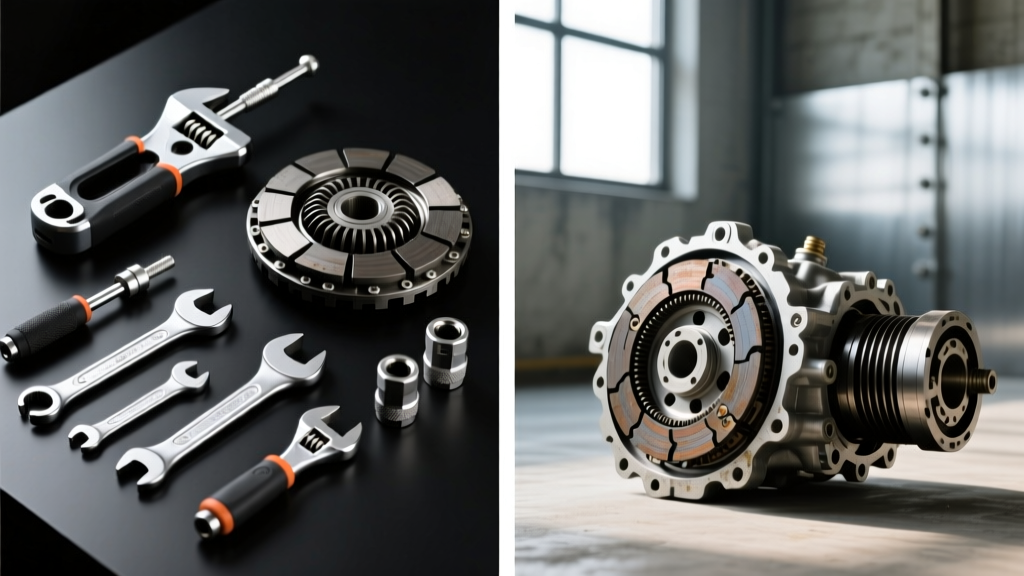
- 1x M10 x 1.5 x 80mm Grade 8.8 (or higher) Hex Bolt
- 3x M10 Flat Fender Washers (Large OD)
- 1x Standard 3-Jaw Gear Puller or Steering Wheel Puller
The Procedure:
- Remove the center 6mm Allen bolt holding the AC clutch plate to the compressor shaft.
- Stack the fender washers onto the M10x1.5 bolt. The washers act as a spacer stack to ensure the bolt bottoms out against the compressor shaft threads without bottoming out inside the clutch plate threaded hole.
- Thread the bolt into the AC clutch plate. As you tighten the bolt with a wrench, it will push against the end of the compressor shaft, breaking the friction fit and popping the clutch plate off the splines.
- Once the front plate is off, use the 3-jaw gear puller hooked behind the main pulley to extract the pulley assembly from the compressor snout.
With the pulley removed, the compressor body is now flush. You can safely unbolt the compressor from its bracket, maneuver it past the subframe clearance issues, and zip-tie it to the chassis. This provides the exact 14mm of extra clearance needed to slide the transmission off the engine block dowels, granting you full access to the clutch fork, pivot ball, and flywheel to cure your vibrating pedal issues.
Critical Torque Specifications & Reassembly
When reassembling the K-Series drivetrain and hydraulics, adhering to factory torque specifications is non-negotiable to prevent stripped aluminum threads and future pedal binding.
| Component | Fastener Size | Torque Specification |
|---|---|---|
| Clutch Master Cylinder (CMC) Mounting Nuts | 8mm | 12 Nm (9 lb-ft) |
| Slave Cylinder Mounting Bolts | 10mm | 22 Nm (16 lb-ft) |
| Clutch Fork Pivot Ball Bolt | 12mm | 28 Nm (21 lb-ft) |
| Bellhousing to Engine Block Bolts | 12mm / 14mm | 64 Nm (47 lb-ft) |
| AC Compressor Bracket to Block Bolts | 12mm | 45 Nm (33 lb-ft) |
| AC Clutch Plate Center Bolt (Reassembly) | 6mm Allen | 15 Nm (11 lb-ft) |
Final Thoughts on K-Series Diagnostics
Diagnosing clutch pedal problems on the Honda K-Series requires looking beyond the obvious hydraulic leaks. A spongy pedal demands a CDV delete and a low-pressure power bleed, while a vibrating or hard pedal requires a deep dive into the bellhousing mechanicals. By understanding how to navigate the tight engine bay constraints—utilizing a homemade ac clutch removal tool to preserve your AC system while gaining vital transmission clearance—you can execute a professional-grade repair in your home garage, keeping your K-Series on the road for another decade.