The Traction Deficit: Why Open Differentials Fail Off-Road
When evaluating the drivetrain of a heavy-duty rig, the open differential in trucks is often the weakest link in low-traction environments. Open differentials are engineered to route torque to the path of least resistance. While this provides smooth on-road handling and prevents tire scrubbing during tight cornering, it becomes a severe liability off-road. If one wheel loses traction, the open carrier sends 100% of the available torque to the spinning wheel, leaving the truck stranded. For serious overlanding, rock crawling, or heavy towing in adverse conditions, upgrading to a locking differential is not just a performance enhancement; it is a mechanical necessity.
This guide breaks down the primary locking differential architectures available in the 2026 aftermarket, analyzes how these hardware upgrades dictate your gear fluid selection, and provides the exact torque specifications required for a bulletproof installation.
Core Locker Architectures for Heavy-Duty Axles
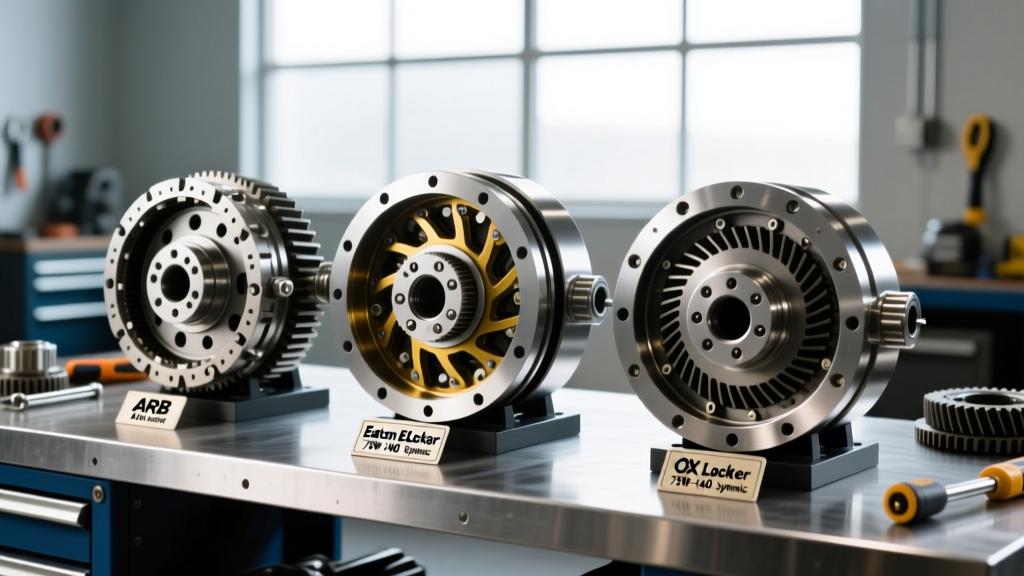
Selecting the right locker depends entirely on your vehicle's primary use case. The modern aftermarket offers three distinct locking mechanisms, each with unique operational characteristics and lubrication requirements.
Selectable Pneumatic Lockers (ARB Air Locker)
The ARB Air Locker remains the gold standard for selectable traction. Utilizing an onboard 12V air compressor, pneumatic pressure is routed through a sealed copper or synthetic air line into the axle housing, pushing a piston that engages a locking ring. When disengaged, the ARB operates exactly like a factory open differential, preserving on-road drivability and tire life. Part Example: The RD116 is the direct-fit Air Locker for the Dana 60 front axle. Because it operates as an open diff 90% of the time, internal friction is minimal, allowing for the use of lower-viscosity gear oils to reduce parasitic drag.
Automatic Mechanical Lockers (Eaton Detroit Locker)
For those who want traction without flipping switches, the Eaton Detroit Locker is a fully automatic, mechanical ratcheting device. It replaces the entire factory carrier and uses internal dog teeth, struts, and a center block to lock both axleshafts together under load. When cornering, the internal components ratchet and slide to allow the outside wheel to spin faster. Part Example: The 225SL19A fits the GM 10.5-inch 14-bolt rear axle. The aggressive metal-on-metal sliding friction during the ratcheting phase generates immense localized heat, demanding a high-shear-stability gear oil.
Manual Cable-Actuated Lockers (OX Locker)
The OX Locker bridges the gap between automatic and selectable systems. Actuated by a mechanical cable linked to a cabin-mounted lever, the OX Locker physically shifts a locking collar inside the carrier. It requires no air compressors, electrical wiring, or complex seals, making it highly reliable in extreme environments where pneumatic lines might freeze or snap.
Comparative Analysis: Locker Types vs. Axle Applications
| Locker Type | Brand / Model | Best Application | On-Road Manners | Relative Cost (2026) |
|---|---|---|---|---|
| Pneumatic Selectable | ARB Air Locker | Rock Crawling, Overlanding | Flawless (Open) | $950 - $1,100 |
| Automatic Mechanical | Eaton Detroit Locker | Mud, Deep Sand, Drag Racing | Poor (Bangs/Clicks) | $650 - $850 |
| Cable Selectable | OX Locker | Extreme Cold, Competition | Flawless (Open) | $1,000 - $1,250 |
| Helical Gear (LSD) | Eaton TrueTrac | Snow, Light Trail, Towing | Excellent (Seamless) | $700 - $900 |
Drivetrain Fluids: Viscosity, Shear Stability, and Additives
Because a locking differential fundamentally alters the internal friction dynamics of the axle housing, your gear fluid selection must be paired directly to the hardware you install. Treating all differentials the same is a fast track to premature bearing failure and gear scoring.
Viscosity and Additive Packages
For automatic lockers like the Detroit Locker, the internal dog teeth and thrust washers endure severe sliding friction during cornering ratcheting. This demands a high-viscosity, high-film-strength lubricant. A full synthetic 75W-140 GL-5 gear oil is highly recommended. The heavier 140-weight base oil cushions the shock loads of the locking teeth and maintains its hydrodynamic film at elevated temperatures, preventing metal-on-metal contact. Conversely, if you are running a selectable locker (ARB or OX) that remains open on the street, a 75W-90 synthetic GL-5 is preferable. The lighter viscosity reduces churning losses, improving fuel economy and lowering steady-state operating temperatures by up to 15 degrees Fahrenheit.
The Friction Modifier Trap
One of the most common mistakes made during a differential rebuild is the misuse of friction modifiers. Friction modifiers are specifically formulated for clutch-type Limited Slip Differentials (LSDs) to prevent clutch chatter during engagement. Do not use friction modifiers in full mechanical lockers or helical gear differentials. A Detroit Locker has no clutches; it relies on positive mechanical engagement. Adding a friction modifier to a Detroit Locker will not stop the characteristic cornering 'bang', but it can dilute the Extreme Pressure (EP) additive package of the gear oil, reducing its load-bearing capacity. Always verify the manufacturer's fluid specification sheet before pouring additives into the fill hole.
Precision Installation: Torque Specs and Bearing Preload
Upgrading the differential in trucks requires precision machining and strict adherence to torque specifications. The immense torque multiplication of low-range transfer cases will instantly destroy a poorly assembled carrier.
- Ring Gear Bolts: Whether installing an ARB or an Eaton carrier, the ring gear must be bolted to the locker flange using high-strength hardware. For a Dana 60 or GM 14-bolt, torque the ring gear bolts to 60-65 lb-ft. Always apply a medium-strength threadlocker (Loctite 242) to the threads to prevent backing out under reverse shock loads.
- Bearing Cap Bolts: The main bearing caps secure the carrier to the axle housing. These must be torqued to 65-75 lb-ft (verify specific housing manual). If the caps stretch or walk under load, the pinion gear will separate from the ring gear, resulting in catastrophic tooth shearing.
- Backlash and Preload: Target a ring gear backlash between 0.006 and 0.008 inches. Carrier bearing preload should be set using shims or threaded adjusters until you achieve 15 to 25 inch-pounds of rotational torque on the bare carrier (measured with an inch-pound dial torque wrench). This ensures the bearings are properly seated and will not loosen as they break in.
Air Line Routing and Fluid Capacity Adjustments
When installing a pneumatic locker like the ARB, the physical presence of the air line inside the axle tube displaces a small volume of gear oil. Furthermore, the bulkhead fitting drilled into the axle housing or differential cover must be sealed with high-temperature RTV or specialized O-rings to prevent weeping. After installing the locker, filling the axle, and cycling the air compressor to engage and disengage the collar, allow the fluid to settle for 15 minutes. Re-check the fill plug. The internal air chambers and the displacement of the heavier locking collar often require an additional 4 to 8 ounces of gear oil to reach the bottom of the fill hole compared to an open carrier.
Final Verdict on Traction Upgrades
Upgrading the differential in trucks transforms a liability into an asset, but the hardware is only half the equation. By matching your locker selection to your driving profile, pairing it with the correct synthetic GL-5 viscosity, and executing a precision assembly with verified torque specs, you ensure that your drivetrain will survive the most punishing terrain the trail can offer.