The Intersection of Cooling Clutches and Drivetrain Diagnostics
In the heavy-duty and commercial vehicle sector, diagnosing drivetrain performance issues requires a holistic understanding of the entire powertrain ecosystem. While transmission clutches and torque converters frequently dominate diagnostic conversations, a severely degraded fan clutch viscous assembly can mimic catastrophic drivetrain failures. For Class 8 commercial trucks equipped with high-output diesel engines like the Cummins X15 or Detroit Diesel DD15, the engine cooling fan represents one of the largest parasitic loads on the crankshaft. When the viscous shear fluid within the fan clutch degrades, or the internal valve mechanism fails, the resulting parasitic drag can consume upwards of 40 to 60 horsepower. To a driver, this sudden loss of power and sluggish acceleration feels identical to a slipping transmission clutch or a failing torque converter.
As we navigate the 2026 landscape of commercial fleet maintenance, optimizing thermal management is no longer just about preventing overheating; it is about reclaiming lost horsepower, reducing fuel consumption, and preventing secondary damage to the water pump and belt tensioner assemblies. This guide provides a comprehensive diagnostic framework and performance upgrade pathway for heavy-duty viscous fan clutches.
Differentiating Fan Clutch Drag from Transmission Clutch Slip
Before tearing down an Eaton Fuller manual transmission or an Allison HD series automatic, technicians must rule out front-of-engine parasitic drag. A locked-up or continuously engaged viscous fan clutch forces the engine to work significantly harder to maintain cruising speeds, especially on highway grades.
- The Acoustic Tell: A failing fan clutch viscous unit that is stuck in the fully engaged position will produce a continuous, deafening 'roar' or 'jet engine' sound at highway speeds (65+ MPH), whereas a slipping transmission clutch will manifest as high RPMs without proportional vehicle acceleration.
- The Thermal Tell: Paradoxically, a fan clutch that is locked ON will cause sub-optimal fuel economy but excellent coolant temperatures. Conversely, a fan clutch that fails in the OFF position (fluid starvation) will trigger immediate ECU thermal derates, putting the truck into 'limp mode'—a symptom often misdiagnosed as an electronic transmission control module (TCM) failure.
- The Wobble Tell: If the internal bearings of the fan clutch viscous hub are failing, you will observe visible wobble at idle. This wobble transfers harmonic vibrations through the serpentine belt, often destroying the water pump bearings and causing belt squeal that mimics a failing accessory drive pulley.
Fluid Dynamics: Understanding Silicone Shear Fatigue
The core of any viscous fan clutch is a precisely engineered labyrinth filled with polymethylsiloxane (silicone) fluid. The torque transfer between the input shaft (driven by the engine) and the output housing (driving the fan blades) is achieved purely through the shear resistance of this fluid. Heavy-duty applications typically utilize silicone fluids ranging from 10,000 cSt (centistokes) to 60,000 cSt.
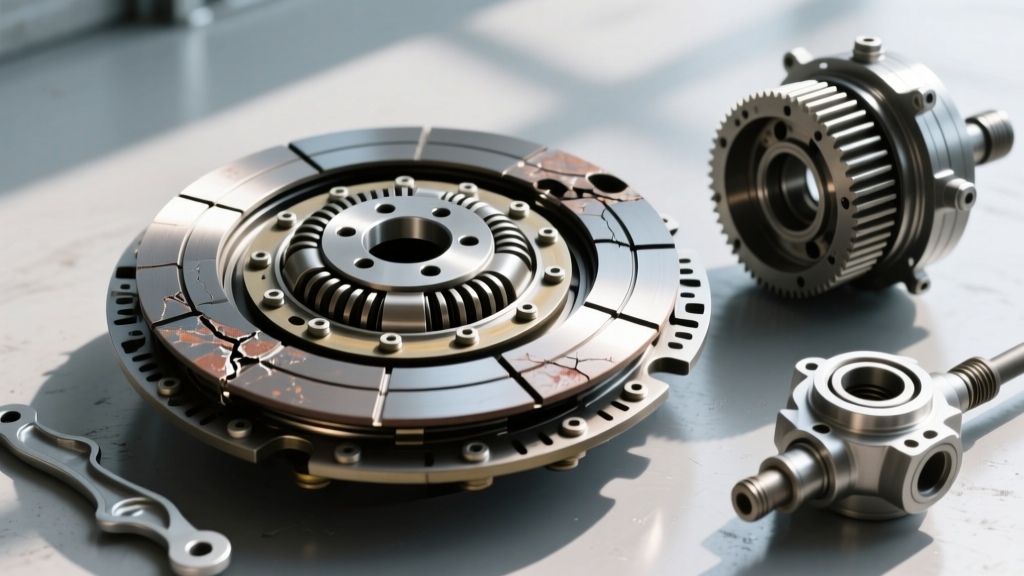
Over hundreds of thousands of miles, the mechanical shearing action breaks down the long-chain silicone polymers. As the fluid loses its viscosity, the clutch loses its ability to transfer torque, resulting in fan slip and subsequent engine overheating under heavy loads. Furthermore, the bi-metallic thermal coil on the front of the clutch can suffer from hysteresis and fatigue, altering its actuation temperature. A coil designed to open the internal valve at 195°F may degrade to open at 175°F, causing the fan to engage prematurely and waste horsepower during standard cruising operations.
Performance Upgrades: Standard vs. Severe-Duty vs. Pneumatic
For fleet managers and owner-operators running heavy-haul, logging, or extreme-climate routes, upgrading the fan clutch viscous system is a proven method to improve reliability and performance. Below is a comparison of the primary heavy-duty fan clutch architectures available for modern Class 8 platforms.
| Clutch Architecture | Actuation Method | Max Parasitic HP Draw | Ideal Application & Upgrade Path |
|---|---|---|---|
| Standard Thermal Viscous | Bi-metal coil / Fluid shear | 35 - 45 HP | Regional haul, flat terrain. (OEM Baseline) |
| Severe-Duty Viscous | Aggressive bi-metal / High cSt fluid | 50 - 65 HP | Heavy haul, steep grades, high ambient temps. |
| Pneumatic On/Off (Air) | ECM controlled air pressure | 0 HP (Disengaged) / 70 HP (Engaged) | Fuel economy focus, stop-and-go, PTO operations. |
| Electronic Viscous (e-Viscous) | Electromagnet / PWM signal | Variable (10 - 60 HP) | Precision thermal management, 2024+ EPA emissions. |
Upgrading from a standard thermal unit to a severe-duty viscous model (such as the Horton HT-Series or Kysor K6 severe-duty lines) ensures that the clutch can handle the immense thermal loads generated by modern high-heat EGR and DPF regeneration cycles without fluid cavitation.
Heavy-Duty Installation Specs and Torque Data
Proper installation of a heavy-duty fan clutch is critical. The rotating mass of a 32-inch, 11-blade composite fan combined with a heavy-duty viscous clutch can exceed 45 lbs. Imbalances or improper torque will rapidly destroy the water pump and front crankshaft seal.
Cummins X15 and PACCAR MX-13 Specifics
When replacing the fan clutch viscous assembly on a Cummins X15 or PACCAR MX-13, technicians must adhere to strict fastener protocols. The fan hub is typically secured to the water pump pulley or dedicated fan drive bracket using M10x1.5 or M12x1.75 flange bolts.
- Thread Preparation: Clean all bolt holes with a thread chaser. Do not use compressed air to blow out blind holes, as this can pressurize and crack the casting. Apply a medium-strength threadlocker (e.g., Loctite 243) to the bolts to prevent backing out under harmonic vibration.
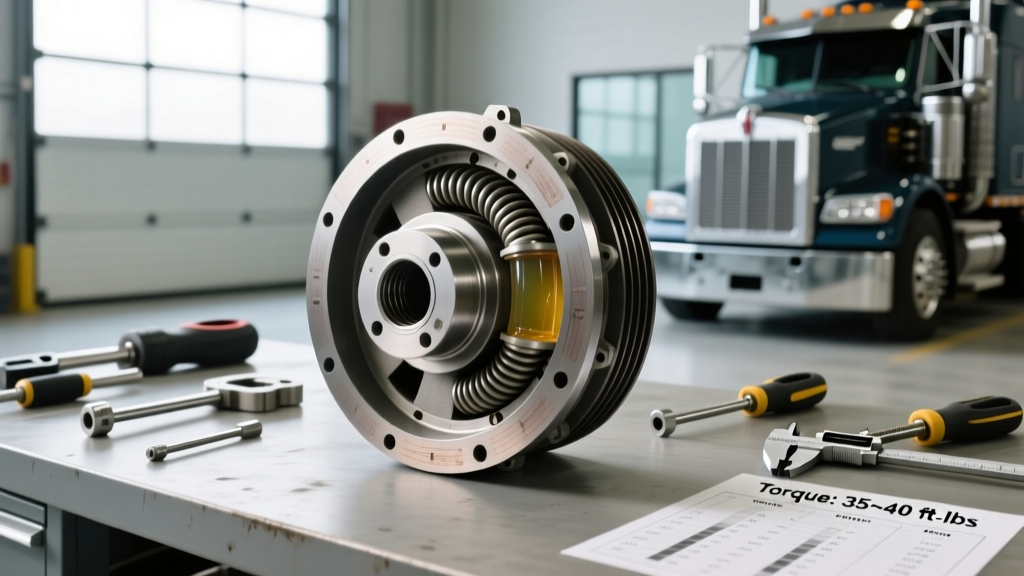
- Torque Specifications: M10x1.5 Grade 10.9 flange bolts must be torqued to 41 lb-ft (55 Nm). M12x1.75 bolts require 77 lb-ft (105 Nm). Always use a calibrated torque wrench; impact guns will stretch the bolts and distort the mounting flange.
- Runout Tolerances: After installation, use a magnetic dial indicator on the fan hub. Maximum allowable radial and axial runout is typically 0.060 inches at the hub, and no more than 0.250 inches at the fan blade tip. Excessive runout indicates a warped mounting flange or a defective clutch bearing.
Belt Tensioner and Pulley Alignment
A heavy-duty viscous fan clutch upgrade often changes the rotational inertia of the accessory drive. It is mandatory to inspect the automatic belt tensioner. If the tensioner damper is worn, the heavy fan clutch will cause severe belt flutter during engine shutdown and gear shifts, leading to premature serpentine belt failure. Replace the tensioner assembly and idler pulleys as a complete set when upgrading the fan clutch.
Fleet ROI and Fuel Economy Considerations
While the upfront cost of a premium severe-duty or electronically controlled fan clutch can range from $800 to $1,600 (compared to $400 for a standard replacement), the return on investment is realized through fuel savings and drivetrain protection. By ensuring the fan clutch viscous unit disengages fully during cold starts and highway cruising, fleets can recover 1% to 3% in fuel economy. Over a 120,000-mile annual cycle, this equates to thousands of dollars in saved diesel fuel per truck, alongside the elimination of catastrophic water pump failures caused by out-of-spec fan wobble.
For authoritative engineering data on heavy-duty cooling systems and fan clutch testing protocols, technicians should consult the SAE J2228 Cooling System Standards. Additionally, fleet managers can review application-specific upgrade guides and torque matrices directly from manufacturers like Horton Heavy-Duty Thermal Systems to ensure compatibility with specific OEM radiator shrouds and belt routing configurations.
Final Diagnostic Takeaways
When a commercial driver reports a 'slipping clutch' or severe power loss, do not immediately drop the transmission. Perform a front-of-engine parasitic drag test. Verify the bi-metallic coil operation with a heat gun, check for silicone fluid weeping around the clutch perimeter, and measure fan blade runout. Upgrading to a modern, application-specific fan clutch viscous or pneumatic unit not only solves thermal management issues but restores the drivetrain's intended performance profile, ensuring the truck hauls efficiently through the most demanding 2026 freight corridors.