The Fundamental Divide: Belt-Driven CVTs vs. Hydraulic Turbines
When a hobbyist transitions from assembling a small-engine buggy to rebuilding a daily-driven GM or ZF automatic transmission, the price discrepancy in drivetrain components can induce severe sticker shock. A high-quality go kart torque converter kit can be sourced for under $100, while a modern automotive torque converter replacement easily eclipses $1,200. Why the massive gap?
The answer lies in the physics of torque multiplication, hydraulic lockup mechanisms, and precision CNC machining. In this 2026 cost analysis guide, we break down the economics, failure symptoms, and model-specific pricing of torque converters, contrasting simple belt-driven CVTs with complex automotive hydraulic turbines like the GM 4L60E, 6L80, and ZF 8HP.
Why a Go Kart Torque Converter Costs Under $100
The quintessential small-engine CVT—such as the ubiquitous Comet TAV2 (Part# 218352A)—is technically a continuously variable transmission, but the powersports industry commonly refers to the assembly as a 'torque converter.' According to Summit Racing's current catalog, this kit retails for roughly $65 to $85.
- Construction: Cast aluminum drive clutch, stamped steel driven pulley, and a reinforced rubber drive belt.
- Operation: Relies entirely on centrifugal weights and spring tension. There is no hydraulic fluid, no stator, and no lockup clutch.
- Failure Symptoms: Belt slipping, bogging at low RPMs, or a stuck drive clutch sheave.
- Replacement Economics: Because there are no hydraulic seals to machine and no friction materials to bond, manufacturing costs are negligible. You simply unbolt the old unit, swap the driver/driven pulleys, and install a $15 replacement belt.
Automotive Torque Converter Cost Breakdown by Model
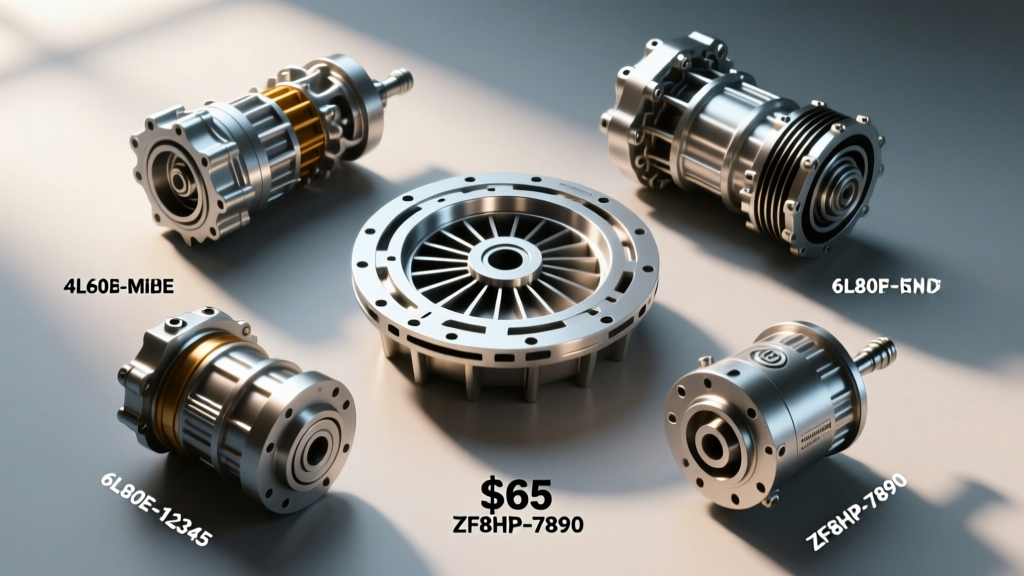
Automotive torque converters are sealed, fluid-coupled hydraulic pumps that require dynamic balancing, furnace brazing, and precise friction material application. Below is a comparative cost matrix for common platforms in 2026.
| Application | Transmission Model | Type / Size | Lockup Mechanism | Avg 2026 Cost (Part Only) |
|---|---|---|---|---|
| Small Engine / Buggy | Comet TAV2 / Clone | Belt CVT / Asymmetric | None (Mechanical Grip) | $65 - $95 |
| GM Light Truck / Sedan | 4L60E / 4L65E | Hydraulic / 298mm | Single-Plate TCC | $220 - $450 |
| GM Modern V8 / V6 | 6L80 / 6L90 | Hydraulic / 300mm+ | Multi-Plate Controlled Slip | $650 - $1,100 |
| European / Chrysler | ZF 8HP45 / 8HP70 | Hydraulic / Integrated Damper | Multi-Plate w/ Pendulum | $900 - $1,500 |
Deep Dive: GM 4L60E Torque Converter Economics
The GM 4L60E is the undisputed workhorse of the American V8. Despite its age, replacing its torque converter requires a deep understanding of hydraulic stall speeds and stator clutches.
Core Charges and Machining Costs
A stock-replacement 298mm torque converter for a 4L60E typically costs between $220 and $300. However, if you are upgrading to a performance unit (e.g., a Circle D 2800 RPM stall), expect to pay $400 to $450. The cost increase is driven by:
- Furnace Brazing: High-stall converters generate immense heat. Performance builders furnace-braze the impeller fins to the outer cover to prevent fin flex under high torque loads.
- Upgraded Friction Materials: Standard paper TCC (Torque Converter Clutch) linings are replaced with Kevlar or carbon-fiber composites to prevent the dreaded 'TC shudder' (often diagnosed as a P1870 code for excessive slip).
- Billet Steel Hubs: The splined hub that mates to the transmission input shaft is upgraded to billet steel to prevent shearing under hard launches.
Expert Note: Always factor in a $35 to $50 core charge. Rebuilders require your old 4L60E converter to harvest the steel cover and stator assembly, as raw steel prices and casting costs dictate the aftermarket supply chain.
The 6L80 and ZF 8HP: When Engineering Inflates the Price Tag
As transmissions evolved to feature 6, 8, and 10 speeds, the torque converter transformed from a simple fluid coupling into a highly complex electro-hydraulic component. This is where the true cost analysis diverges from older platforms.
GM 6L80: The TEHCM Integration and Multi-Plate TCC
The GM 6L80 utilizes a sophisticated 'controlled slip' torque converter clutch. Instead of simply locking or unlocking, the Transmission Electro-Hydraulic Control Module (TEHCM) modulates the TCC apply pressure to maintain a 20 to 40 RPM slip. This eliminates driveline harshness and improves fuel economy, but it destroys cheap friction materials.
Symptoms of 6L80 TC Failure:
- P0741 (TCC Stuck Off / Excessive Slip): The multi-plate friction material degrades, contaminating the TEHCM solenoids with clutch dust.
- Highway Shudder (40-60 MPH): Often misdiagnosed as a misfire or bad spark plugs, this is actually the TCC failing to modulate micro-slip due to warped apply plates.
A high-quality 6L80 replacement converter (such as those from Precision Industries or Yank Powertrains) costs between $750 and $1,100. The price reflects the CNC-machined multi-plate clutch pack, the reinforced turbine hub, and the necessity of Sonnax-recommended stator upgrades to handle modern towing loads.
ZF 8HP: Torsional Dampers and Centrifugal Pendulums
The ZF 8HP (found in BMW, Audi, Dodge, and Jaguar vehicles) represents the pinnacle of torque converter engineering. To allow the engine to lug at extremely low RPMs (down to 1,000 RPM in 8th gear) without vibrating the chassis, ZF integrated a Centrifugal Pendulum Absorber directly into the torque converter's torsional damper assembly.
The Cost Reality: You cannot simply 'rebuild' a ZF 8HP torque converter in a standard garage. The internal dampening springs and pendulum weights require factory-spec calibration. A genuine ZF replacement unit ranges from $1,100 to $1,500. If you attempt to save money by installing a cheap aftermarket unit lacking the pendulum absorber, you will experience severe NVH (Noise, Vibration, and Harshness) and premature wear on the transmission's mechatronic valve body.
Hidden Costs: Installation, Fluid, and Diagnostics
The part price is only half the battle. When budgeting for a torque converter replacement, you must account for the ancillary costs that separate a successful rebuild from a repeat failure.
Fluid and Flush Economics
When a torque converter fails, it sheds metallic debris and friction material into the transmission pan and cooler lines. Replacing the converter without addressing the fluid is a guaranteed path to repeat failure.
- GM Dexron VI / ULV: The 6L80 holds approximately 11.2 quarts (dry fill). At $9 to $12 per quart for OEM-licensed fluid, expect to spend $100 to $135 on fluid alone.
- ZF Lifeguard 8: ZF transmissions require specific, non-substitutable fluid. Lifeguard 8 costs upwards of $25 to $35 per quart. A full fluid and filter service can easily exceed $350 in materials.
Fasteners and Torque Specifications
Automotive torque converters are subjected to extreme rotational mass. Reusing stretched flexplate bolts is a catastrophic error. Below are critical torque specs for common applications (always verify with your specific 2026 factory service manual):
GM 4L60E / 6L80 Flexplate to Crankshaft: 111 lb-ft (150 Nm)
GM 4L60E TC to Flexplate: 34 lb-ft (46 Nm)
GM 6L80 TC to Flexplate: 46 lb-ft (62 Nm) - Note: 6L80 uses 6 bolts, 4L60E uses 3. Ensure full thread engagement before tightening!
Final Verdict: Matching the Converter to the Application
The leap from a $65 go kart torque converter to a $1,200 ZF 8HP unit is a reflection of modern automotive demands: seamless lockup, micro-slip modulation, and extreme NVH dampening. When diagnosing shudder, slip, or stall-speed issues, never compromise on the torque converter. Whether you are dropping in a budget-friendly 4L60E street unit or investing in a multi-plate 6L80 performance build, understanding the internal machining and friction materials justifies the cost and ensures the longevity of your drivetrain.