The Prerequisite: Why GM Rear Differential Identification Dictates Diagnosis
In the realm of drivetrain NVH (Noise, Vibration, and Harshness) analysis, attempting to diagnose a whining or howling rear axle without first confirming its exact architecture is a fool's errand. General Motors has deployed a wide spectrum of rear axles over the last half-century, ranging from the lightweight 7.5-inch 10-bolt found in vintage S-10s to the massive AAM 11.5-inch full-floaters beneath modern Duramax HD trucks. Accurate GM rear differential identification is the absolute first step in troubleshooting differential noise, as it dictates your fluid capacity, gear oil viscosity requirements, bearing part numbers, and rotational torque specifications.
As we move through the 2026 service landscape, older GM axles are accumulating high mileage, making bearing wear and gear lash deviations more prevalent. This expert guide bridges the gap between visual axle identification and advanced acoustic troubleshooting, ensuring you order the right master rebuild kit and the correct friction modifiers before tearing down the housing.
Phase 1: Visual Identification & Hardware Matrix
The quickest way to identify a GM rear differential without pulling the cover is by counting the differential cover bolts and observing the pinion yoke design. However, for precise fluid and rebuild specifications, you must verify the ring gear diameter. Below is the definitive identification matrix for the most common GM rear axles encountered in shops today.
| Axle Family | Cover Bolts | Ring Gear Diameter | Typical Spline Count | Fluid Capacity (Approx) |
|---|---|---|---|---|
| GM 7.5" / 7.625" 10-Bolt | 10 | 7.5" / 7.625" | 26 / 28 | 1.8 Pints |
| GM 8.5" / 8.6" 10-Bolt | 10 | 8.5" / 8.6" | 30 | 2.1 Pints |
| GM 8.875" 12-Bolt (Car) | 12 (Oval Cover) | 8.875" | 30 | 2.0 Pints |
| GM 8.875" 12-Bolt (Truck) | 12 (Round Cover) | 8.875" | 30 | 2.5 Pints |
| GM 9.5" 14-Bolt (Semi-Float) | 14 | 9.5" | 33 | 2.75 Pints |
| GM 10.5" 14-Bolt (Full-Float) | 14 | 10.5" | 33 | 3.5 Pints |
| AAM 11.5" (HD/Duramax) | 14 | 11.5" | 33 | 4.0 Pints |
Phase 2: Decoding GM RPO Codes for Drivetrain Specs
Visual identification tells you the hardware family, but the RPO (Regular Production Option) sticker in the glovebox tells you the internal configuration. This is critical for noise diagnosis because a factory locking differential behaves very differently than an open unit when fluid degrades.
- GU5 (3.23 Ratio) / GU6 (3.42 Ratio): Common highway gears. Whining in these ratios often points to pinion bearing preload loss rather than gear wear, as they are generally under-stressed.
- GT4 (3.73 Ratio) / GT5 (4.10 Ratio): Heavy towing ratios. High torque multiplication accelerates ring and pinion wear on the drive side. If you hear noise under load, suspect gear tooth deflection.
- G80 (Eaton Gov-Loc): GM's automatic locking differential. Expert Warning: The G80 is notorious for low-speed clunking and chatter if the fluid lacks the correct friction modifier or if the internal governor weights are gummed up with metallic debris from normal wear.
Phase 3: Acoustic Profiling & Failure Mode Mapping
Once the axle is identified, you must isolate the noise frequency and its correlation to vehicle dynamics. Differential noise is rarely random; it follows strict mechanical rules based on rotational mass and load vectors.
1. Drive Noise vs. Coast Noise
If the axle howls only when accelerating (Drive Noise), the wear is typically on the convex (drive) side of the ring gear teeth. This is often caused by insufficient pinion depth or worn pinion bearings allowing the pinion gear to climb the ring gear under torque. Conversely, if the noise occurs only when decelerating or lifting off the throttle (Coast Noise), the wear is on the concave (coast) side. This usually indicates excessive backlash or a failing carrier bearing that allows the ring gear to deflect away from the pinion.
2. Pinion Bearing Howl
A continuous, high-pitched whine that changes pitch exactly with vehicle speed (regardless of load or gear selection) is the hallmark of a failing pinion bearing. The front pinion bearing (Timken part # M86649/M86610 for many GM 10-bolts) takes the brunt of the thrust load during acceleration. When the roller cage degrades, the harmonic frequency resonates through the pinion yoke and into the driveshaft.
3. Carrier Bearing Rumble
A low-frequency rumble or growl that occurs at speeds above 25 MPH, which may slightly change tone during left or right turns, points to the differential carrier bearings. When turning, the load shifts to one side of the carrier, unloading the failing bearing and temporarily altering the noise profile.
Phase 4: Fluid Forensics & The G80 Locker Chatter Fix
Because differential fluid acts as both a lubricant and a diagnostic medium, draining the housing is a mandatory troubleshooting step. The condition of the gear oil will immediately validate or invalidate your acoustic diagnosis.
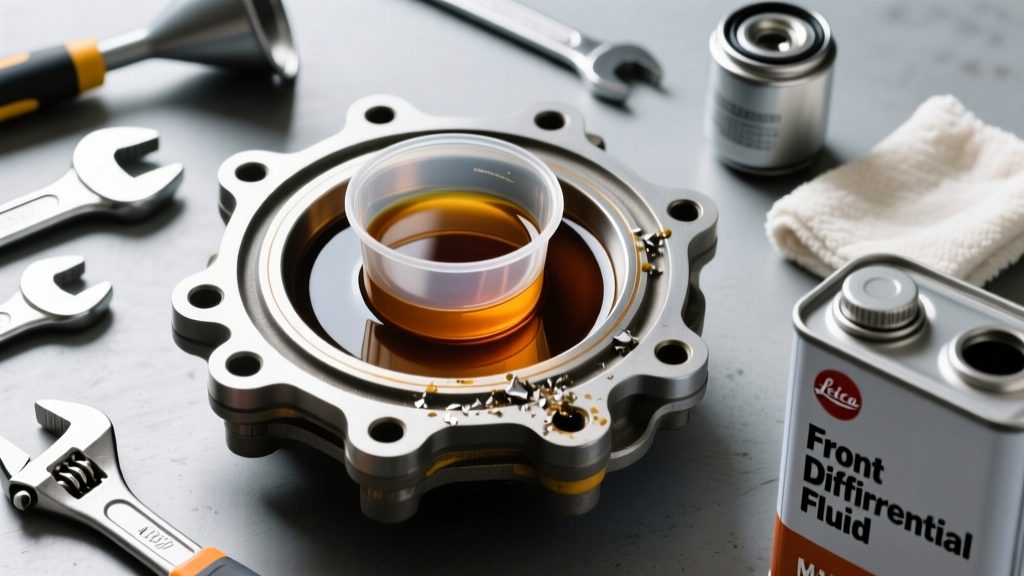
- Glitter/Metallic Sheen: Normal for the first 15,000 miles. Beyond that, it indicates active bearing or thrust washer degradation.
- Chunky Metal on the Drain Plug Magnet: Immediate teardown required. This signifies catastrophic gear tooth spalling or a disintegrated pinion bearing cage.
- Burnt Smell / Black Sludge: The 75W-90 synthetic fluid has exceeded its thermal limits, often due to heavy towing without an aftermarket differential cover. The extreme pressure (EP) additives have broken down, leading to micro-welding on the gear teeth.
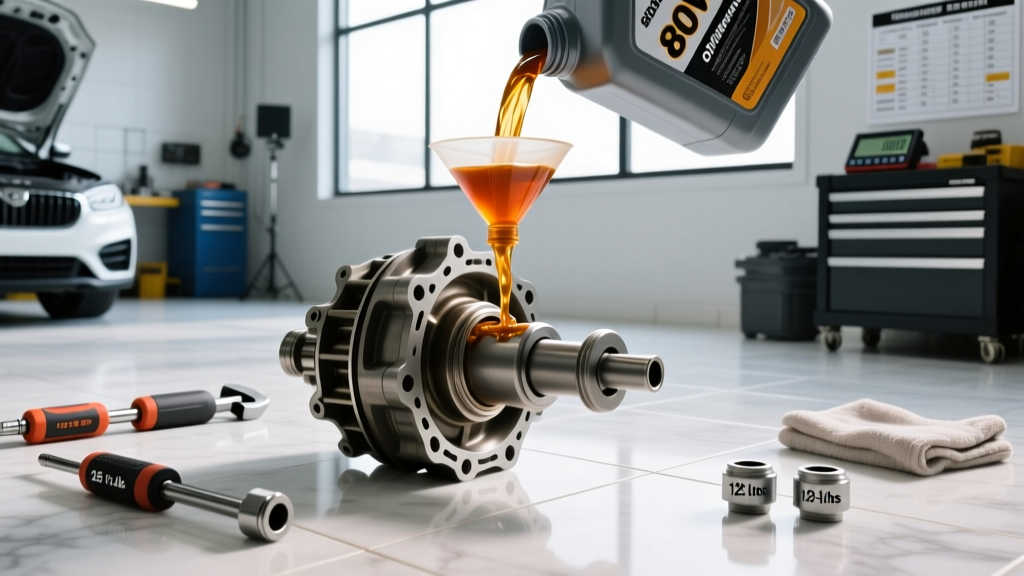
The G80 Chatter Solution: If your GM rear differential identification confirms a G80 Eaton Gov-Loc, and you are experiencing a binding chatter during tight, low-speed turns, the fluid is your first suspect. Standard 75W-90 is not enough. You must use a high-quality synthetic like ACDelco Dexron Gear Oil 75W-90 and add exactly 4 ounces of GM Friction Modifier (Part No. 1052358 or ACDelco 10-4016). Perform five figure-eight turns in a parking lot to work the modifier into the clutch packs. If the chatter persists, the internal governor spring is fatigued, requiring a G80 rebuild kit (approx. $180-$240 for parts).
Phase 5: Precision Assembly & Torque Specifications
If your diagnosis dictates a rebuild, guessing on torque specs will result in a noisy differential within 500 miles. Gear setup is about measuring rotational torque and deflection, not just applying foot-pounds to a nut. For authoritative setup procedures, technicians frequently consult the Ring & Pinion Tech Library for pattern reading and crush sleeve elimination techniques.
Critical Torque & Measurement Specs (GM 8.5" 10-Bolt & 8.875" 12-Bolt)
- Ring Gear Bolts: 55-65 lb-ft. Best Practice: Always use a medium-strength threadlocker (Loctite 242) and torque in a crisscross pattern. Left-hand threads are used on some older GM carriers; verify before applying force.
- Carrier Bearing Cap Bolts: 60-70 lb-ft. These caps are line-bored with the housing. Never mix up the left and right caps, or you will induce severe bearing bind and gear misalignment.
- Pinion Bearing Preload (Used Bearings): 15-25 inch-pounds of rotational torque.
- Pinion Bearing Preload (New Bearings): 25-35 inch-pounds of rotational torque.
- Ring Gear Backlash: 0.006" to 0.010". Measured at three equidistant points around the ring gear using a magnetic dial indicator. Variation between points must not exceed 0.002", or the ring gear is warped and must be replaced.
The Crush Sleeve Dilemma
The GM pinion nut torque spec (often cited as 125-150 lb-ft) is essentially useless for setting preload because the crush sleeve's resistance varies wildly. Expert builders measure rotational torque at the yoke while incrementally tightening the pinion nut. If you over-crush the sleeve, you must throw it away and install a new one. For high-horsepower or heavy-towing applications, consider upgrading to a solid pinion spacer shim kit (approx. $45-$60), which eliminates the crush sleeve entirely and provides permanent, adjustable preload. For more advanced drivetrain theory and NVH troubleshooting, resources like MotorTrend's How-To Archives offer excellent visual guides on reading gear contact patterns.
Summary: The Expert's Diagnostic Workflow
Successful differential noise diagnosis is never a guessing game. It requires a systematic approach: verify the GM rear differential identification via bolt count and RPO codes, map the acoustic profile to specific load vectors, analyze the fluid for physical evidence of failure, and finally, execute the rebuild using precision inch-pound measurements rather than blunt force. Whether you are servicing a classic 12-bolt or a modern AAM 11.5-inch, adhering to these best practices ensures a quiet, durable, and reliable drivetrain for the long haul.