The Critical Role of 80W90 Differential Fluid in Hypoid Axles
The hypoid gear design found in nearly all modern solid rear axles and many independent front differential assemblies relies on extreme sliding friction to transfer torque from the driveshaft to the wheels. This sliding action generates immense localized heat and shear forces that would instantly destroy standard motor oil or transmission fluid. To survive, the ring and pinion gears require the specialized sulfur-phosphorus extreme pressure (EP) additives found exclusively in API GL-5 rated 80W90 differential fluid. When this fluid degrades, micropitting, spalling, and catastrophic gear failure follow. This comprehensive guide details the exact step-by-step procedure, torque specifications, and interval data required to service your differential correctly in 2026.
Debunking 'Lifetime' Fluid: Correct Service Intervals
Many OEM owner's manuals from the mid-2010s to the early 2020s listed rear differential fluid as a 'lifetime' fill. From a drivetrain engineering perspective, 'lifetime' simply means the expected warranty period of the vehicle. By 2026, the consensus among axle manufacturers like Dana and Spicer is clear: if your vehicle is used for towing, off-roading, or frequent stop-and-go driving, the fluid must be changed. According to Spicer Parts installation and maintenance guidelines, severe-duty applications demand fluid changes every 15,000 to 30,000 miles. For normal highway commuting, a 50,000 to 60,000-mile interval is the mechanical sweet spot to prevent varnish buildup and additive depletion.
Tools and Materials Required
Do not attempt this service with generic sealants or inadequate tools. Gather the following before lifting the vehicle:
- Fluid: API GL-5 80W-90 Gear Oil (e.g., Red Line 75W90 or 80W90, Mobil 1 Synthetic). Check your specific capacity in the table below.
- Gasket Maker: Permatex Ultra Black Rigid Flange RTV (Part #85084) or a pre-cut cork/rubber gasket specific to your axle cover.
- Friction Modifier: Motorcraft XL-3 or GM EOS (only if equipped with a clutch-type Limited Slip Differential).
- Tools: 3/8-inch drive ratchet, 1/4-inch and 3/8-inch drive torque wrenches, 6-point sockets, plastic gasket scraper, brake cleaner, and a manual fluid transfer pump.
Step-by-Step 80W90 Differential Service Procedure
Step 1: Safety, Prep, and The Golden Rule
Park the vehicle on a level surface and engage the parking brake. Chock the front wheels. The absolute most important rule of differential service is to remove the fill plug before removing the drain plug or differential cover. If you drain the axle first and then discover the fill plug is seized or stripped, you are left with an empty differential and no way to refill it. Use a 3/8-inch square drive or the appropriate 6-point socket to break the fill plug loose, then re-thread it loosely.
Step 2: Draining and Fluid Inspection
Place a drain pan capable of holding at least 6 quarts beneath the axle. Remove the drain plug (if equipped) or begin unbolting the differential cover. Leave the top two bolts loosely threaded to act as a hinge, allowing the heavy gear oil to drain into the pan without dropping the cover entirely on your chest. Once drained, remove the cover completely. Inspect the fluid and the drain plug magnet. A fine, silvery paste on the magnet is normal wear from the ring and pinion mating process. However, if you find metallic chunks, brass-colored flakes (indicating spider gear thrust washer failure), or a burnt, sulfurous odor, internal mechanical damage has occurred and a rebuild is necessary.
Step 3: Surface Preparation
Clean the mating surfaces of the differential housing and the cover using brake cleaner and lint-free shop towels. Use a plastic gasket scraper to remove old RTV or gasket material. Never use a metal razor blade or steel wire wheel on aluminum differential housings or stamped steel covers, as scoring the mating surface will create permanent micro-channels that guarantee future leaks. According to chemical engineers at Permatex, surfaces must be completely free of oil and moisture for RTV to achieve proper molecular adhesion.
Step 4: RTV Application and Cover Reinstallation
If your axle uses RTV instead of a pre-cut gasket, apply a continuous 3mm to 4mm bead of Permatex Ultra Black around the cover's sealing flange, ensuring you circle all bolt holes. Do not use excessive amounts; excess RTV will squeeze into the housing, break off, and clog the oil pickup or bearing journals. Wait 10 minutes for the RTV to skin over, then mate the cover to the housing. Thread all bolts by hand to prevent cross-threading.
Step 5: Torquing the Cover Bolts
Using a 1/4-inch or 3/8-inch torque wrench, tighten the cover bolts in a crisscross star pattern. This ensures even clamping force and prevents warping the stamped steel cover. Refer to the torque table below for your specific axle model. Over-torquing these bolts is a common novice mistake that strips the aluminum housing threads or cracks the cover.
Step 6: Filling with 80W90 Fluid and Additives
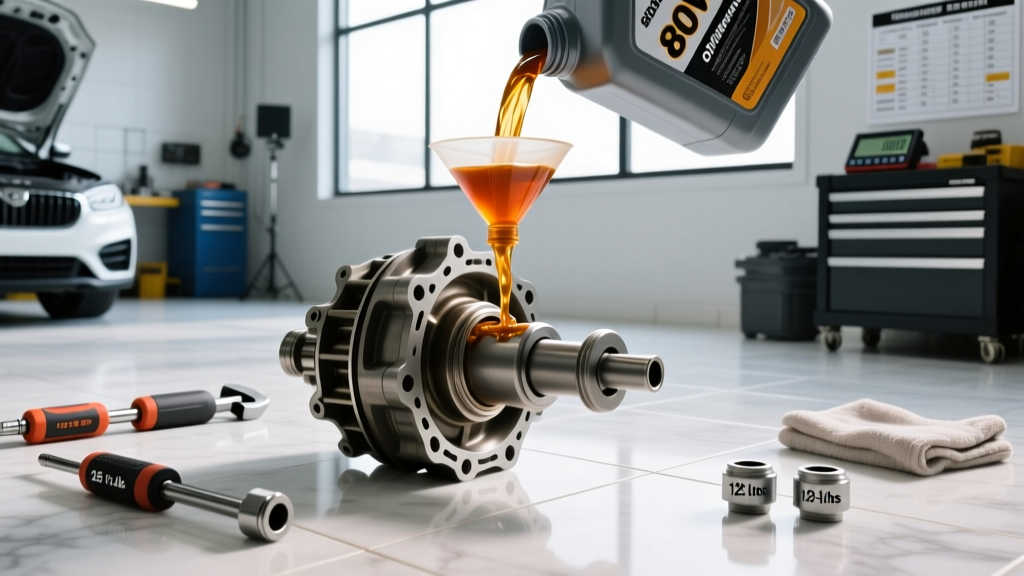
If your vehicle has a clutch-type Limited Slip Differential (LSD) like the Ford Traction-Lok or Auburn GM, add the required 4 to 8 ounces of friction modifier directly into the empty fill hole before pumping in the gear oil. This ensures the modifier mixes thoroughly. Attach your fluid transfer pump to your jug of 80W90 differential fluid and pump the oil into the fill hole until it begins to weep out of the opening. This indicates the fluid has reached the correct level, sitting precisely at the centerline of the pinion gear.
Step 7: Final Sealing and Curing
Wipe the threads of the fill plug, apply a single wrap of PTFE (Teflon) tape or a dab of liquid thread sealant, and torque it to spec. If you used RTV silicone on the cover, you must wait a minimum of 12 to 24 hours before driving the vehicle to allow the silicone to fully cure and prevent blowout under internal axle pressure.
Limited Slip Additive Protocol
Understanding the chemistry of your differential is vital. Standard API GL-5 80W90 differential fluid contains high levels of sulfur-phosphorus EP additives designed to protect metal under extreme loads. However, clutch-type LSDs require long-chain organic friction modifiers to prevent the clutches from grabbing and releasing abruptly. If you skip the friction modifier, you will experience 'chatter'—a violent shuddering sensation when turning corners at low speeds. Conversely, adding friction modifier to an open differential or a helical gear LSD (like the Eaton Truetrac or Torsen) is unnecessary and can slightly reduce the fluid's shear stability. Always verify your specific differential type before adding modifiers. Experts at Red Line Synthetic Oil note that many modern premium synthetic gear oils already contain a baseline friction modifier, but supplementary doses are often still required for aggressive clutch-pack LSDs.
Axle Capacity and Torque Specification Reference Table
| Axle Model | Fluid Capacity | Cover Bolt Torque | Fill/Drain Plug Torque |
|---|---|---|---|
| Ford 8.8-inch | 3.5 - 4.0 Pints | 28 - 38 lb-ft | 22 - 30 lb-ft |
| Dana 44 (Standard) | 4.0 Pints | 30 - 40 lb-ft | 25 - 35 lb-ft |
| GM 9.5-inch (14-Bolt SF) | 5.5 Pints | 20 - 35 lb-ft | 25 - 35 lb-ft |
| Chrysler 9.25-inch | 4.8 Pints | 30 - 40 lb-ft | 25 - 35 lb-ft |
| Toyota 8.0-inch (Solid) | 3.2 Pints | 29 - 42 lb-ft | 29 lb-ft (Plug) |
Cost Analysis: DIY vs. Professional Service in 2026
As of 2026, professional drivetrain shops and dealerships typically charge between $160 and $250 per axle for a differential fluid service. This high cost is driven by shop labor rates averaging $150 to $220 per hour, plus the markup on OEM-branded fluids and shop supplies. By performing this 80W90 differential fluid change procedure yourself, your total out-of-pocket cost will range from $45 to $85, depending on whether you choose conventional or full-synthetic gear oil and whether you need to purchase a new fluid pump. Given the critical nature of hypoid gear protection, mastering this procedure is one of the highest-ROI maintenance skills a truck or SUV owner can develop.