Why Accurate GM Rear Differential ID Dictates Performance
Whether you are building a dedicated towing rig out of a 2026 Silverado Trail Boss or optimizing a Camaro SS for road course duty, understanding your drivetrain is the first step in any performance build. General Motors has utilized dozens of rear axle configurations over the last three decades, ranging from the legendary 12-bolt to the modern ZF-sourced independent rear suspensions. Performing an accurate GM rear differential ID is not just about knowing what parts to order for a rebuild; it is the foundational step in calculating your effective gear ratio, determining your towing capacity, and selecting the exact differential fluid chemistry required to keep the assembly alive under extreme loads.
In this model-specific repair and identification guide, we will break down how to decode GM axle tags, translate RPO (Regular Production Option) codes, and match your differential's gear ratio to your performance goals. Finally, we will cover the critical fluid specifications, torque values, and friction modifier rules that differentiate an open carrier from the infamous G80 Eaton locking differential.
Decoding the Glovebox: GM RPO Axle Codes
The fastest way to perform a preliminary GM rear differential ID without crawling under the truck is to check the Service Parts Identification (SPID) sticker. Located in the glovebox or under the spare tire cover, this sticker contains a series of three-character RPO codes. The axle ratio and differential type are dictated by specific codes. You can cross-reference these using the GM RPO Code Database or the chart below.
| RPO Code | Gear Ratio | Differential Type / Notes |
|---|---|---|
| GU4 | 3.08:1 | Open / Standard Highway Cruiser |
| GU5 | 3.23:1 | Open / Standard Fleet & Fuel Economy |
| GU6 | 3.42:1 | Open / Balanced Towing & Daily Driving |
| GT4 | 3.73:1 | Open / Heavy Towing & Off-Road (Z71/Trail Boss) |
| GT5 | 4.10:1 | Open / Max Trailering Package & Diesel |
| HC4 | 4.56:1 | Open / Extreme Off-Road / Aftermarket Common |
| G80 | N/A (Locker) | Eaton Automatic Locking Rear Differential |
Note: The G80 code is an add-on. You will typically see a ratio code (like GT4) paired with G80, indicating a 3.73 ratio with an Eaton locking mechanism.
Model-Specific Identification: Silverado & Sierra 1500
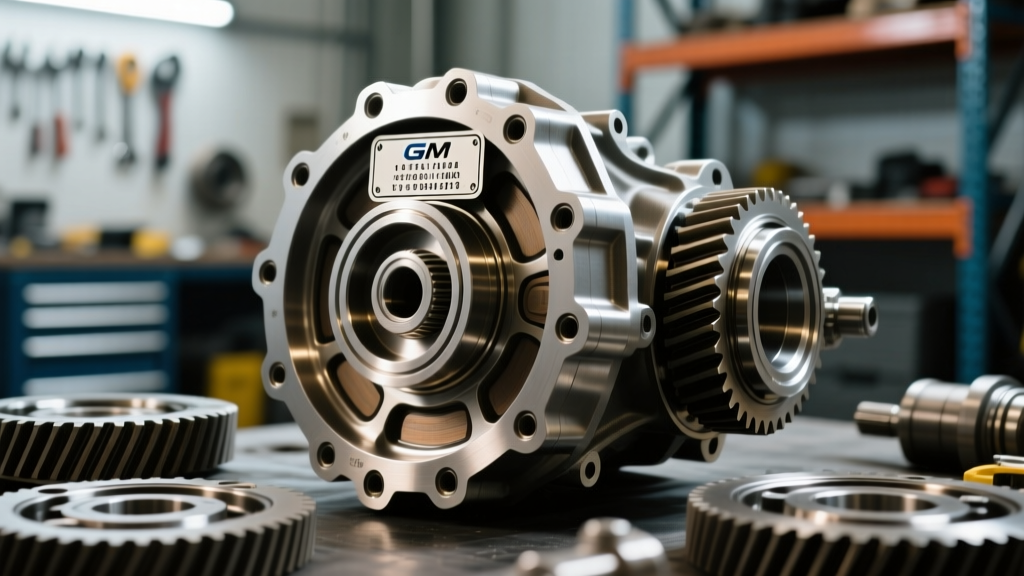
When the RPO sticker is missing or you suspect a previous owner swapped the rear end, you must perform a physical GM rear differential ID by inspecting the housing and carrier.
The 9.5-Inch 14-Bolt Semi-Floating Axle
Introduced in the late 1990s and still prevalent in 2026 heavy-duty half-ton packages, the 9.5-inch 14-bolt is a semi-floating axle easily identified by its 14-bolt differential cover and a distinct '14' cast into the upper webbing of the axle tube. It features a 3.25-inch pinion shaft and handles up to 9,500 lbs of Gross Axle Weight Rating (GAWR). If you are upgrading to 37-inch tires, this is the housing you want. Ring gear bolts on the 9.5-inch 14-bolt should be torqued to 85 lb-ft using red Loctite, and the cover bolts require 30 lb-ft.
The 8.6-Inch 10-Bolt
Standard on most light-duty Silverado 1500s, the 8.6-inch 10-bolt is identified by its 10-bolt cover and a smoother, more rounded pumpkin shape. While adequate for stock 32-inch tires and light towing, the 8.6-inch ring gear struggles with the shock loads of aggressive off-roading or heavy camper payloads. Identifying this diff early allows owners to plan for an aftermarket 9.5-inch swap or a reinforced chromoly axle shaft upgrade before the stock 30-spline shafts snap under stress.
Performance Cars: Camaro and Corvette Differential ID
GM's performance lineup utilizes entirely different architecture. The 5th and 6th Gen Camaro SS and ZL1 models transitioned from the traditional solid 12-bolt to independent rear suspension (IRS) setups sourced from ZF and Dana. Identifying these requires looking at the cast aluminum differential carrier rather than a stamped steel cover. For example, the Camaro ZL1 utilizes a Dana M220 rear differential with a 3.73 ratio (RPO GU6 or GT4 depending on the year) and an electronic Limited Slip Differential (eLSD). Fluid requirements here are drastically different from the truck line, requiring specific GL-5 synthetic fluids compatible with eLSD clutch packs.
The Math of Performance: How Ratios Alter Drivetrain Dynamics
Identifying your gear ratio is only half the battle; understanding how it impacts your vehicle's physics is where the real performance gains are found. Your effective final drive ratio is calculated by multiplying the transmission's output gear by the rear differential ratio, then factoring in tire diameter.
- Towing & Acceleration (3.73 - 4.56): Numerically higher ratios multiply engine torque more aggressively at the wheels. A 2026 Silverado with a 3.73 (GT4) ratio will hit boost on the 3.0L Duramax or 6.2L V8 much earlier, drastically reducing transmission hunting on 6% grades.
- Highway Cruising & MPG (3.08 - 3.23): Numerically lower ratios reduce engine RPM at highway speeds. However, pairing a 3.08 ratio with heavy 35-inch mud-terrain tires will 'over-gear' the truck, causing the 10-speed automatic (10L80) to constantly downshift, generating excess transmission heat and destroying fuel economy.
Differential Fluid Specifications and G80 Locker Care
Because this guide falls under our differential fluid and maintenance protocols, we must address the lubrication requirements tied directly to your GM rear differential ID. Using the wrong fluid in a G80 Eaton locker will result in clutch pack chatter, premature wear, and eventual failure to lock.
Fluid Capacities and Torque Specifications
For standard open differentials and most limited-slip setups, a high-quality 75W-90 GL-5 synthetic gear oil is mandatory. We recommend AMSOIL Severe Gear 75W-90 or ACDelco Dexron Gear Oil (Part # 10-4017). Expect to pay between $25 and $35 per quart in 2026.
- 8.6-inch 10-Bolt Capacity: ~2.1 Quarts
- 9.5-inch 14-Bolt Capacity: ~2.75 Quarts
- Differential Cover Torque (10-Bolt): 22 lb-ft
- Differential Cover Torque (14-Bolt): 30 lb-ft
- Pinion Nut Torque (Crush Sleeve Preload): 150-250 lb-ft (Must measure rotating torque in inch-pounds)
The G80 Eaton Locker Friction Modifier Rule
This is a critical edge case that trips up many DIY mechanics and even some quick-lube technicians. Standard limited-slip differentials (like the Ford Traction-Lok or Chrysler Sure-Grip) require a generic friction modifier additive to prevent clutch chatter. The GM G80 Eaton Automatic Locker operates on a completely different flyweight and ramp mechanism. Do not use standard limited-slip friction modifiers in a G80 differential. Doing so will make the internal locking mechanism slip and fail to engage. If your GM rear differential ID confirms a G80, use straight 75W-90 GL-5 synthetic gear oil. If the manufacturer specifically calls for an additive, use only the GM-approved ACDelco G80 Additive (Part # 10-4004), though modern top-tier synthetics often render this unnecessary. Always consult the specific year's GM Service Manual via resources like the GM-Trucks.com Technical Forums before finalizing your fluid choice.
Conclusion
Mastering your GM rear differential ID is the gateway to unlocking your vehicle's true potential. Whether you are verifying a 3.73 GT4 ratio for a heavy-duty towing setup or confirming the absence of a G80 locker before selecting your gear oil, precision identification prevents catastrophic mechanical failures. Always verify your RPO codes, measure your casting numbers, and adhere strictly to the torque and fluid specifications outlined for your exact axle housing.