The Archival Blueprint: 'To understand the modern electronic valve body, one must first master the mechanical throttle valve (TV) geometry that birthed it.' — Archived Engineering Notes, GM Powertrain Division, 1989.
When a customer rolls a classic C4 Corvette or a 1990s GM C/K1500 into your shop, diagnosing the drivetrain requires more than just reading OBD-II codes. It requires an understanding of mechanical lineage. If you have ever asked yourself how does an automatic transmission work at a foundational level, the answer lies buried in the patents of the 1930s and the engineering compromises of the 1980s. By tracing the invention of the planetary gearset and the specific evolution of the legendary GM Turbo-Hydramatic 700R4 (later the 4L60E), modern rebuilders can diagnose catastrophic failures and execute precision repairs with historical context.
The Invention That Answered: How Does an Automatic Transmission Work?
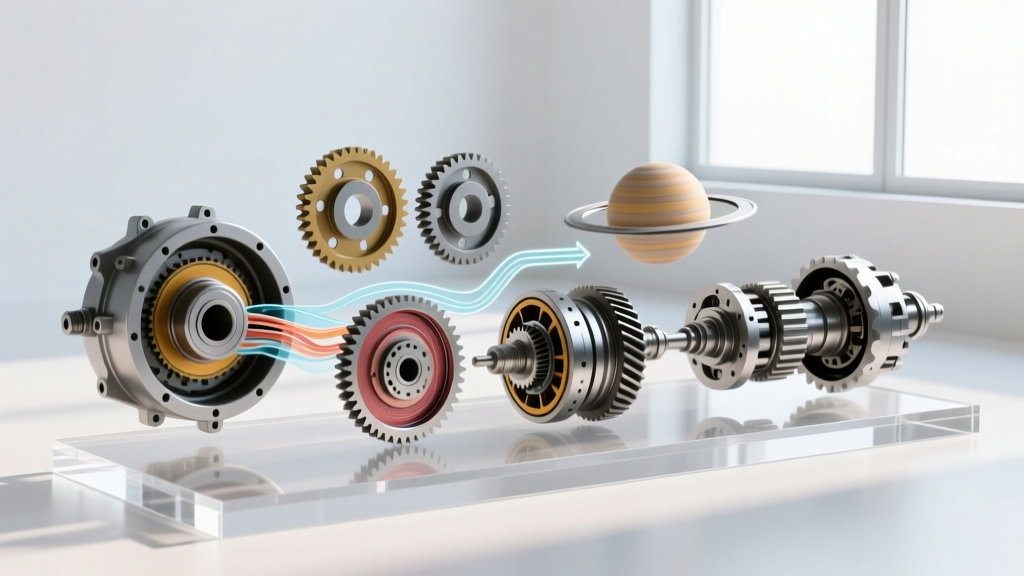
The core question of early automotive engineering was how to multiply engine torque without requiring the driver to manually engage a friction clutch. The answer was the planetary gearset. According to the GM Heritage Center, the mass-production breakthrough occurred in 1939 with the Oldsmobile Hydra-Matic. Engineers utilized a fluid coupling paired with two Simpson planetary gearsets to provide four forward speeds.
A Simpson gearset consists of two simple planetary sets sharing a common sun gear. This invention is the very reason how an automatic transmission works seamlessly today: by holding different members of the planetary set (the ring gear, planet carrier, or sun gear) stationary using hydraulic bands and multi-disc clutches, the transmission alters the gear ratio without interrupting torque flow. This hydraulic logic, governed by centrifugal governors and throttle valves, remained the undisputed king of the highway until the fuel crises of the 1970s forced a radical redesign.
The 1982 Shift: Birth of the 700R4 and Overdrive
By 1982, Corporate Average Fuel Economy (CAFE) standards demanded lower highway RPMs. GM responded by adapting the proven 350 Turbo-Hydramatic into the 700R4, introducing a 0.70:1 overdrive ratio and a lock-up torque converter. However, this historical leap introduced a mechanical complexity that still plagues restorers and repair shops in 2026: the Throttle Valve (TV) cable.
Unlike modern electronic transmissions that use a Throttle Position Sensor (TPS) to command line pressure, the 700R4 relied on a physical cable connected to the carburetor or throttle body. This cable directly actuated the TV valve in the transmission's valve body. If the historical geometry of the throttle lever was off by even a few millimeters, line pressure would drop during wide-open throttle (WOT), resulting in immediate clutch pack burnout. Understanding this historical invention is critical: if you are swapping a 700R4 into a modern LS-swapped vehicle today, you must install a precise TV cable correction bracket (like the Sonnax 35190) to replicate the exact 1982 throttle geometry.
Lineage Evolution: From Mechanical to Electronic
| Specification | 700R4 (1982-1992) | 4L60E (1993-1997) | 4L65E (2001+) |
|---|---|---|---|
| Shift Control | Mechanical TV Cable / Governor | Electronic Solenoids (PWM) | Electronic Solenoids (PWM) |
| Front Planetary Pinions | 4-Pinion | 4-Pinion (Early) / 5-Pinion (Late) | 5-Pinion (Hardened) |
| Input Shaft Material | Standard Steel | Standard Steel | High-Strength Alloy |
| Max Torque Capacity | ~350 lb-ft | ~380 lb-ft | ~420 lb-ft |
| Fluid Type (Original) | Dexron II | Dexron III | Dexron VI (Current Std) |
Historical Flaws & Modern Model-Specific Repairs
The transition from the 700R4 to the electronic 4L60E in 1993 eliminated the TV cable, replacing it with Pulse Width Modulated (PWM) solenoids. However, the mechanical DNA—the Ravigneaux-style compound planetary layout—remained largely unchanged. This shared history means both units suffer from the exact same mechanical edge cases.
The Infamous Sun Shell Failure (1987-1996)
If a 700R4 or early 4L60E suddenly loses 2nd, 3rd, and 4th gears, leaving the vehicle with only 1st and Reverse, you are looking at a sun shell failure. The factory sun shell utilized a thin, stamped-steel spline interface that mated to the 4th gear clutch housing. Under heavy load or aggressive towing, these splines would strip, severing the mechanical link to the planetary sets.
The 2026 Repair Protocol: Do not replace it with an OEM-style stamped shell. Source a hardened, wide-spline aftermarket shell, universally known in the industry as 'The Beast' (Sonnax part number 77729). This historically upgraded part features a solid steel spline ring that is TIG-welded to the shell, completely eliminating the stripping failure point. When installing, ensure the stator support tube is perfectly seated, and lubricate the splines with assembly gel (not standard ATF) to prevent dry-start scoring.
TCC Shudder and the Auxiliary Valve Body
The invention of the Torque Converter Clutch (TCC) was meant to eliminate slip at highway speeds, mimicking a manual clutch. Early 700R4 units suffered from violent TCC shudder due to harsh hydraulic apply. GM's historical fix was the introduction of an auxiliary valve body (often called the 'shudder fix' valve body) to cushion the apply fluid. If you are rebuilding a 1989-1992 700R4 today, you must verify the presence of this auxiliary valve body casting. If missing, retrofit it using a TransGo SK-700-HD kit to ensure smooth lockup engagement.
2026 Rebuilder's Blueprint: Precision Specs
When executing a model-specific rebuild on the 700R4/4L60E lineage, adhering to factory clearances is non-negotiable. The historical tolerance stack-up in these units is notoriously tight. Use the following precision specifications during your bench assembly:
- Input Shaft Endplay: 0.010' to 0.025' (0.25mm - 0.63mm). Use selective thrust washers (Part #8658368 series) to dial this in. Excessive endplay will destroy the front pump rotor.
- 2nd/4th Band Servo Pin Travel: 0.100' to 0.150'. Measure this with a dial indicator before installing the valve body. If travel exceeds 0.160', the 2-4 band will slip during the 1-2 shift, burning the direct clutch pack.
- Valve Body to Case Torque: 8-10 Nm (70-88 in-lbs). Warning: Overtorquing these M6 bolts will warp the aluminum separator plate, causing cross-leaks between the 3rd and 4th gear hydraulic circuits.
- Pump to Case Torque: 10-12 Nm (7-9 lb-ft). Always align the pump halves using two input shafts as guide pins to prevent shearing the internal gear teeth.
- Bellhousing to Engine Block: 47 Nm (35 lb-ft). Crucial for maintaining the historical alignment of the dowel pins. Runout must be less than 0.005'.
Sourcing and Cost Breakdown for the Modern Shop
As of 2026, the aftermarket support for the 700R4 and 4L60E remains incredibly robust due to its status as one of the most produced transmissions in history. When estimating a bench rebuild for a customer, factor in the following real-world pricing tiers:
- Master Rebuild Kit (Banner/TransTec): $165 - $210 (Includes all paper gaskets, O-rings, lip seals, and standard friction plates).
- Raybestos GPZ High-Energy Frictions: $130 - $160 (Highly recommended for any application exceeding 400 lb-ft of torque).
- Sonnax 'The Beast' Sun Shell (77729): $55 - $75 (Mandatory insurance policy against spline failure).
- Heavy-Duty 2-4 Band (Kevlar Lined): $45 - $60.
- Fluid Capacity & Type: 11.2 Quarts (Dry). Use Dexron VI ULW ($65-$85 per case), which is fully backward-compatible and offers superior shear stability compared to the historical Dexron III.
By respecting the history of how an automatic transmission works—specifically the hydraulic and planetary inventions that defined the GM 700R4 and 4L60E—technicians can move beyond simple parts swapping. True model-specific repair requires honoring the original engineering intent while applying modern metallurgical upgrades, ensuring these historic drivetrains survive the demands of the modern road.