Decoding the Drivetrain: What Does Automatic Transmission Mean?
When a new driver or curious car buyer asks, what does automatic transmission mean, the simplest answer is that it is a complex mechanical device that automatically changes gear ratios as the vehicle moves, freeing the driver from manually operating a clutch and shift lever. But from an engineering perspective, an automatic transmission is a marvel of hydraulic, mechanical, and electronic synchronization. It takes the raw rotational power from the engine and multiplies it, allowing a 4,500-pound vehicle to accelerate from a stoplight and still cruise efficiently at 80 mph on the highway.
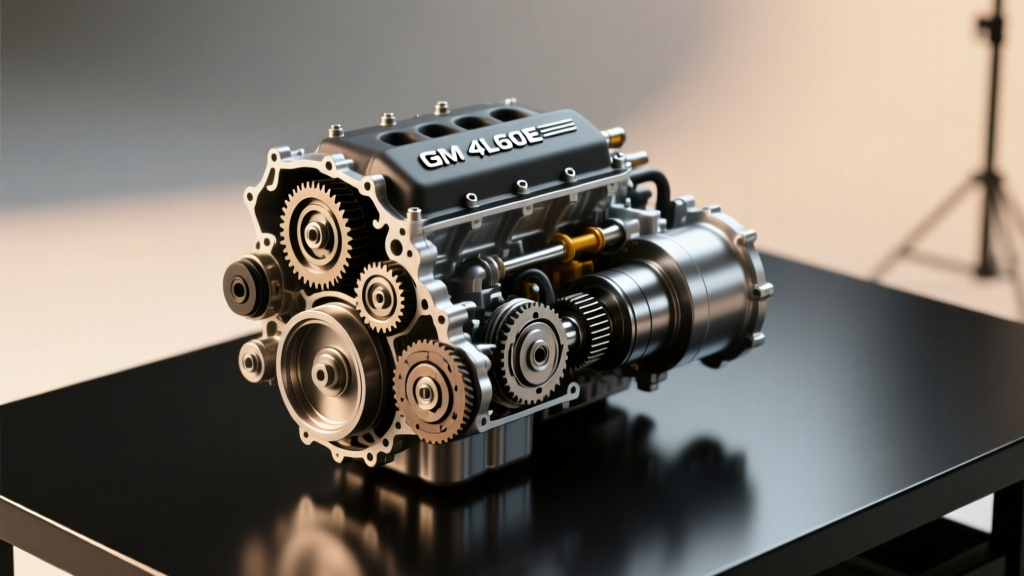
As of 2026, the automotive industry has largely standardized around 8-speed, 9-speed, and 10-speed automatic transmissions, moving far beyond the sluggish 3-speed and 4-speed units of the past. To truly understand how these systems operate, we must break down the fundamental components that make seamless gear changes possible. Whether you are looking at a legendary GM 4L60E, a robust Ford 10R80, or the ubiquitous ZF 8HP found in everything from BMWs to Dodge Chargers, the core architecture remains remarkably consistent.
The Heart of the System: The Torque Converter
If the engine is the heart of the car, the torque converter is the valve that connects it to the transmission. Unlike a manual transmission that uses a mechanical friction clutch, an automatic transmission uses a fluid coupling to transfer power. The torque converter is a sealed, donut-shaped housing filled with Automatic Transmission Fluid (ATF) and contains three primary internal elements:
- The Impeller (Pump): Bolted directly to the engine's flexplate, it spins at engine RPM, using centrifugal force to push ATF outward.
- The Turbine: Connected to the transmission input shaft, it catches the fluid thrown by the impeller, causing the transmission to turn.
- The Stator: Sitting between the impeller and turbine, the stator redirects fluid flow to multiply torque during initial acceleration (typically providing a 2:1 torque multiplication ratio).
Expert Insight: Modern torque converters feature a Torque Converter Clutch (TCC). Once the vehicle reaches cruising speed, the TCC physically locks the impeller and turbine together, eliminating parasitic fluid slip and improving fuel economy. For example, a classic GM 4L60E utilizes a 298mm torque converter with a stall speed of roughly 2,000 to 2,400 RPM. In contrast, modern 10-speed units utilize multi-plate lock-up clutches that can engage smoothly in almost every gear above 1st.
The Muscle: Planetary Gearsets
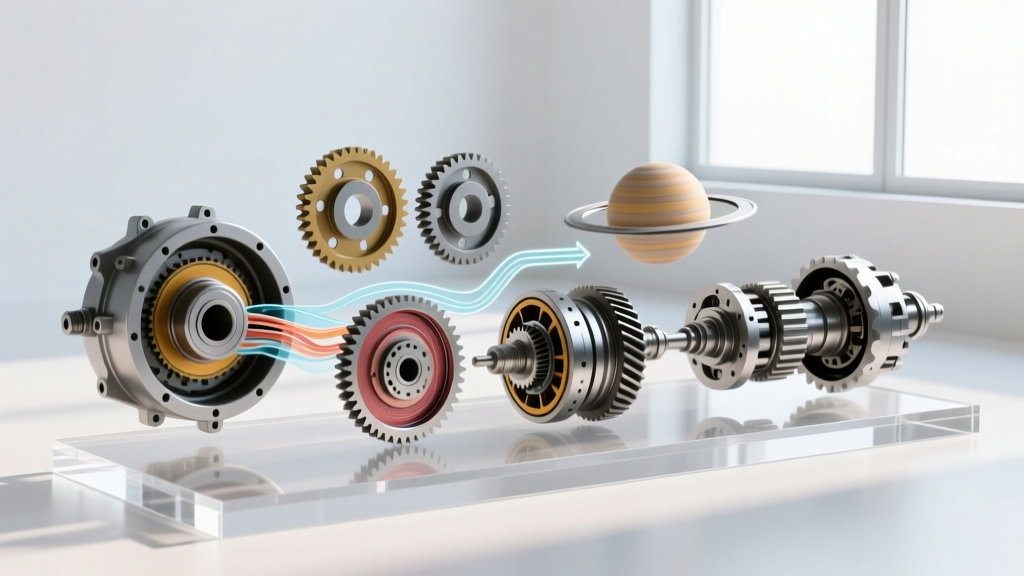
While manual transmissions use sliding spur gears on parallel shafts, automatic transmissions rely on planetary gearsets to achieve different gear ratios. A single planetary gearset consists of three main components:
- The Sun Gear: The central gear.
- The Planet Carrier: Holds multiple smaller planet gears that orbit the sun gear.
- The Ring Gear: An internal-toothed gear that surrounds the planet gears.
By selectively holding one component stationary, driving another, and using the third as the output, the transmission can create forward gears, reverse, and neutral without physically shifting gears in and out of mesh.
Early 4-speed automatics often used a Simpson or Ravigneaux compound gearset. However, modern 8-speed transmissions, like the legendary ZF 8HP, utilize a Lepelletier arrangement. This design places a simple planetary gearset in front of a Ravigneaux gearset, allowing engineers to extract eight forward gears and two reverse gears using only four shift elements (clutches/brakes), drastically reducing internal drag and weight.
The Nervous System: Valve Body and Solenoids
The valve body is the hydraulic control center of the transmission. It is a maze of channels, valves, and springs cast into aluminum or magnesium. Its job is to route pressurized ATF to the correct clutch packs at the exact right millisecond.
In older, purely hydraulic transmissions, governor pressure and throttle cables dictated shift points. Today, the valve body is controlled by the Transmission Control Module (TCM) via electronic solenoids.
- Shift Solenoids: Simple on/off valves that block or open fluid passages to initiate a gear change.
- Pressure Control (PC) Solenoids: These use Pulse Width Modulation (PWM) to infinitely vary line pressure. A PC solenoid might cycle on and off 30 to 50 times per second to ensure a clutch pack applies smoothly, preventing harsh "clunking" during shifts.
Real-World Application: In the GM 6L80 and 6L90 transmissions, the valve body and solenoids are integrated into a single unit called the TEHCM (Transmission Electro-Hydraulic Control Module). If the TEHCM fails or develops internal cross-leaks due to worn casting bores, the transmission will default to "limp mode" (usually locked in 3rd or 4th gear).
Friction Elements: Clutch Packs and Bands
To hold the members of the planetary gearsets stationary or lock them together, automatic transmissions use friction elements.
Clutch Packs consist of alternating steel plates (splined to the outside drum) and friction plates (splined to the inner hub). When hydraulic pressure is applied to a piston, it squeezes the pack together, locking the components. Proper clearance is critical during a rebuild. For instance, when rebuilding the notorious 3-4 clutch pack in a GM 4L60E, technicians must maintain a clearance of 0.040" to 0.060". Too tight, and the clutches drag and burn; too loose, and the transmission slips and flares during the 2-3 shift.
Bands are lined steel straps that wrap around the outside of a brake drum. A hydraulic servo applies the band to lock the drum to the transmission case. While bands were common in older 3- and 4-speeds, most modern 8- and 10-speed automatics have eliminated them entirely in favor of multi-plate clutch packs to reduce rotational mass.
Component Overview and Failure Data
Understanding the cost and failure modes of these components is vital for diagnosis and repair. Below is a breakdown of core automatic transmission components and their real-world service data.
| Component | Primary Function | Common Failure Mode | Avg. Replacement Cost (2026) |
|---|---|---|---|
| Torque Converter | Fluid coupling & torque multiplication | Stator clutch failure, TCC shudder, fin deformation | $450 - $1,200 |
| Valve Body / TEHCM | Directs hydraulic fluid to clutches | Solenoid wear, cross-leak casting bore erosion | $350 - $950 |
| Planetary Gearset | Provides specific gear ratios | Stripped splines, needle bearing disintegration | $800 - $2,500 (Reman) |
| Clutch Pack | Locks gearset members together | Friction material burnout, piston seal blowout | $150 - $400 (per pack) |
| Mechatronic Sleeve | Seals electronics to transmission case (ZF) | Rubber O-ring degradation causing external leaks | $40 - $120 (Part only) |
The Lifeblood: ATF and Maintenance Specifications
Automatic Transmission Fluid (ATF) is not just a lubricant; it is a vital hydraulic medium, a coolant, and a friction modifier. Using the wrong fluid can destroy a modern transmission in a matter of miles because the friction modifiers dictate how the TCC and clutch packs engage.
For example, GM's Dexron VI is a low-viscosity fluid designed for tight clearances and high efficiency, while ZF requires their proprietary Lifeguard 8 fluid for the 8HP series. According to automotive engineering principles outlined by HowStuffWorks, the detergents and anti-wear additives in ATF break down over time due to extreme shear forces and heat.
Maintenance Tip: When performing a fluid service on a 6L80 or 8HP transmission, the transmission pan is often made of thin aluminum or composite plastic with an integrated filter. Over-tightening the pan bolts will warp the sealing surface and cause permanent leaks. Always use a calibrated inch-pound torque wrench. The factory specification for the 6L80 aluminum pan bolts is exactly 8 Nm (71 lb-in). For further technical depth on hydraulic wear and valve body repairs, resources like Sonnax technical guides provide invaluable schematics for transmission technicians.
Summary
So, what does automatic transmission mean in the modern automotive landscape? It means a highly sophisticated integration of hydrodynamics, metallurgy, and computer science. From the fluid multiplication of the torque converter to the precise electronic orchestration of the valve body and planetary gearsets, every component must operate in perfect harmony. Understanding these basic components not only demystifies how your vehicle drives but also empowers you to make informed decisions regarding maintenance, diagnostics, and repairs.