The GM 10-Bolt Legacy: 8.5-Inch vs. 8.6-Inch Architecture
The GM 10-bolt differential is one of the most ubiquitous axle assemblies in North American automotive history. From the classic 8.5-inch 10-bolt found in 1982–2013 Silverados, Camaros, and C10s, to the modern 8.6-inch iteration utilized in newer half-ton trucks, this platform balances weight, cost, and surprising durability. However, when modifying a GM truck or muscle car for enhanced towing capacity, off-road crawling, or drag strip performance, the factory gear ratio is rarely optimal. Swapping the ring and pinion requires a deep understanding of drivetrain math, precision setup tolerances, and the specific hardware required to reseal the axle.
Gear Ratio Selection: The Performance Matrix
Selecting the correct gear ratio is the single most effective modification you can make to restore performance after adding larger tires, or to multiply low-end torque for heavy towing. The numerical ratio represents the number of times the driveshaft (pinion gear) must rotate to turn the axle shafts (ring gear) one full time. A higher numerical ratio (e.g., 4.10) provides more torque multiplication but increases highway RPM, while a lower numerical ratio (e.g., 3.08) favors fuel economy at the expense of acceleration.
| Ring & Pinion Ratio | Primary Application | Tire Size Sweet Spot | Towing Performance | Highway RPM (70 MPH, 33" Tire, 6L80) |
|---|---|---|---|---|
| 3.08 | Highway Cruising / Empty Bed | 29" - 31" | Poor (Struggles on grades) | ~1,650 RPM |
| 3.42 | OEM Standard / Light Towing | 31" - 32" | Moderate (Good for boat trailers) | ~1,830 RPM |
| 3.73 | Heavy Half-Ton Towing | 32" - 33" | Excellent (Keeps engine in powerband) | ~2,000 RPM |
| 4.10 | Off-Road / Steep Grade Towing | 33" - 35" | Superior (Max torque multiplication) | ~2,200 RPM |
| 4.56 | Dedicated Crawling / Drag Radials | 35"+ | N/A (Specialty use only) | ~2,450 RPM |
Drivetrain Math: Overdrive and Tire Diameter
When planning a gear swap, you must account for the transmission's final overdrive ratio. A classic 4L60E features a 0.70 overdrive, whereas the modern 6L80 uses a 0.67 overdrive, and the 8L90 drops to a staggering 0.65. If you install 4.10 gears in a truck with an 8-speed 8L90 transmission, your final drive ratio at highway speeds will mimic a 2.66 ratio on a direct-drive transmission. This allows modern GM trucks to run aggressive 4.10 or 4.30 gears for towing heavy fifth-wheel trailers while still achieving sub-2,000 RPM cruising speeds. Always use a comprehensive gear calculator from authoritative sources like Spicer Drivetrain to map your exact RPM targets before purchasing a ring and pinion set.
Teardown Hardware: GM 10 Bolt Differential Cover Bolt Size
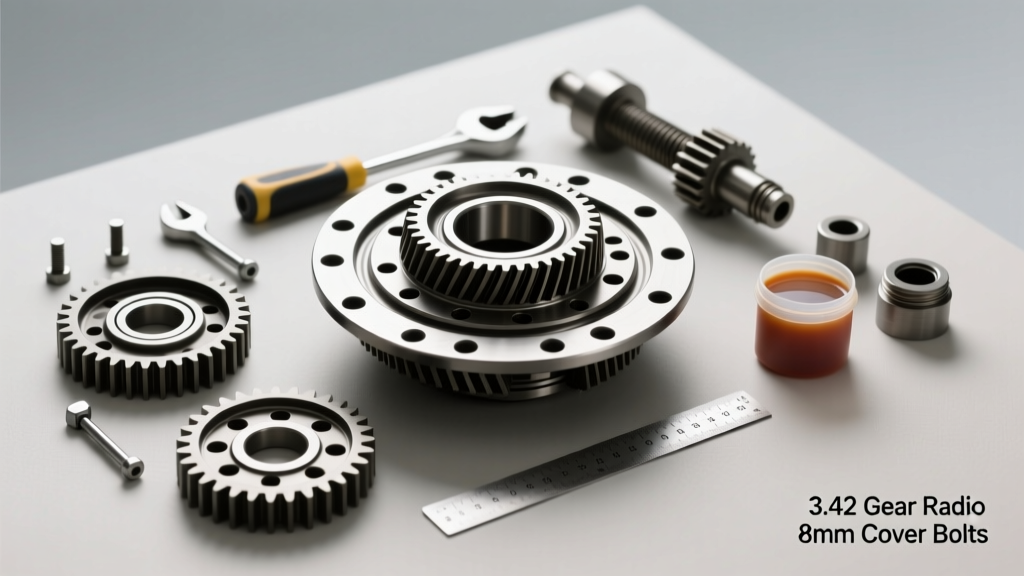
Before you can measure factory backlash, pull the carrier, or swap the ring and pinion, you must drain the housing. A surprisingly common stumbling block for DIY mechanics and novice technicians is guessing the exact gm 10 bolt differential cover bolt size. Using the wrong thread pitch or excessive length can result in cross-threading the housing or bottoming out the bolt, which will crack the cast-iron or aluminum differential cover.
Classic 8.5-Inch 10-Bolt (1982–2013)
- Bolt Size: 3/8"-16 UNC x 5/8" Length
- Quantity: 10 Bolts
- Material Recommendation: Grade 8 Flange Bolts (Yellow Zinc or Black Oxide)
- Torque Specification: 22 - 25 lb-ft
Expert Warning: Never use bolts longer than 5/8" on the classic 8.5" cover. The internal clearance between the cover and the ring gear/ABS tone ring is minimal. A 3/4" bolt will protrude into the housing and physically strike the rotating ring gear or ABS sensor, causing catastrophic failure.
Modern 8.6-Inch IFS/Rear (2014+ Silverado/Sierra)
GM transitioned to metric hardware on many newer AAM-manufactured 8.6" axles. Depending on the exact casting year, the cover bolts are typically M8-1.25 x 16mm or M8-1.25 x 20mm. Always thread a bolt by hand first to verify pitch before applying a torque wrench. The torque spec for the M8 metric covers remains similar: 22 lb-ft (30 Nm).
Ring and Pinion Setup: Backlash and Pattern
Once the cover is removed and the old 75W-90 fluid is drained, the precision work begins. The GM 10-bolt utilizes a shim-under-bearing design for pinion depth, meaning the pinion bearing must be pressed on and off to adjust depth shims. This requires a specialized bearing puller and setup bearings to avoid damaging the final press-fit bearings.
Critical Setup Specifications
- Ring Gear Backlash: 0.006" - 0.010" (Target 0.008" for optimal thermal expansion)
- Ring Gear Bolt Torque: 75 - 85 lb-ft (Must use Red Loctite 272)
- Carrier Bearing Cap Torque: 60 - 65 lb-ft (Always reuse original caps; they are line-bored with the housing and are NOT interchangeable)
- Pinion Bearing Preload: 15 - 25 in-lbs (with used bearings) or 25 - 35 in-lbs (with new bearings)
Pro-Tip on Gear Patterns: When applying yellow marking compound to the ring gear, look for a pattern centered on the tooth face. A pattern biased toward the heel (toe of the gear) indicates the pinion is too deep; a pattern biased toward the toe indicates the pinion is too shallow. Adjust the pinion depth shim in 0.003" increments until the pattern is perfectly centered under both drive and coast loads.
Fluid Specifications and Break-In Protocol
The longevity of your newly installed gear set relies heavily on proper lubrication and thermal management during the break-in period. The GM 10-bolt differential holds approximately 2.0 to 2.2 quarts of gear oil, depending on the specific housing depth and whether an aftermarket deep-sump cover is installed.
Recommended Fluid Viscosity
For standard daily driving and light towing, a high-quality 75W-90 Synthetic gear oil is ideal. It provides excellent cold-weather flow and adequate high-temperature shear stability. However, if you are running 4.10 or 4.56 gears, towing over 7,000 lbs, or subjecting the axle to sustained off-road crawling, upgrade to a 75W-140 Synthetic. The thicker 140-weight oil maintains a more robust hydrodynamic film between the hypoid gear teeth under extreme pressure. Consult the AMSOIL Technical Guides for specific shear-stability data on synthetic hypoid lubricants.
The 500-Mile Break-In Rule
New ring and pinion gears generate immense friction as the machined surfaces mate. This friction creates heat and microscopic metal particulates.
- First 15 Miles: Drive at varying speeds under 45 MPH. Do not tow.
- 15 to 500 Miles: Avoid sustained highway speeds. Stop every 100 miles and let the axle cool for 30 minutes to prevent thermal breakdown of the gear oil.
- At 500 Miles: Drain the break-in fluid. You will notice a metallic glitter in the oil—this is normal. Inspect the differential cover magnets for large metal chunks (which indicate a bearing failure).
- Refill: Fill with your final synthetic 75W-90 or 75W-140 fluid. If your GM 10-bolt is equipped with an Eaton G80 locking differential or an Auburn limited-slip, ensure you add the exact OEM-specified friction modifier (typically 4 oz) to prevent chatter during low-speed cornering.
Cost Analysis: DIY vs. Professional Installation
A complete master rebuild kit (including Timken bearings, shims, crush sleeve, and pinion nut) for a GM 8.5" 10-bolt costs between $120 and $180. A premium USA-forged ring and pinion set (Yukon, Motive, or Spicer) runs $250 to $400. If you lack the hydraulic press, dial indicator, and inch-pound torque beam required for setup, professional installation at a dedicated driveline shop typically ranges from $800 to $1,200 in labor. Given the cost of a second gear set if the backlash is set incorrectly, investing in the proper setup tools or hiring a certified axle technician is highly recommended for first-time builders.