The Intersection of Gear Oil Chemistry and Industrial Telemetry
When managing heavy-duty drivetrain systems, mining haul trucks, or advanced automotive R&D dynos, understanding differential gear oil specifications goes far beyond simply reading the back of a plastic bottle. In extreme operational environments, gear oil degradation directly impacts the hydraulic and lubrication dynamics within the axle housing. To monitor these dynamics in real-time, engineers and fleet managers increasingly rely on high-precision telemetry. This brings us to a unique intersection of automotive maintenance and industrial instrumentation: utilizing a Rosemount differential pressure transmitter to monitor filter restriction, fluid aeration, and viscosity shear across heavy-duty axle filtration loops.
In this 2026 cost analysis and technical breakdown, we will explore the true cost of implementing industrial-grade pressure telemetry for drivetrain testing, decode the intricate chemistry of modern API GL-5 gear oils, and provide actionable torque specifications and fluid capacities for common heavy-duty axles.
Why Monitor Differential Pressure in Axle Systems?
In standard consumer vehicles, the differential is a sealed, splash-lubricated system. However, in heavy-haul, military, and high-performance applications (such as the Dana Spicer S130 or AAM 11.5 axles used in severe-duty trucks), differentials are often equipped with external pump-and-filter circulation loops. These loops manage the immense heat generated by hypoid gear sets operating under extreme loads.
As gear oil is subjected to mechanical shearing and thermal cycling, its viscosity breaks down. A fluid that starts as an SAE 75W-90 can shear down to a 75W-80 or lower, altering its flow characteristics. Conversely, if the oil oxidizes or becomes contaminated with particulate matter, it thickens and restricts flow through the axle’s filtration system. By measuring the pressure drop (Delta-P) across the filter housing, technicians can infer the physical state of the gear oil without pulling a physical sample.
Standard Automotive Sensors vs. Rosemount Differential Pressure Transmitter
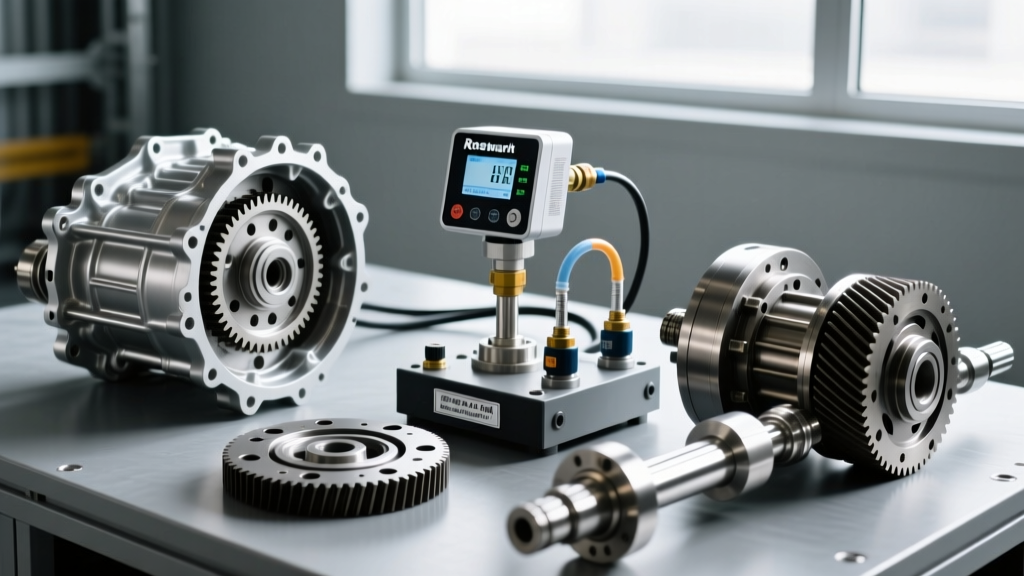
While standard automotive pressure switches are sufficient for triggering a dashboard warning light, they lack the resolution required for predictive maintenance and R&D fluid validation. The Rosemount 3051S Coplanar differential pressure transmitter is the industry standard for industrial fluid loops, offering unparalleled accuracy and long-term stability.
| Feature | Standard OEM Axle Pressure Switch | Rosemount 3051S Transmitter |
|---|---|---|
| Primary Use Case | AWD Clutch Pack / Basic Lube Pump | R&D Dyno Loops / Heavy Fleet Filtration |
| Accuracy | +/- 5% to 10% (Binary or low-res) | +/- 0.025% of Span |
| Output Signal | 12V Switch / 0-5V Analog | 4-20mA HART / Fieldbus |
| Estimated 2026 Unit Cost | $45 - $120 | $1,600 - $2,400 |
| Data Logging Capability | None (ECM fault codes only) | Continuous high-speed telemetry |
2026 Cost Breakdown: Drivetrain R&D and Fleet Telemetry Loops
Implementing a differential pressure monitoring system to validate SAE J306 gear oil specifications requires more than just the sensor. Below is a realistic 2026 cost breakdown for outfitting a heavy-duty axle test cell or a fleet of mining trucks with continuous fluid-condition telemetry.
- Rosemount 3051S Differential Pressure Transmitter (Coplanar, HART protocol): $1,850.00
- 316 Stainless Steel Manifold & Instrument Fittings: $320.00
- Heavy-Duty Wiring & Shielded Signal Cable (per 50ft run): $145.00
- DAQ Module / Telemetry Gateway (e.g., National Instruments or Fleetmatics): $650.00
- High-Capacity Axle Filtration Housing (Modified for Delta-P ports): $480.00
- Reference Gear Oil (Mobil Delvac 1 Synthetic 75W-90, 5-Gallon Pail): $165.00
- Total Estimated Hardware Cost per Axle/Test Loop: $3,610.00
While $3,600+ per axle seems exorbitant for consumer applications, for a fleet of Caterpillar 797F mining trucks where an unplanned differential failure results in $150,000+ in downtime and component replacement, the ROI on predictive fluid telemetry is realized within the first oil change interval.
Deep Dive: Differential Gear Oil Specifications
To understand what the telemetry is actually measuring, we must understand the fluid itself. Gear oil specifications are governed primarily by the American Petroleum Institute (API) and SAE International.
Viscosity Grades and Shear Stability
Unlike engine oils, gear oils use a different viscosity grading scale (SAE J306). A 75W-90 gear oil has a kinematic viscosity roughly equivalent to a 10W-40 engine oil at operating temperatures, but it is formulated with high-molecular-weight polymers to maintain film strength under the extreme sliding friction of hypoid gears.
The critical metric for heavy-duty axles is shear stability. In a differential, the ring and pinion gears act like a mechanical blender, physically tearing the polymer chains of the viscosity index improvers. If an oil lacks shear stability, a 75W-90 will permanently lose viscosity, dropping to a 75W-80. This thinner fluid flows faster through the axle filter, resulting in a lower baseline differential pressure reading on the Rosemount transmitter, alerting engineers to fluid degradation before gear scuffing occurs.
Extreme Pressure (EP) Additive Packages
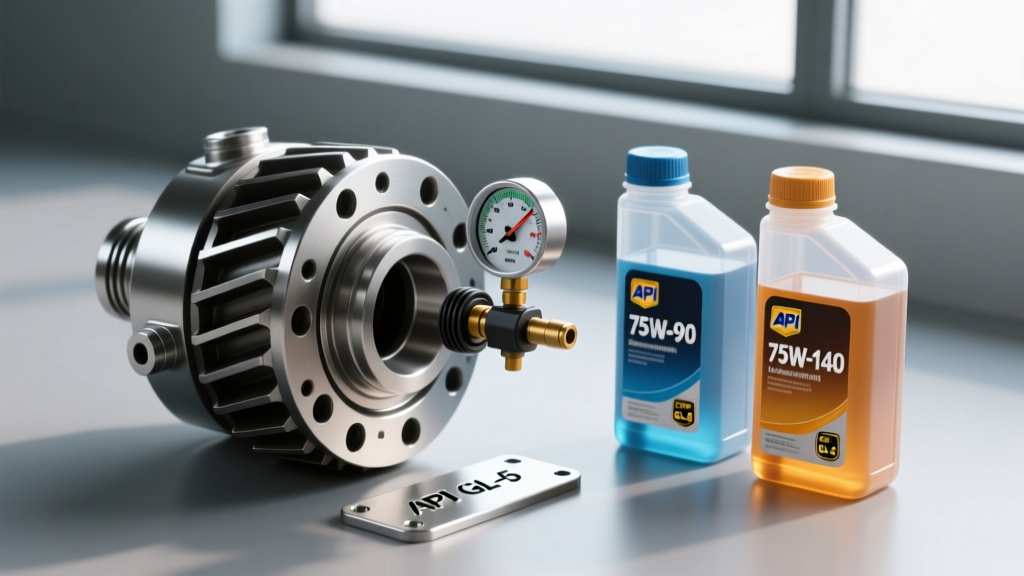
API GL-5 is the mandatory specification for modern hypoid differentials. GL-5 oils contain high levels of Sulfur-Phosphorus EP additives. Under extreme localized heat (up to 400°F at the gear tooth contact patch), these additives react with the metal surface to form a sacrificial iron sulfide/iron phosphate layer, preventing metal-to-metal welding.
Cost Note on Fluids: Premium synthetic GL-5 fluids (e.g., AMSOIL Severe Gear or Royal Purple Max Gear) cost between $20 and $35 per quart, compared to $8 to $12 for conventional mineral-based 80W-90. However, synthetics offer a 30% reduction in viscous drag, improving fuel economy in fleet applications by 1-2%, which offsets the initial fluid cost within 40,000 miles.
Physical Axle Service: Torque Specs and Capacities
Whether you are validating fluid specs in a lab or performing routine maintenance in the bay, adhering to exact OEM torque specifications is critical to prevent housing distortion and fluid leaks. Below are the 2026 reference specifications for common heavy-duty and performance axles.
| Axle Model | Fluid Capacity | Drain/Fill Plug Torque | OEM Fluid Spec |
|---|---|---|---|
| Dana Spicer S130 (Heavy Truck) | 32.0 Pints (15.1 L) | 35 - 45 lb-ft | API GL-5 SAE 75W-90 |
| AAM 11.5 (Ram HD / GM 2500) | 7.4 Pints (3.5 L) | 25 lb-ft | API GL-5 SAE 75W-85 |
| Ford 10.5 (Super Duty) | 6.9 Pints (3.25 L) | 33 lb-ft | API GL-5 SAE 75W-140 |
| Dana 60 (Off-Road / Performance) | 6.0 Pints (2.8 L) | 25 - 30 lb-ft | API GL-5 SAE 80W-90 |
Pro-Tip: Always use a calibrated torque wrench on differential fill plugs. Over-torquing cast iron or aluminum differential covers can warp the sealing surface, leading to chronic weeping that mimics a blown pinion seal.
Calculating the ROI of Advanced Fluid Monitoring
For standard automotive repair shops and consumer vehicles, the cost of a Rosemount differential pressure transmitter is entirely unjustifiable; time-based or mileage-based fluid intervals (e.g., every 60,000 miles for severe duty) remain the most cost-effective approach. A standard differential fluid service costs between $150 and $300 at a dealership, utilizing standard hand pumps and basic fluid extraction.
However, for drivetrain R&D facilities, OEMs validating new EV reduction gearboxes (which require specialized low-viscosity, non-conductive fluids), and heavy mining fleets, the calculus changes. A single catastrophic ring-and-pinion failure in a 400-ton haul truck costs upwards of $85,000 in parts and labor, excluding the $10,000-per-day cost of lost production. By utilizing high-fidelity telemetry to track the exact moment a gear oil shears out of its SAE specification, fleets can transition from preventative maintenance to true predictive maintenance, maximizing the usable life of synthetic lubricants while entirely eliminating catastrophic mechanical failures.
Understanding the deep chemistry of API GL-5 specifications, combined with the precision of industrial instrumentation, represents the cutting edge of 2026 drivetrain reliability engineering.