How Drivetrain Architecture Dictates Clutch Kit Design
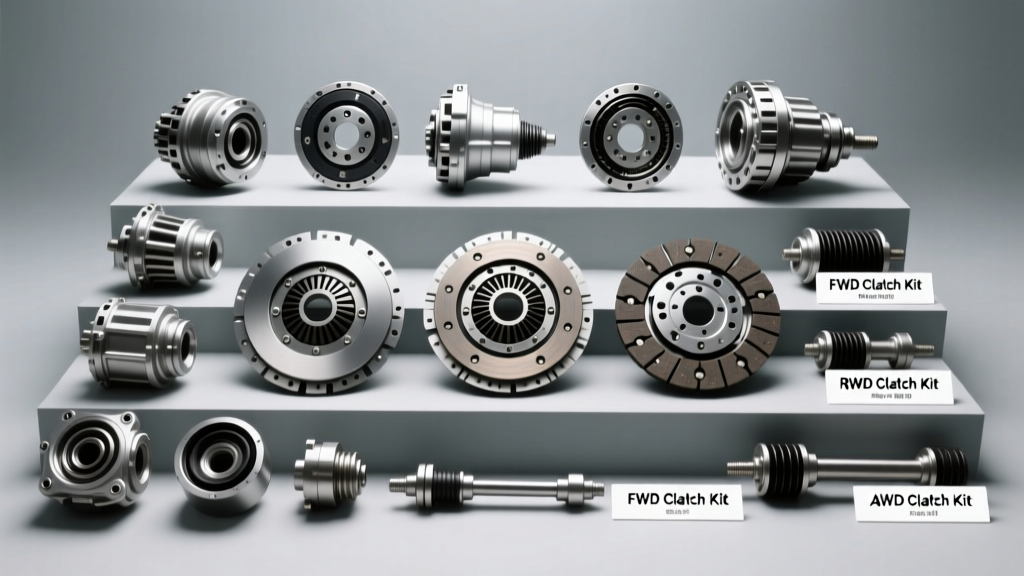
When diagnosing slip, chatter, or pedal failure, understanding the underlying drivetrain layout is critical. The term drivetrain clutch kits encompasses a wide variety of friction and hydraulic components, but the physical architecture of these kits changes drastically depending on whether the vehicle is Front-Wheel Drive (FWD), Rear-Wheel Drive (RWD), or All-Wheel Drive (AWD). The drivetrain type dictates not only the diameter and spline count of the clutch disc but also the release mechanism, flywheel mass, and the labor-intensive removal procedures required for replacement.
In this model-specific repair guide, we break down the nuances of replacing drivetrain clutch kits across three benchmark platforms: the transverse FWD Honda Civic Si, the longitudinal RWD Ford Mustang GT, and the symmetrical AWD Subaru WRX. By examining these distinct drivetrain types for different vehicles, we can highlight the exact part numbers, torque specifications, and mechanical edge cases that separate a successful repair from a catastrophic drivetrain failure.
FWD Transaxle Repair: Honda Civic Si (K20C1)
In a front-wheel-drive layout, the engine and transmission are combined into a single transverse unit called a transaxle. The clutch is housed inside the bellhousing section of the transaxle, which bolts directly to the side of the engine block. Because the drivetrain components (axles, differential, and clutch) share the same housing, fluid contamination from a leaking axle seal can easily destroy a new clutch disc.
FWD Kit Contents & Part Numbers
For the 1.5L Turbo K20C1 engine, the OEM replacement kit is the Exedy HCD031U (or Honda OEM 22200-5R0-005). A standard FWD drivetrain clutch kit includes:
- Sprung hub friction disc (212mm outer diameter, 24-spline)
- Diaphragm pressure plate
- Concentric hydraulic release bearing (slave cylinder)
- Pilot bearing and alignment tool
Expert Note: The K20C1 utilizes a dual-mass flywheel (DMF). If you experience low-RPM chatter or rattling, inspect the DMF for radial play exceeding 2mm. Replacing the DMF with a single-mass conversion (like an Exedy lightweight kit) will increase NVH (Noise, Vibration, and Harshness) but eliminate future DMF failure points.
FWD Torque Specifications & Subframe Removal
Accessing an FWD clutch requires dropping the front subframe and removing the passenger-side half-shaft. The repair demands strict adherence to torque-to-yield protocols:
- Flywheel Bolts (M10x1.25): 87 lb-ft + 30-degree turn (Replace bolts every time)
- Pressure Plate Bolts (M8x1.25): 19 lb-ft (Tighten in a star pattern)
- Passenger Axle Nut (M22): 134 lb-ft (Prevailing torque, do not reuse)
- Subframe Mounting Bolts: 76 lb-ft + 45-degree turn
RWD Longitudinal Repair: Ford Mustang GT (MT-82)
Rear-wheel-drive vehicles utilize a longitudinal drivetrain layout where the transmission is mounted inline with the engine and sends power rearward via a driveshaft. This configuration allows for larger bellhousings, accommodating heavier, higher-capacity drivetrain clutch kits designed for high-torque applications.
RWD Kit Selection & Twin-Disc Upgrades
The Ford Mustang GT equipped with the Tremec MT-82 (or MT-82 D4) 6-speed manual is a prime candidate for upgraded drivetrain clutch kits. While the OEM Ford Performance kit (M-7548-M8) handles up to 450 lb-ft of torque, modified 5.0L Coyote engines frequently exceed this. For builds pushing 600-800 wheel horsepower, the McLeod RXT Twin-Disc Kit (Part #691103) is the industry standard.
Twin-disc RWD kits utilize a floater plate between two friction discs, doubling the surface area without requiring an excessively heavy pressure plate spring. This maintains a street-friendly pedal effort while preventing slip under high-boost or nitrous conditions. When sourcing from McLeod Racing, ensure you select the correct 26-spline input shaft configuration to match your specific MT-82 generation.
RWD Driveshaft & Bellhousing Torque Specs
RWD clutch replacement requires supporting the exhaust system, dropping the aluminum driveshaft, and unbolting the transmission crossmember. Critical torque specifications include:
- Flywheel Bolts (M11x1.5): 59 lb-ft (Apply medium threadlocker)
- Bellhousing to Engine Block: 33 lb-ft
- Driveshaft Flange Bolts (M10): 85 lb-ft (Mark alignment before removal)
- Transmission Crossmember: 66 lb-ft
Fluid Note: Upon reassembly, the MT-82 D4 requires exactly 2.3 liters of Motorcraft Dual Clutch Transmission Fluid (XT-11-QDC). Using standard GL-4 gear oil will destroy the internal synchronizers.
AWD Symmetrical Repair: Subaru WRX (FA20 / 6MT)
All-wheel-drive layouts introduce immense complexity to clutch replacement. In the Subaru WRX, the drivetrain features a symmetrical AWD system where the transmission houses not only the forward gears but also the center limited-slip differential and the rear output shaft. The clutch kit must be perfectly balanced, as any imbalance is magnified through the AWD transfer gears, causing severe driveline whine.
AWD Transfer Case Considerations & Kit Specs
For the 2015-2021 VA-chassis WRX, the Exedy SJK011 Stage 1 Heavy Duty Kit is a highly reliable OEM-plus replacement. AWD drivetrain clutch kits often feature a heavier marcel (wave) spring in the friction disc to absorb the violent torque spikes that occur when the center differential binds during tight, low-speed cornering.
Unlike FWD or RWD setups, the AWD Subaru requires the removal of the pitch stopper, the intercooler, and the starter motor from the top side before the transmission can be separated from the engine block. The clearance between the clutch fork and the AWD transfer case housing is notoriously tight; improper installation of the throwout bearing collar will result in immediate fork binding.
AWD Engine-Out vs. Transmission-Drop Strategy
While it is possible to drop the AWD transmission from underneath by unbolting the rear driveshaft and crossmember, many experienced technicians prefer the "engine-out" or "front-clip" removal method for AWD platforms. Pulling the engine and transmission together as a single unit provides unobstructed access to the flywheel and clutch alignment, reducing the risk of damaging the fragile rear main seal or the AWD input shaft seal.
- Flywheel Bolts (M10x1.25): 59 lb-ft
- Pressure Plate Bolts (M8x1.25): 19 lb-ft
- Transmission to Engine Block (M10): 35 lb-ft
- Pitch Stopper Mount: 42 lb-ft
Comparative Data: Drivetrain Clutch Kits by Layout
| Drivetrain Type | Vehicle Platform | Recommended Kit | Est. Parts Cost | Labor Time | Primary Complexity |
|---|---|---|---|---|---|
| FWD (Transverse) | Honda Civic Si (K20C1) | Exedy HCD031U | $350 - $450 | 4.5 - 5.5 Hours | Subframe drop, axle seal protection |
| RWD (Longitudinal) | Ford Mustang GT (MT-82) | McLeod RXT Twin-Disc | $1,200 - $1,500 | 5.0 - 6.5 Hours | Driveshaft alignment, exhaust clearance |
| AWD (Symmetrical) | Subaru WRX (FA20 6MT) | Exedy SJK011 Stage 1 | $450 - $600 | 6.5 - 8.0 Hours | Center diff clearance, pitch stopper removal |
Sourcing and Final Assembly Protocols
When purchasing drivetrain clutch kits, avoid unbranded marketplace kits that lack certified friction material data. Reputable manufacturers like Exedy USA provide exact clamping load data and dynamic friction coefficients necessary for matching your vehicle's specific torque curve. Always verify the spline count and input shaft diameter, as mid-year transmission revisions (such as the Ford MT-82 to MT-82 D4 transition) frequently alter clutch hub geometries.
Finally, the break-in procedure is universal across all drivetrain types. Whether you are installing a twin-disc RWD kit or a standard FWD transaxle kit, perform 500 miles of varied city driving. Avoid full-throttle launches, aggressive downshifts, and sustained highway cruising during this period to allow the friction material to properly mate with the flywheel surface, ensuring maximum torque transfer and longevity.