The Hidden Complexity of Front Differential Fluid Service
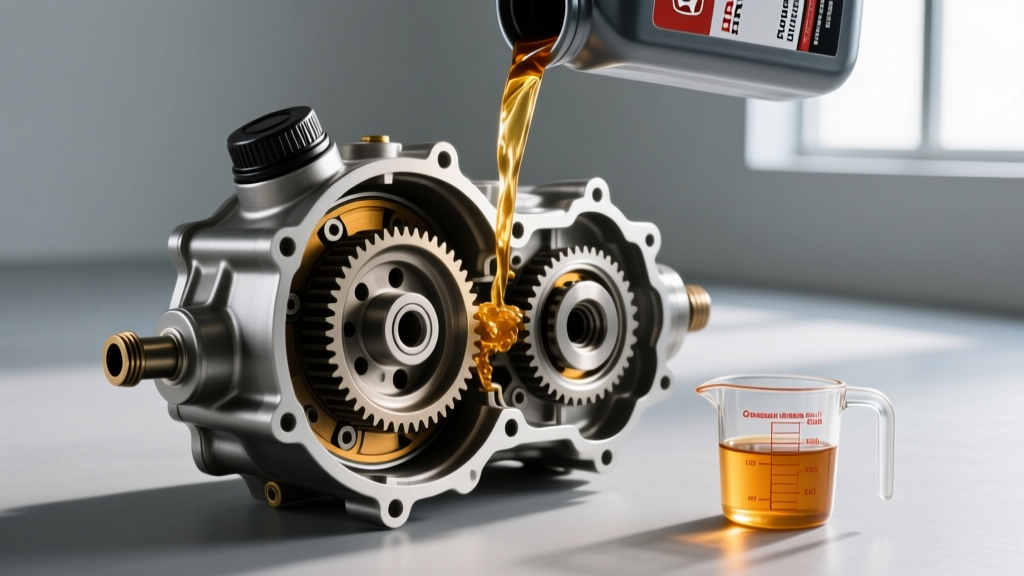
When planning a drivetrain maintenance schedule, the rear differential often gets all the attention, while the front differential is treated as an afterthought. However, performing a proper front differential fluid service is critical, especially for modern 4WD and AWD vehicles featuring Independent Front Suspension (IFS). Front differentials operate under unique thermal and mechanical stresses, frequently subjected to steering angles, CV joint articulation, and proximity to engine exhaust heat. Choosing the wrong gear oil can lead to accelerated ring and pinion wear, bearing failure, and catastrophic clutch-pack degradation in limited-slip setups.
This 2026 buyer's guide cuts through the marketing noise, providing a deep-dive comparison of differential fluid types, API specifications, and viscosity grades to ensure you select the exact lubricant your front axle requires.
API Service Classifications: Decoding GL-4 vs. GL-5
The American Petroleum Institute (API) categorizes gear oils based on their extreme pressure (EP) additive packages. Understanding the chemical difference between GL-4 and GL-5 is the most critical step in your purchasing decision.
API GL-5: The Standard for Hypoid Gears
Most modern front differentials utilize hypoid ring and pinion gearsets, where the pinion gear sits below the centerline of the ring gear. This geometry creates massive sliding friction. GL-5 gear oils contain high levels of sulfur-phosphorus EP additives designed to sacrifice themselves under extreme loads, preventing metal-to-metal contact. If your vehicle has a standard open or clutch-type limited-slip front differential, GL-5 is almost universally required.
API GL-4 and the 'Yellow Metal' Warning
GL-4 oils contain roughly half the sulfur-phosphorus additives of GL-5. While this makes them safe for 'yellow metals' (brass, bronze, and copper syncros found in manual transmissions and some integrated transfer cases), they generally do not provide adequate shear protection for standalone hypoid differential gears. Never substitute GL-4 in a front differential that explicitly calls for GL-5, unless the manufacturer specifies a GL-4/GL-5 dual-rated synthetic fluid.
Viscosity Grades Compared: SAE J306 Standards
Gear oil viscosity is governed by the SAE J306 standard. Unlike engine oil, gear oil numbers are much higher, but a 75W-90 gear oil is actually similar in absolute thickness to a 10W-40 engine oil at operating temperature. Here is how the primary front differential viscosities compare for 2026 applications.
| Viscosity Grade | Kinematic Viscosity @ 100°C (cSt) | Best Application Scenario | Cold Weather Performance |
|---|---|---|---|
| 75W-85 | 11.0 - 13.4 | Modern lightweight IFS (e.g., newer Toyota/Lexus front diffs) | Excellent (down to -40°C) |
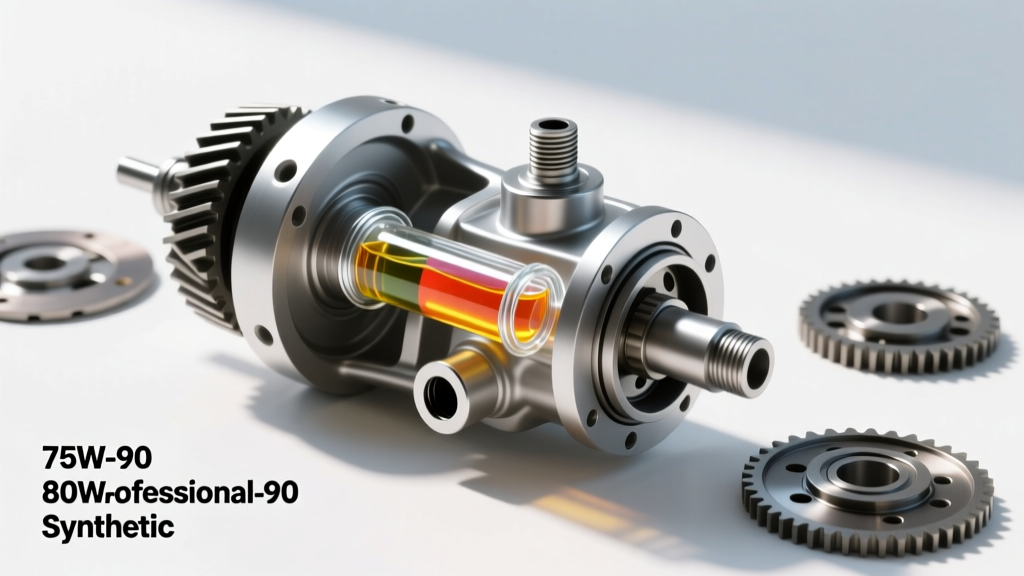
| 75W-90 | 13.5 - 18.4 | The global standard for most light-duty 4x4 front axles | Very Good (down to -40°C) |
| 80W-90 | 13.5 - 18.4 | Older solid-axle trucks, heavy towing, warmer climates | Poor (thickens below -26°C) |
| 75W-140 | 24.0 - 32.4 | Severe-duty off-roading, high-shock rock crawling | Good (down to -40°C) |
Expert Insight: Do not blindly upsize to 75W-140 for 'extra protection' in a daily-driven front differential. The thicker fluid increases parasitic drag, reduces fuel economy, and runs significantly hotter in light-load IFS applications due to fluid churning.
Synthetic vs. Conventional: The KRL Shear Stability Test
When shopping for your front differential fluid service, you will face a price gap: conventional 80W-90 costs roughly $8-$12 per quart, while full synthetic 75W-90 ranges from $16-$24 per quart. The justification for synthetic lies in shear stability, measured by the CEC L-45-99 KRL tapered roller bearing test.
In the KRL test, gear oil is subjected to 20 hours of extreme mechanical shearing. Cheap conventional gear oils can lose up to 15% of their original viscosity, effectively turning a 90-weight oil into an 80-weight oil after just 15,000 miles. Premium synthetics (like Amsoil Severe Gear or Red Line) utilize polyalphaolefin (PAO) and ester base stocks that typically experience less than 3% viscosity loss. Given that front differential capacities are notoriously small (often under 2 quarts), the fluid degrades faster than in a high-capacity rear axle. Synthetic is highly recommended to maintain the hydrodynamic film between the ring and pinion gears.
The Limited-Slip Dilemma: Friction Modifiers Explained
If your front axle is equipped with a clutch-type limited-slip differential (LSD), such as the Auburn Pro-Series or the classic Ford 8.8 Trac-Lok, the fluid choice becomes more complex. Clutch packs require a specific coefficient of friction to engage smoothly without chattering during tight turns.
- Pre-Blended 'LS' Fluids: Products like Mobil 1 Synthetic Gear Lube LS 75W-90 (Part # 104361) contain friction modifiers right out of the bottle. However, the exact concentration is a trade secret and may not perfectly match your specific clutch pack's requirements.
- Base Synthetic + Additive: Professional drivetrain builders prefer using a standard synthetic GL-5 (like Red Line 75W90 NS) and adding a precise dose of friction modifier (e.g., Red Line 80302 or Motorcraft XL-3) incrementally during the fill process.
- Helical/Torsen LSDs: If your front diff uses a gear-based LSD like the Eaton Detroit Truetrac, do not use friction modifiers. These units rely on the natural friction of standard GL-5 gear oil to generate torque bias.
Real-World Application Guide: Capacities and Torque Specs
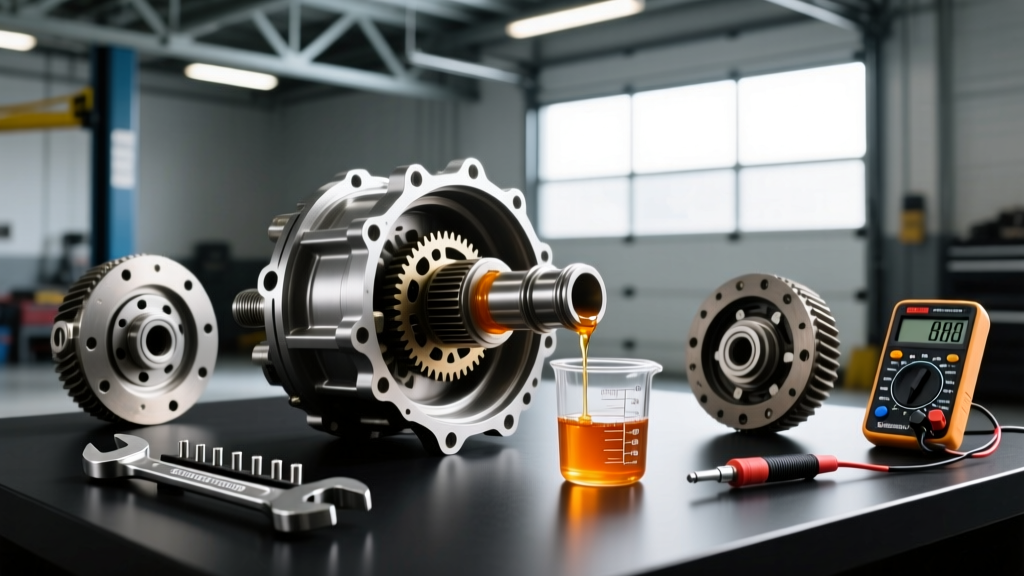
A successful front differential fluid service requires precision during the refill process. Overfilling can blow out axle seals due to thermal expansion, while underfilling starves the pinion bearings. Below is a reference matrix for popular 4x4 platforms.
| Vehicle Platform | Front Axle Type | Fluid Capacity | OEM Spec / Recommended Viscosity | Fill Plug Torque |
|---|---|---|---|---|
| Jeep Wrangler JL (2018+) | Dana 44 M210 (Solid) | 2.0 Pints (0.95L) | API GL-5 75W-85 / 80W-90 | 25 ft-lbs (34 Nm) |
| Toyota Tacoma (2016-2023) | 8-inch IFS | 1.6 Pints (0.75L) | API GL-5 75W-85 | 29 ft-lbs (39 Nm) |
| Ford F-150 (2015-2024) | 9.75-inch IFS | 2.4 Pints (1.13L) | API GL-5 75W-140 (Severe) / 80W-90 | 35 ft-lbs (47 Nm) |
| Ram 2500 (2014+) | AAM 9.25 (Solid) | 2.7 Pints (1.27L) | API GL-5 75W-90 Synthetic | 25 ft-lbs (34 Nm) |
2026 Buyer's Checklist for Your Fluid Purchase
Before heading to the parts counter or checking out online, run through this rapid diagnostic checklist to ensure you buy the exact right products for your front differential fluid service:
- Verify the Axle Model: Do not rely solely on the vehicle year/make/model. Use your VIN to confirm the exact front axle manufacturer (e.g., Dana, AAM, Spicer) and ring gear diameter.
- Identify the LSD Type: Check your glovebox for the axle code tag or spin the front wheels to determine if you have an open, clutch-type, or helical LSD. Buy friction modifier (approx. $8-$12 per bottle) only if required.
- Check for Integrated Hubs: Some older IFS setups require the differential fluid to lubricate the inner CV joints and axle disconnects. Ensure your chosen GL-5 fluid is compatible with these specific metallurgies.
- Buy New Crush Washers: Never reuse copper or aluminum crush washers on differential fill/drain plugs. A pack of OEM M14/M18 drain plug gaskets costs less than $5 and prevents micro-leaks.
- Invest in a Pump: Front differential fill plugs are often located in tight, upward-facing positions near the engine skid plate. A $12 manual fluid transfer pump is mandatory to avoid spilling gear oil on your exhaust components.
For further technical reading on gear lubricant formulations and extreme pressure testing methodologies, refer to the Red Line Oil Technical Information Database and the API Lubricants Certification Program. Proper fluid selection is the cheapest insurance policy you can buy for your front drivetrain.