The Reality of Ford DCT Slip: Dry vs. Wet Architectures
When diagnosing a slipping Ford twin clutch transmission, technicians and owners often mistakenly condemn the clutch packs immediately. However, understanding the root cause of slip requires distinguishing between Ford's two primary DCT architectures: the dry-clutch DPS6 (6DCT250) found in millions of Focus and Fiesta models, and the wet-clutch systems like the Getrag 7DCT300 and the Tremec TR-9077 used in high-performance applications like the Shelby GT500. As of 2026, the aging fleet of dry DCTs is experiencing severe actuator-related slip, while wet DCTs are primarily suffering from fluid shear and clutch glazing due to deferred maintenance.
Slipping in a dual-clutch system is defined as a discrepancy between engine RPM and transmission input shaft speed. Unlike traditional torque converter automatics, DCTs rely on precise hydraulic or electromechanical clamping force. When that force degrades, or when the Transmission Control Module (TCM) loses its physical reference points, slip occurs. This preventive maintenance guide will walk you through exact diagnostic procedures, fluid protocols, and mechanical interventions required to stop slip before it destroys the dual-mass flywheel (DMF).
Pinpointing the Slip: FORScan PID Diagnostics
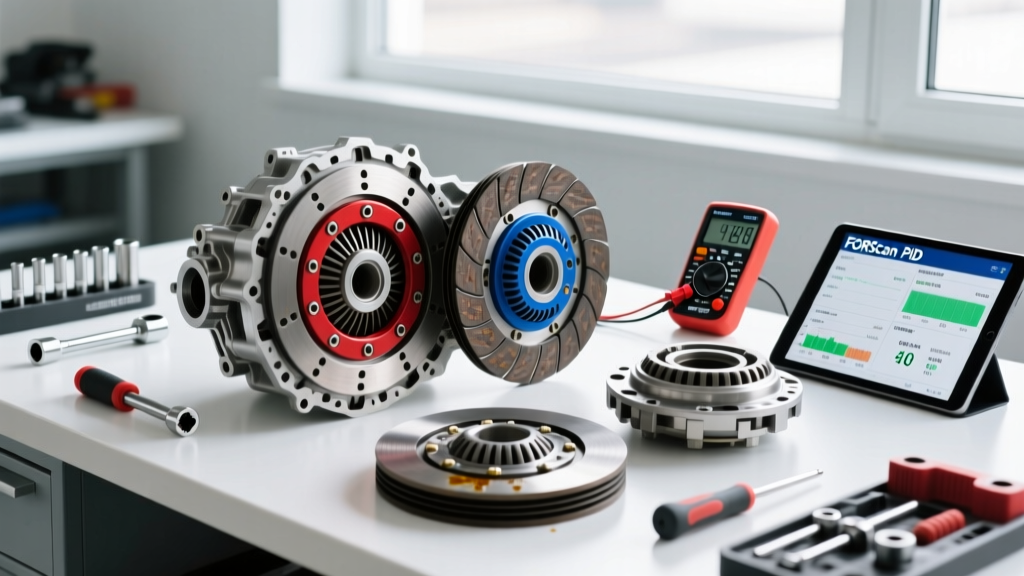
Before dropping the transmission, you must quantify the slip. Relying on 'seat-of-the-pants' feel is insufficient for modern DCTs. Using an OBD-II adapter and the FORScan Community Forums recommended software, you can access the TCM's internal slip calculations.
Reading the Clutch Slip PIDs
- CLTCH_A_SLIP & CLTCH_B_SLIP: These Parameter IDs (PIDs) calculate the real-time difference between engine speed and the calculated input shaft speed based on the engaged gear ratio.
- Acceptable Baseline: Under steady-state load (e.g., 65 MPH in 6th gear, 15% throttle position), slip should read between 0 and 15 RPM.
- Failure Threshold: If you observe slip exceeding 45-50 RPM consistently under load, the friction material is worn, or the hydraulic actuator is bypassing fluid internally.
- CLTCH_A_TOUCH_PT & CLTCH_B_TOUCH_PT: Monitor the touch-point adaptation values. If the touch-point position has drifted beyond 14.5mm (on the DPS6), the TCM has exhausted its software compensation limits, resulting in physical slip during gear changes.
The Hidden Culprit: Clutch Dust and Actuator Binding
For the dry DPS6 (6DCT250) transmission, the most common cause of artificial slip and severe shudder is not worn clutches, but clutch dust contamination. The dry Kevlar and ceramic friction materials shed microscopic dust during normal operation. Over 40,000 miles, this dust migrates past the input shaft seals and coats the shift drum actuators and clutch levers.
When the actuators become caked in this abrasive dust, they bind. The TCM interprets this mechanical binding as a 'soft' clutch and pulls the actuator back prematurely to prevent stalling, resulting in a lack of clamping force and immediate RPM flare (slip) upon acceleration.
Master Tech Preventive Tip: Every 30,000 miles, remove the lower black plastic inspection cover on the DPS6 bell housing. Use a specialized vacuum and low-pressure compressed air to extract clutch dust from the actuator cavity. This single 20-minute preventive step can extend the life of the clutch actuators (Part # AE8Z-7B122-A) by over 60,000 miles.
Preventive Maintenance Matrix: Fluids and Intervals
Wet twin-clutch systems rely entirely on specialized fluid for both hydraulic actuation and clutch pack cooling. Using incorrect fluid or exceeding service intervals leads to a breakdown in the friction modifiers, causing the clutch packs to glaze and slip under high torque loads. Below is the definitive 2026 maintenance matrix for Ford's DCT lineup.
| Transmission Model | Architecture | Factory Fluid Specification | Capacity | Preventive Interval |
|---|---|---|---|---|
| DPS6 (6DCT250) | Dry Clutch | Motorcraft Dual Clutch (WSS-M2C200-D2) | 1.9 Liters (Gear Oil Only) | 37,500 Miles |
| 7DCT300 (Getrag) | Wet Clutch | FFL-4 / Motorcraft Equivalent | 4.2 Liters | 60,000 Miles |
| TR-9077 (Tremec) | Wet Clutch | Tremec DCT Fluid / Motorcraft | 7.5 Liters | 30k (Track) / 60k (Street) |
Note: For the dry DPS6, the gear oil only lubricates the helical cut gears and differential bearings. It does not touch the clutches. However, if the input shaft seals leak, gear oil will contaminate the dry clutches, causing catastrophic, unrecoverable slip. Always inspect the weep hole between the engine and transmission for gear oil drips during routine service.
Hard Part Replacement: When Adaptation Fails
If your FORScan diagnostics confirm touch-point limits have been exceeded, or if physical inspection reveals oil contamination on the dry clutch packs, preventive maintenance transitions into hard-part replacement. Sourcing OEM or high-quality aftermarket components is critical, as cheap friction materials will shatter under the aggressive torque management of Ford's TCM.
Crucial Torque Specifications and Reassembly
Improper torque during DCT reassembly guarantees immediate slip and vibration. The clamping load must be perfectly distributed across the dual-mass flywheel. When replacing the clutch kit (e.g., Motorcraft Part # AE8Z-7540-A or equivalent LuK RepSet), adhere strictly to these specifications:
- Dual Mass Flywheel to Crankshaft: 90 Nm (66 lb-ft) plus an additional 90-degree turn. Always use new, oiled torque-to-yield bolts.
- Clutch Pressure Plate to Flywheel: 25 Nm (18 lb-ft). Tighten in a strict crisscross star pattern to prevent warping the diaphragm spring, which causes localized slip.
- Actuator to Bell Housing: 10 Nm (89 lb-in). Over-torquing these small bolts will distort the actuator housing and bind the internal sweep motor.
- Input Shaft Alignment: Use the OEM alignment tool (Ford part # 308-D121). Forcing the transmission onto the engine without the tool will chip the friction material on the clutch splines, leading to immediate engagement slip.
The TCM Relearn Protocol
Replacing the hardware is only half the battle. Once the new clutches are installed, the TCM must be forced to relearn the physical touch-points. Using FORScan or the Ford Integrated Diagnostic System (IDS), initiate the Clutch Touch-Point Adaptation routine. This process requires the vehicle to be lifted with the drive wheels free to spin. The TCM will slowly engage the clutches against the engine's idle torque to map the exact millimeter where friction begins. Skipping this step will result in the TCM applying excessive clamping force, burning up the new clutches within 5,000 miles.
Expert Verdict on DCT Longevity
The Ford twin clutch transmission is a marvel of shift-speed engineering, but it demands rigorous adherence to preventive maintenance. By monitoring slip PIDs via FORScan, executing regular clutch dust extractions on dry models, and strictly observing fluid intervals on wet models like the Tremec TR-9077, you can easily push these units past 150,000 miles. Never ignore early RPM flares; in a DCT, a 50-RPM slip today is a $2,500 dual-mass flywheel and clutch replacement tomorrow. Stay proactive, use Motorcraft Official Site approved fluids, and respect the precise torque specs that govern these high-tolerance systems.