The Ford 9.75 Axle: Why the Cover and Fluid Matter
The Ford 9.75-inch rear axle, commonly found in 2015 and newer F-150s equipped with the Max Trailer Tow Package, as well as modern Expeditions, is a formidable piece of engineering. Featuring a massive 9.75-inch ring gear and a 10-bolt cover pattern, this axle is designed to handle the immense low-end torque generated by the 3.5L EcoBoost V6 and the 5.0L Coyote V8. However, when subjected to sustained heavy towing, steep grades, or high-speed highway cruising with a 7,000-pound trailer, the differential generates tremendous thermal energy.
Heat is the primary enemy of gear oil. As differential temperatures climb past 220°F, conventional and lower-tier synthetic fluids begin to experience shear breakdown, leading to accelerated wear on the hypoid ring and pinion gears. This is where a strategic hardware upgrade meets precise fluid chemistry. Pairing an aftermarket Ford 9.75 differential cover with the exact OEM-specified synthetic gear oil is not just a maintenance task; it is a critical drivetrain preservation strategy for 2026 and beyond.
Buyer's Guide: Top Ford 9.75 Differential Covers
Before we dive into the fluid specifications, selecting the right housing is paramount. The factory stamped-steel cover is prone to flexing under impact and offers minimal surface area for heat dissipation. Upgrading to a finned, cast-aluminum or heavy-duty cast-iron cover increases fluid capacity and acts as a passive heat sink.
1. Mag-Hytec Cast Aluminum Cover (Premium Heavy-Duty)
Mag-Hytec remains the gold standard for differential cover upgrades. Their Ford 9.75-inch model features deep cooling fins, a magnetic drain plug to capture ferrous metal shavings, and a dipstick for precise fluid level measurement. The cast aluminum construction sheds heat significantly faster than stamped steel. Expect to pay between $160 and $190 for this unit. It typically adds about 1.5 quarts of additional fluid capacity, bringing the total system volume to roughly 3.5 quarts, which drastically increases the thermal mass of the axle.
2. PPE (Pacific Performance Engineering) Nodular Iron Cover
For those who frequently traverse rocky, off-road terrain where rock strikes are a genuine threat to the differential housing, PPE offers a nodular cast-iron alternative. While it does not shed heat quite as efficiently as aluminum, its sheer structural rigidity and impact resistance are unmatched. Priced around $140 to $170, it includes a brass fill plug and maintains a near-stock fluid capacity while offering immense physical protection.
Decoding Differential Fluid Types and Specifications
Choosing the right differential fluid requires understanding both viscosity grades and the chemical additive packages designed for hypoid gear sets. The Ford 9.75 axle utilizes hypoid gears, where the pinion gear intersects the ring gear below the centerline. This geometry creates a high-sliding friction environment that demands Extreme Pressure (EP) additives.
Viscosity Grades: 75W-85 vs. 75W-90 vs. 75W-140
Ford's factory fill for many modern F-150s is a 75W-85 synthetic gear oil. This lower-viscosity fluid was selected primarily to reduce parasitic drivetrain drag and meet strict CAFE (Corporate Average Fuel Economy) standards. While excellent for daily driving and light loads, 75W-85 can thin out excessively under severe towing conditions.
For owners who regularly tow heavy trailers, upgrade to a 75W-90 or 75W-140 full synthetic. The 75W-140 viscosity maintains a thicker hydrodynamic lubricating film at high temperatures, protecting the gear teeth from micro-pitting and spalling. According to the API Service Classifications, you must ensure the fluid meets the API GL-5 specification, which guarantees the presence of sulfur-phosphorus EP additives necessary to prevent weld-spotting on the gear faces under extreme shock loads.
The Chemistry of API GL-5 and Yellow Metals
It is vital to note that GL-5 fluids contain active sulfur compounds that can corrode yellow metals (brass, bronze, copper). While the Ford 9.75 differential does not use yellow metal synchronizers or bushings inside the differential carrier itself, you must never use GL-5 fluid in a manual transfer case or transmission that requires GL-4. Always verify that your chosen 75W-140 or 75W-90 gear oil explicitly states it is safe for hypoid differentials and meets Ford's WSL-M2C192-A (for 75W-140) or WSS-M2C942-A (for 75W-85) specifications.
Fluid Specification Table & Ford OEM Part Numbers
To eliminate guesswork, refer to the table below for the exact Motorcraft part numbers and specifications required for the Ford 9.75-inch axle.
| Fluid Type | Ford Specification | Motorcraft Part Number | Best Use Case |
|---|---|---|---|
| 75W-85 Synthetic | WSS-M2C942-A | XY-75W85-QL | Daily driving, fuel economy, light loads |
| 75W-90 Synthetic | WSS-M2C942-A (Alt) | XY-75W90-QL | Mixed use, moderate towing, all-season |
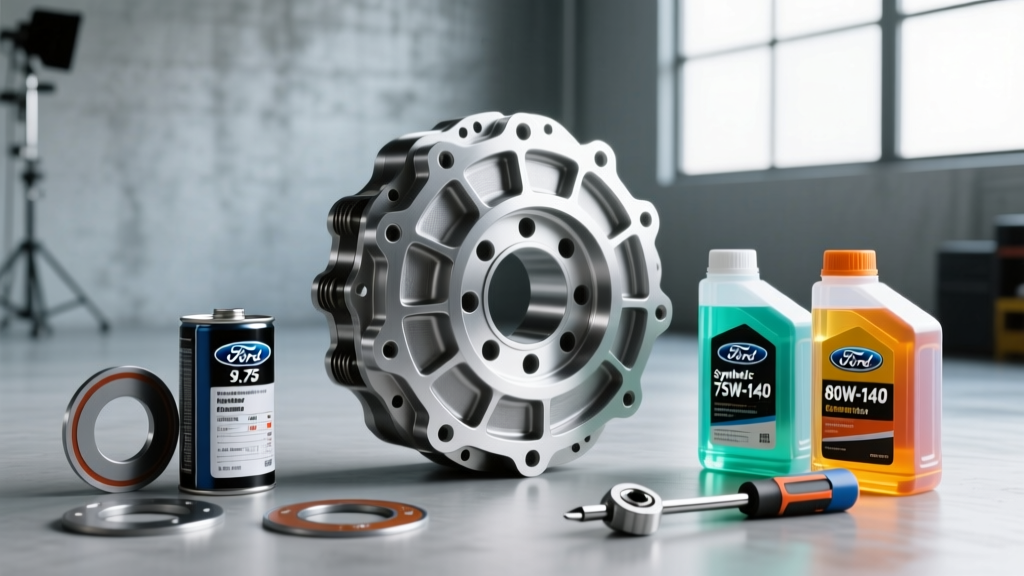
| 75W-140 Synthetic | WSL-M2C192-A | XY-75W140-QL | Heavy towing, 5th wheel, off-road, high heat |
| Friction Modifier | ESTER Based | XL-3 | Required ONLY for clutch-based LSDs |
For more detailed chemical data sheets and OEM recommendations, you can cross-reference the Ford Motorcraft Support portal or consult your specific vehicle's owner manual supplement.
The Limited Slip & Locking Diff Variable: Friction Modifiers
The Ford 9.75 axle is frequently equipped with either an electronic locking differential (e-Locker) or a clutch-based Limited Slip Differential (LSD), such as the Torsen or traditional clutch-pack designs. This distinction dictates whether you need a friction modifier.
- Electronic Locking Differential: If your F-150 has the push-button rear locker, it operates as an open diff until engaged, at which point it mechanically locks the axles together via a dog clutch. No friction modifier is required. Adding it can actually reduce the holding capacity of the internal mechanisms.
- Clutch-Based Limited Slip: If your axle uses a traditional clutch-pack LSD, you must add 4 ounces of Motorcraft XL-3 Friction Modifier. Without it, the clutch packs will chatter and bind during low-speed cornering, causing a noticeable shudder and premature wear to the friction discs.
Step-by-Step Service: Capacities and Torque Specs
When performing a differential fluid service on the 9.75-inch axle, precision in reassembly is just as important as the fluid you pour in. Follow these exact specifications to prevent leaks and hardware failure.
1. Removal and Cleaning
The factory 10-bolt cover is sealed using Ford-specific black RTV silicone, not a pre-cut gasket. Carefully pry the cover off using a flathead screwdriver at the designated notch. Scrape all old RTV from both the axle housing and the cover mating surface using a plastic gasket scraper to avoid gouging the aluminum or steel. Clean both surfaces thoroughly with brake cleaner and allow them to dry completely.
2. Torque Specifications
Whether you are reinstalling the OEM stamped steel cover or bolting on an aftermarket Mag-Hytec Differential Cover, proper torque is critical. Over-torquing can warp the cover or strip the threads in the aluminum axle housing.
- Cover Bolts (10mm / 8mm hex): Torque to 20 lb-ft (27 Nm) in a crisscross star pattern.
- Fill Plug (if equipped): Torque to 20-25 lb-ft. Note that many Ford 9.75 axles do not have a traditional drain plug; the fluid must be extracted via the fill hole using a fluid transfer pump.
- Aftermarket Dipstick/Fill Plug: Hand tighten, then snug to 15 lb-ft. Do not over-torque brass or aluminum plugs.
3. Fill Procedure and Capacity
The stock Ford 9.75 axle holds approximately 2.0 to 2.2 quarts of fluid. If you have installed a deep-sump aftermarket cover, the capacity will increase to between 3.0 and 3.8 quarts. Fill the differential until the fluid level is exactly even with the bottom edge of the fill hole. If using an aftermarket cover with a dipstick, follow the manufacturer's specific cold-fill line markings, as fluid expansion will raise the level once the axle reaches operating temperature.
Summary
Upgrading your Ford 9.75 differential cover and meticulously selecting the correct differential fluid types and specifications is one of the highest-ROI modifications you can perform on a modern F-150 or Expedition. By moving away from the fuel-economy-focused 75W-85 and stepping up to a high-shear 75W-140 synthetic like Motorcraft XY-75W140-QL, and pairing it with a finned aluminum housing, you effectively future-proof your rear axle against the thermal devastation of heavy towing. Always verify your limited-slip requirements, adhere strictly to the 20 lb-ft cover bolt torque spec, and your 9.75-inch axle will deliver hundreds of thousands of miles of reliable, noise-free service.