The Economics of Front Differential Maintenance in 2026
When planning drivetrain maintenance, enthusiasts and daily drivers alike often prioritize the rear differential or the transfer case, leaving the front differential neglected. However, in modern AWD and 4WD systems, the front axle assembly endures immense stress from steering angles, CV joint articulation, and torque vectoring. Modern front differentials, particularly those integrated into transaxles or Power Transfer Units (PTUs) in FWD-based AWD systems like the Ford Explorer or Toyota Highlander, operate in extremely hostile thermal environments. The fluid degrades not just from mechanical shearing of the ring and pinion gears, but from direct proximity to exhaust catalytic converters and engine oil pans.
Understanding the true front differential service cost requires a granular breakdown of labor rates, shop fees, and the vast array of differential oil types available on the market today. In 2026, average dealership labor rates have climbed to between $165 and $215 per hour, while independent 4x4 specialists charge $135 to $175. Because a standard front differential drain and fill is typically billed at 0.5 to 0.8 hours of labor, the shop rate heavily dictates your final invoice. But the fluid itself? That is where you can either save money or invest in long-term axle longevity.
Comparing Differential Oil Types: Price vs. Performance
Not all gear oils are created equal. The American Petroleum Institute (API) classifies gear oils into distinct service categories, with GL-4 and GL-5 being the most relevant for automotive axles. It is crucial to note that API GL-5 fluids contain high levels of sulfur-phosphorus extreme pressure (EP) additives. While these additives are essential for protecting the hypoid gear sets found in most front and rear axles, they can be corrosive to yellow metals (like bronze bushings or shift forks) if used in applications specifically requiring GL-4. Always verify your owner's manual before substituting oil types.
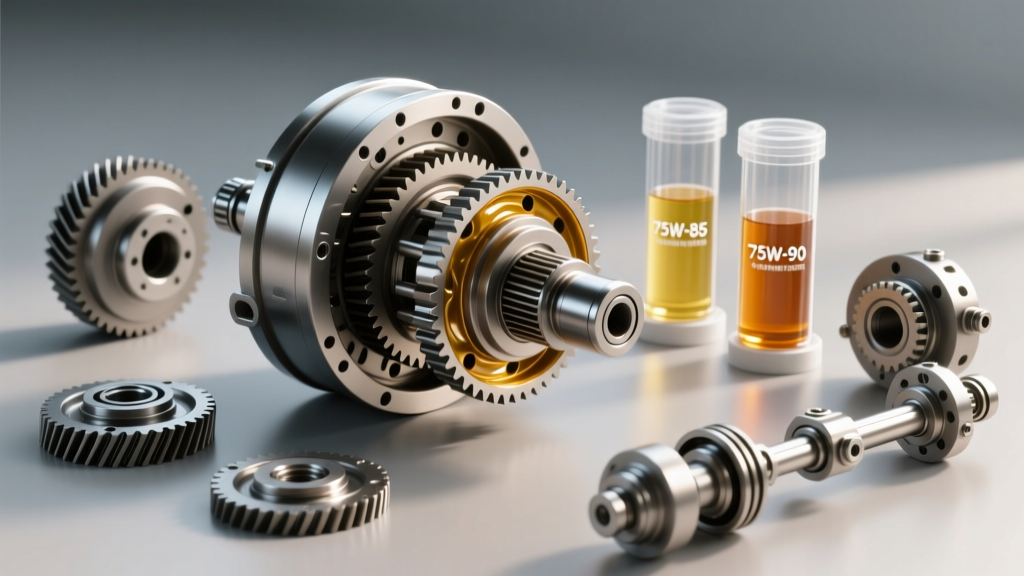
| Differential Oil Type | Viscosity | Avg. Price (Per Quart) | Base Stock | Recommended Interval |
|---|---|---|---|---|
| Conventional Mineral | 80W-90 GL-5 | $7.00 - $9.50 | Petroleum | 30,000 Miles |
| Synthetic Blend | 75W-90 GL-5 | $10.00 - $13.00 | Group II/III Mix | 45,000 Miles |
| Full Synthetic (Standard) | 75W-90 GL-5 | $14.00 - $18.00 | Group IV/V (PAO/Ester) | 60,000+ Miles |
| Heavy Duty Synthetic | 75W-140 GL-5 | $18.00 - $24.00 | Group IV/V (PAO/Ester) | 60,000+ Miles (Towing) |
| OEM Specialty (e.g., Honda/Toyota) | Proprietary | $22.00 - $35.00 | Specialty Additive Pack | As Specified by OEM |
For high-torque applications, full synthetics like Mobil 1 Synthetic Gear Lube LS 75W-90 offer superior shear stability and cold-weather flow. The PAO (Polyalphaolefin) base stocks resist thermal breakdown far better than conventional petroleum oils, maintaining a protective hydrodynamic film even when the differential housing exceeds 220°F.
Vehicle-Specific Front Diff Service Cost Scenarios
To provide actionable data, let us break down the exact costs, capacities, and torque specifications for three of the most common AWD and 4WD platforms on the road.
1. Subaru WRX / Outback (Continuous Symmetrical AWD)
- Fluid Capacity: 1.2L to 1.7L (varies by generation; 2015+ WRX uses ~1.2L, older models up to 1.7L).
- Fluid Spec: 75W-90 GL-5 Gear Oil.
- Torque Specs: Drain plug and fill plug both require 33 lb-ft (45 Nm).
- Hidden Cost: Subaru requires specific aluminum crush washers (Part #803918060 for drain, #803926090 for fill). Reusing old washers leads to seepage and eventual gear whine from low fluid levels. Cost: ~$3.50 per washer at the dealer.
- Total DIY Cost: ~$35 (Fluid + Washers).
- Dealership Cost: ~$180 - $240.
2. Ford F-150 (4WD Independent Front Suspension)
- Fluid Capacity: ~1.5L to 1.8L (varies by 8.8 or 9.75 ring gear size).
- Fluid Spec: 75W-140 Synthetic for heavy towing; 75W-90 for standard duty.
- Torque Specs: Fill plug typically 22 lb-ft; Drain plug 25 lb-ft.
- Hidden Cost: If equipped with a clutch-type Limited Slip Differential (LSD), you must add Ford XL-3 Friction Modifier Additive (~$9.00). Failure to do so results in aggressive chatter during low-speed turns. The 9.75-inch ring gear found in heavy-duty tow packages generates immense frictional heat; conventional oil will rapidly oxidize at sustained temperatures above 250°F, leading to accelerated wear on the 8620 steel pinion bearings.
- Total DIY Cost: ~$55 (Synthetic 75W-140 + Additive).
- Dealership Cost: ~$220 - $290.
3. Jeep Wrangler JL (Dana 30 / M210 Front Axle)
- Fluid Capacity: 1.2L (2.5 pints).
- Fluid Spec: 75W-140 Synthetic API GL-5.
- Torque Specs: Fill and drain plugs require 25 lb-ft.
- Hidden Cost: Many JL front diffs lack a traditional drain plug, requiring fluid extraction via a pump through the fill hole, or removing the differential cover. If removing the cover, you need a new gasket or RTV silicone and brake cleaner to prep the mating surface.
- Total DIY Cost: ~$45 (Fluid + RTV/Cleaner).
- Independent Shop Cost: ~$160 - $210.
The Hidden Costs: Additives, Gaskets, and Fluid Analysis
When budgeting for a front differential service, the price of the differential oil types you select is only part of the equation. Shops bake these ancillary costs into their flat-rate manuals, but DIYers often forget them until the truck is already on the lift.
- Limited Slip Additives: Clutch-type LSDs require friction modifiers to allow the clutches to slip smoothly during cornering. A 4oz bottle of Red Line Limited Slip Friction Modifier costs around $11.00. Without it, the clutches will bind, shudder, and eventually destroy the cross-pins.
- RTV Silicone vs. Paper Gaskets: If your front differential requires cover removal (common on older GM 8.25-inch IFS or Dana 30 axles), never reuse the old gasket. A tube of Permatex Ultra Black (Part #81170) costs $8.50 and provides a superior seal to cheap cork gaskets, which tend to split under torque and contaminate the gear oil with dirt and moisture.
- Fluid Transfer Pumps: Because front differentials are tucked high up in the chassis near the engine crossmember, gravity draining into a pan is rarely possible. A high-quality pneumatic or manual fluid transfer pump is a mandatory one-time investment ($35-$50) for DIYers.
- Thermal Degradation and Fluid Analysis: Over time, the sulfur-phosphorus EP additive package in GL-5 gear oil becomes depleted due to continuous heat cycling. This is why drained differential fluid often smells sharply of burnt sulfur and appears opaque black rather than its original honey hue. If you are pushing your vehicle on the track or towing heavy loads, consider sending a $35 sample to a lab like Blackstone Laboratories to check for iron and copper particulates before committing to a full rebuild.
DIY vs. Dealership: Where is the Break-Even Point?
If you are running a standard AWD crossover, the front differential is often integrated into the transaxle or sits in a tightly packaged subframe. Accessing the fill and drain plugs can require removing skid plates, sway bar end links, or even lowering the subframe. In these scenarios, the 0.8 to 1.2 hours of shop labor is entirely justified, and paying the $200+ dealership fee is a worthwhile trade-off for saved time and guaranteed proper torque application.
Conversely, if you drive a body-on-frame truck or a dedicated off-roader, the front differential is highly accessible. Spending 45 minutes in your driveway to swap out $40 worth of full-synthetic gear oil yields an immediate return on investment. According to drivetrain specialists at Red Line Oil, changing synthetic gear oil before it loses its extreme pressure additive efficacy can extend ring and pinion life by over 40%, effectively saving you from a $2,500+ differential rebuild down the road.
Final Verdict on Front Axle Maintenance
Ignoring the front differential is a costly gamble. By understanding the specific capacities, torque specifications, and the financial differences between various differential oil types, you can accurately forecast your maintenance budget. Whether you opt for a budget-friendly 80W-90 conventional oil for a leased commuter car or invest in a $20-a-quart ester-based 75W-140 synthetic for your tow rig, the most critical factor is adherence to the service interval. Protect your ring and pinion gears, and they will protect your wallet.