The Anatomy of Intermittent DPS6 Failures
The Ford Focus dual clutch transmission, officially designated as the Getrag 6DCT250 (Ford service code DPS6), remains one of the most heavily scrutinized drivetrains in modern automotive history. While Ford's extended Customer Satisfaction Programs (like 14N01 and 19N01) provided temporary relief for owners, as of 2026, the vast majority of these vehicles are now entirely out of warranty. This shifts the burden of repair and accurate diagnosis to independent transmission specialists and DIY enthusiasts.
Unlike wet dual-clutch systems that rely on pressurized hydraulic fluid for cooling and actuation, the DPS6 is a dry dual-clutch system. It utilizes electric motors and gear-reduction mechanisms to actuate the clutch levers, making it fundamentally closer to an automated manual transmission than a traditional torque-converter automatic. The most frustrating aspect of the DPS6 is its intermittent failure mode. A vehicle may exhibit violent shuddering on cold starts, only to drive perfectly once warmed up, or it may drop into a false neutral on inclines but function normally on flat surfaces. Diagnosing these intermittent clutch problems requires moving beyond generic OBD2 scanners and understanding the thermal and vibrational triggers of the DPS6's electromechanical components.
Step 1: Thermal vs. Vibrational Fault Isolation
Intermittent shudder and hesitation in the Ford Focus dual clutch transmission are rarely random; they are dictated by thermodynamics and harmonic resonance. Before turning a wrench, you must categorize the intermittency using advanced PID (Parameter Identification) data logging. We highly recommend utilizing FORScan, as generic scan tools cannot access the DPS6's proprietary clutch pressure and actuator duty cycle PIDs.
Critical PIDs to Monitor
- CLTCH_A_ACT_DUTY & CLTCH_B_ACT_DUTY: Monitors the PWM (Pulse Width Modulation) signal sent to the clutch actuator motors. If you see erratic spikes in duty cycle correlating with shudder, the TCM is desperately trying to compensate for a slipping clutch or a binding actuator lever.
- TCM_TEMP: The Transmission Control Module is mounted directly to the transmission case. If intermittent faults only occur when TCM_TEMP exceeds 185°F (85°C), you are likely dealing with thermal expansion issues inside the TCM's solder joints.
- CLTCH_A_TOQ & CLTCH_B_TOQ: Calculated clutch torque. A sudden drop to zero while the engine is under load indicates an intermittent loss of clutch clamp force, often caused by clutch dust buildup or a failing actuator motor brush.
Step 2: Electric Actuator Motor Diagnostics
A massive misconception among general mechanics is that the DPS6 uses hydraulic slave cylinders. It does not. It uses two external electric clutch actuator motors (often referred to as Clutch Actuator A and B). Intermittent 'ghost shifting' or failure to engage 1st gear is frequently caused by carbon brush wear inside these electric motors.
When the motor heats up, the internal components expand. If the carbon brushes are worn down to their limits, this thermal expansion can cause the brush to lose physical contact with the commutator, resulting in an open circuit. The TCM instantly detects this and triggers codes like P090C (Clutch Actuator 'A' Control Circuit Low) or P090D (Clutch Actuator 'B' Control Circuit Low). Because the circuit closes again once the motor cools and contracts, the problem appears entirely intermittent.
Testing Actuator Resistance
- Disconnect the 12-pin connector from the suspect actuator motor.
- Set your multimeter to measure Ohms (Ω).
- Probe the motor terminals. A healthy DPS6 clutch actuator motor should read between 2.0 and 4.0 ohms at room temperature.
- The Heat Gun Test: While monitoring the multimeter, apply moderate heat to the actuator casing using a heat gun. If the resistance suddenly spikes to 'OL' (Open Loop) or fluctuates wildly, the internal brushes or windings are failing under thermal load. Replace the actuator.
DPS6 Intermittent Symptom vs. Root Cause Matrix
Use this diagnostic matrix to cross-reference the driver's complaint with the underlying mechanical or electrical fault.
| Intermittent Symptom | Trigger Condition | Probable Root Cause | Diagnostic Action |
|---|---|---|---|
| Violent shudder on takeoff | Cold engine, 1st to 2nd gear | Glazed dry clutch facings or excessive clutch dust | Perform Clutch Touchpoint Relearn; inspect bellhousing for dust. |
| False Neutral / No Drive | Stop-and-go traffic, hot ambient days | Actuator motor thermal open-circuit (brush wear) | Test actuator resistance with heat application; check P090C/P090D. |
| Harsh downshifts & clunking | Random, often over bumps | TCM micro-fracture or loose ground strap | Perform TCM tap-test; inspect chassis-to-transmission ground wire. |
| Hesitation, then sudden engagement | Incline starts or heavy loads | Clutch lever pivot bearing binding | Monitor actuator duty cycle; requires transmission removal to inspect. |
Step 3: TCM Micro-Fracture Identification
The Transmission Control Module on the DPS6 is subjected to extreme vibrational harmonics and heat cycles. Over time, the lead-free solder joints connecting the main microprocessor to the actuator driver circuits develop microscopic fractures. This results in intermittent communication drops between the TCM and the clutch actuators.
The Tap Test: With the engine running and the vehicle in gear (brakes firmly applied, wheels chocked), use the insulated handle of a screwdriver to firmly tap the TCM housing. If the transmission suddenly clunks, shifts, or drops into neutral, you have confirmed a solder joint micro-fracture. According to technical bulletins and long-term reliability data tracked by organizations like the NHTSA, TCM-related electrical faults account for a significant percentage of sudden power-loss complaints in the Focus platform. The only reliable fix is TCM replacement or professional PCB-level micro-soldering repair.
The Clutch Touchpoint Adaptation Procedure
If you have ruled out electrical faults and suspect that intermittent shudder is caused by uneven clutch wear or clutch dust, a software adaptation reset is mandatory. The DPS6 TCM continuously learns the 'touchpoint' (the exact millimeter the clutch begins to transfer torque). If the friction material wears or glazes, the learned touchpoint becomes inaccurate, causing the TCM to slip the clutch excessively during engagement, generating massive heat and shudder.
Relearn Protocol via FORScan:
- Connect to the vehicle and navigate to the TCM Service Functions.
- Select 'Clutch Touchpoint Adaptation' (sometimes labeled as Clutch Learn).
- Ensure the transmission is at operating temperature (above 140°F / 60°C).
- Follow the on-screen prompts. The vehicle will automatically cycle the clutches, producing loud mechanical clunking from the bellhousing. This is normal.
- Once complete, perform a 10-mile drive cycle featuring at least 20 stop-and-go events to allow the TCM to refine the micro-adaptations.
Expert Note: If the Touchpoint Adaptation fails to complete and throws a 'Clutch Stuck' or 'Out of Range' error, the dry clutch pack is mechanically worn past its service limit, or the clutch lever pivot bearings have seized. Software cannot fix mechanical wear.
Hard Parts, Fluids, and Torque Specifications
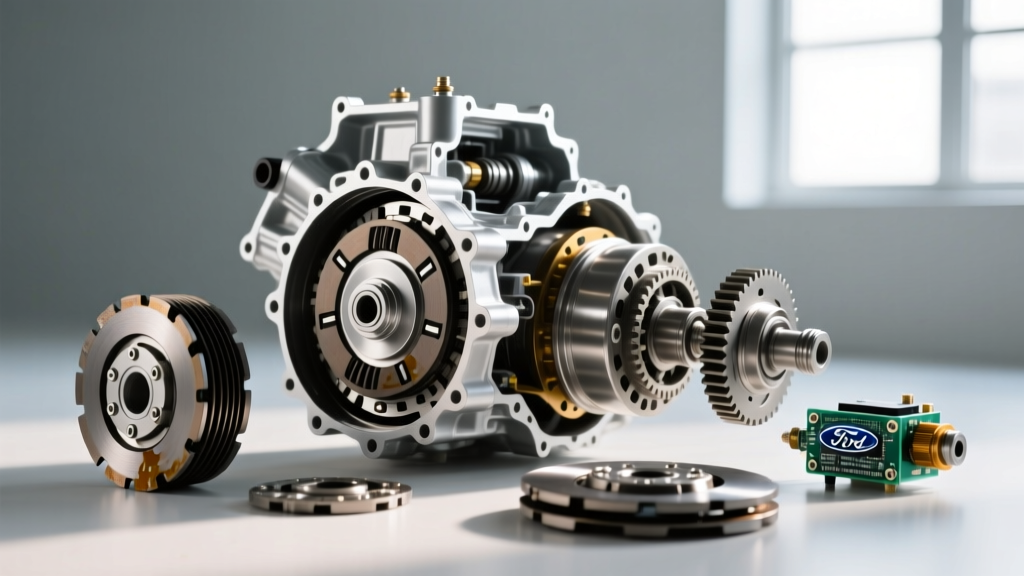
When intermittent diagnosis confirms that the dry clutch assembly requires replacement, precision during reassembly is non-negotiable. The clutches in the Getrag 6DCT250 are aligned using specialized factory tools to ensure the clutch splines mate perfectly with the dual input shafts. Misalignment by even a fraction of a millimeter will cause immediate binding and intermittent engagement faults upon startup.
Essential Part Numbers & Pricing (2026 Estimates)
- Clutch Kit: Motorcraft MC-1500 or LuK RepSet (LuK is the OEM supplier for Schaeffler Group, the parent company of Getrag). Expect to pay between $450 and $650 for a complete kit including the clutch pack, release bearings, and alignment tool. You can verify OEM specifications via Schaeffler's technical portal.
- Clutch Actuator Motors: Motorcraft / Ford OE (AE8Z-7C600-A / B). Roughly $250 to $350 each. Never use cheap aftermarket actuators; their internal gear ratios and brush compositions are notorious for premature failure.
- Transmission Control Module (TCM): AE8Z-7Z490-A (or latest superseded revision). Prices range from $500 to $900. Must be programmed with the vehicle's exact as-built data.
Fluid and Torque Specs
While the clutches are entirely dry, the gearsets and differential require specific lubrication. Using standard manual transmission gear oil will destroy the synchronizers and bearings.
- Fluid: Motorcraft Dual Clutch Transmission Fluid (Xt 11 QDC). Specification: WSS-M2C200-D2.
- Capacity: Exactly 1.9 Liters (2.0 Quarts). Overfilling causes windage and aeration, leading to bearing failure.
- Bellhousing to Engine Block Bolts: M10x1.25, Torque to 35 lb-ft (48 Nm).
- Clutch Actuator Mounting Bolts: M6, Torque to 89 lb-in (10 Nm). Do not overtighten, as the actuator housings are cast aluminum and crack easily.
- Flexplate to Torque Converter (Clutch Housing) Bolts: Torque to 85 lb-ft (115 Nm) using a flywheel holding tool.
Summary of the Diagnostic Approach
Diagnosing intermittent problems in the Ford Focus dual clutch transmission requires a methodical elimination of thermal, electrical, and mechanical variables. By leveraging FORScan to monitor real-time actuator duty cycles, performing thermal stress tests on the electric clutch motors, and understanding the limitations of dry friction materials, you can accurately pinpoint the root cause of shudder and slip. Stop throwing parts at the DPS6 based on generic codes; let the data and the thermodynamics guide your wrench.