The Evolution of the F-150 Rear Axle: Why Fluid Choice Matters
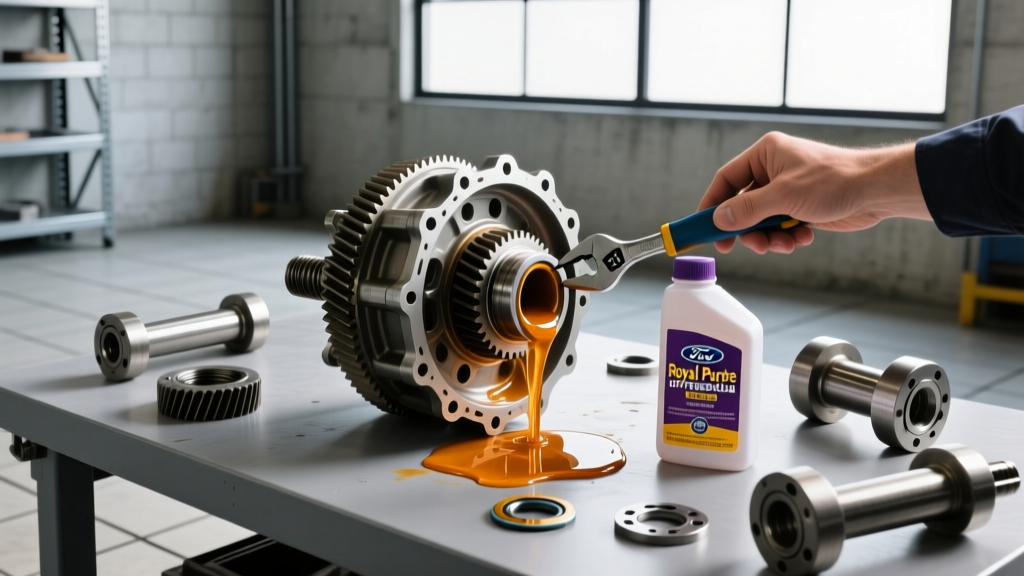
When maintaining the 14th generation (2021–2026) Ford F-150, or servicing older 13th generation models, selecting the correct Ford F150 rear differential fluid type is critical to the longevity of your drivetrain. Modern F-150s feature advanced powertrains, including the 3.5L EcoBoost V6, the 5.0L Coyote V8, and the PowerBoost Full Hybrid systems. However, regardless of what sits under the hood, the rear axle relies on hypoid ring and pinion gears that generate immense sliding friction and shearing forces.
Using the wrong viscosity or failing to meet the API GL-5 specification can lead to accelerated gear wear, clutch-pack chatter in limited-slip differentials, and catastrophic bearing failure under heavy towing loads. In this 2026 buyer’s guide, we break down the exact OEM specifications, compare top-tier synthetic alternatives, and provide the precise torque specs and capacities you need for a flawless differential service.
Decoding the Ford F150 Rear Differential Fluid Type by Axle Model
Ford does not use a single universal rear axle across the F-150 lineup. The required gear oil viscosity changes based on the axle housing size, the gear ratio, and whether the truck is equipped with the Max Trailer Tow Package.
Ford 8.8-Inch and Super 8.8 Axles
The standard 8.8-inch axle (found in older F-150s) and the reinforced "Super 8.8" (standard on most 2021–2026 non-tow package F-150s) are highly efficient, lightweight differentials. For standard duty cycles, Ford specifies a 75W-85 Synthetic Gear Oil. This lower-viscosity fluid reduces parasitic drag, improving fuel economy and reducing operating temperatures during light commuting.
However, if your Super 8.8 is equipped with a higher numerical gear ratio (e.g., 3.55 or 3.73) and you frequently tow near the truck's Gross Combined Weight Rating (GCWR), stepping up to a 75W-140 Synthetic is highly recommended to maintain film strength under extreme heat.
Ford 9.75-Inch and 10.5-Inch Heavy-Duty Axles
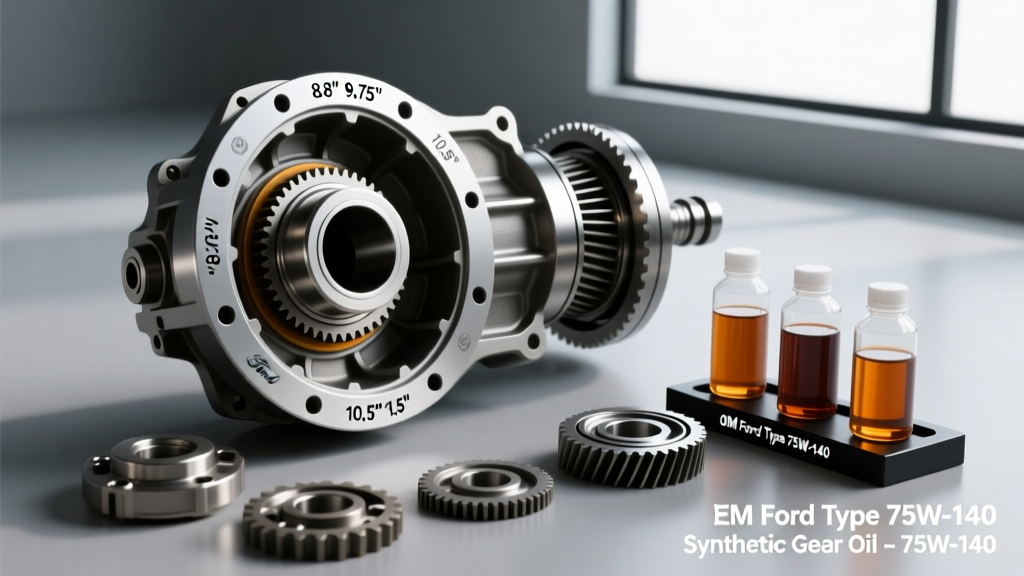
Trucks equipped with the Max Trailer Tow Package, the Heavy-Duty Payload Package, or the 14th Gen 7.3L Megazilla crate engine swaps utilize the massive 9.75-inch or 10.5-inch semi-floating rear axles. These housings contain larger ring gears and bear significantly higher torque loads. Ford strictly mandates a 75W-140 Synthetic Gear Oil for these axles to ensure the lubricant film does not rupture under the immense pressure of the hypoid gear contact patch.
2026 Gear Oil Comparison: OEM vs. Premium Synthetics
While Motorcraft fluids are engineered specifically to Ford's factory tolerances, the aftermarket offers premium synthetic alternatives that boast superior shear stability and extreme-pressure (EP) additives. Below is a comparison of the top contenders for your F-150 rear axle.
| Brand & Product | Viscosity Options | API Rating | Est. Price (Per Qt) | Friction Modifier Included? |
|---|---|---|---|---|
| Motorcraft Synthetic (OEM) | 75W-85, 75W-140 | GL-5 | $12 - $16 | No (Requires XL-3 for LSD) |
| AMSOIL Severe Gear | 75W-90, 75W-110, 75W-140 | GL-5 | $18 - $24 | No (Requires Slip-Lock) |
| Royal Purple Max Gear | 75W-90, 75W-140 | GL-5 | $22 - $28 | Yes (Pre-mixed) |
| Red Line Heavyweight | 75W-140 | GL-5 | $25 - $32 | No (Requires Additive) |
According to the Ford Chemicals and Lubricants Division, Motorcraft fluids are validated against Ford's specific axle seal compatibility standards. However, independent tribology testing consistently shows that premium esters found in AMSOIL Severe Gear and Red Line offer a 15-20% lower coefficient of friction and superior resistance to thermal breakdown at temperatures exceeding 250°F (121°C), which is common when towing heavy campers up mountain grades.
The Limited-Slip Additive: Do You Need Friction Modifier XL-3?
One of the most common mistakes DIYers make when servicing the Ford F150 rear differential fluid type is ignoring the limited-slip differential (LSD) friction modifier requirements. If your F-150 is equipped with an electronic locking rear differential (e-Locker) or a Torsen (Torque-Sensing) helical gear differential, you do not need a friction modifier. These systems rely on gear binding or mechanical torque biasing, not clutch packs.
However, if your truck features a traditional clutch-type Traction-Lok limited-slip differential, you must add a friction modifier. Without it, the clutch packs will grab and release erratically, causing a violent "chatter" or "judder" during low-speed tight turns. Ford's official specification is the Motorcraft XL-3 Friction Modifier (Part # XL-3). You typically need 4 oz (120 ml) per axle, added before filling the rest of the housing with gear oil.
Pro Tip: Royal Purple Max Gear and some specific Valvoline formulations include the friction modifier pre-mixed in the bottle. Always read the label to avoid "double-dosing" the axle, which can cause the clutch packs to slip excessively under heavy acceleration.
Service Data: Capacities, Torque Specs, and Intervals
Precision during the drain and fill process is just as important as the fluid itself. Over-tightening the fill plug can crack the axle housing, while under-tightening the cover bolts will guarantee a slow leak. Below are the exact specifications for the most common F-150 rear axles.
- Ford 8.8 / Super 8.8 Axle
- Fluid Capacity: 3.5 to 4.0 Pints (approx. 1.75 - 2.0 Quarts)
- Cover Bolt Torque: 20 - 25 lb-ft
- Fill Plug Torque: 33 lb-ft (3/8" drive square plug)
- Ford 9.75-Inch Axle
- Fluid Capacity: 4.5 to 5.0 Pints (approx. 2.25 - 2.5 Quarts)
- Cover Bolt Torque: 33 lb-ft
- Fill Plug Torque: 35 lb-ft
- Ford 10.5-Inch Axle
- Fluid Capacity: 5.5 to 6.0 Pints (approx. 2.75 - 3.0 Quarts)
- Cover Bolt Torque: 45 lb-ft
- Fill Plug Torque: 45 lb-ft
Service Intervals: Under Ford's "Normal" driving schedule, the rear differential fluid is considered a "lifetime" fill, meant to last up to 150,000 miles. However, under "Severe" conditions—which includes frequent towing, driving in dusty environments, or extensive idling (common on job sites)—Ford recommends changing the rear axle fluid every 50,000 miles. Given that a DIY fluid change costs between $60 and $120 in materials, compared to $180–$250 at a dealership, adhering to the 50,000-mile severe interval is a highly cost-effective insurance policy for your drivetrain.
Diagnosing Axle Noise: Fluid Shear and Gear Wear
The condition of your differential fluid can tell you a lot about the internal health of your F-150's axle. When draining the old fluid, inspect it carefully:
- Dark, Burnt Smell: Indicates the fluid has exceeded its thermal limits and the EP additives have depleted. The gear oil has sheared, losing its viscosity. A simple fluid change will resolve this if no physical damage has occurred.
- Glitter / Fine Metallic Paste: Normal wear. The magnetic fill plug or cover magnet will catch fine ferrous dust. This is expected on high-mileage trucks.
- Large Metal Chunks or Teeth Fragments: Catastrophic failure. The ring and pinion gear set or carrier bearings are physically disintegrating. A fluid change will not fix this; a complete differential rebuild or axle replacement is required.
If your F-150 exhibits a high-pitched "whine" that changes pitch with vehicle speed (not engine RPM), it is often a sign of pinion bearing wear or improper gear backlash, which degraded fluid cannot mask. Conversely, a "clunk" when shifting from Drive to Reverse usually points to excessive backlash in the ring and pinion or worn axle shaft splines, rather than a fluid issue.
Final Verdict: What Should You Put in Your F-150?
For the daily driver or light-duty commuter with a Super 8.8 axle, sticking to the OEM Motorcraft 75W-85 Synthetic is the most economical and factory-compliant choice. It ensures optimal fuel efficiency and perfectly matches Ford's seal materials.
For F-150 owners who tow heavy trailers, haul payload, or frequently drive in mountainous terrain, upgrading to a premium synthetic like AMSOIL Severe Gear 75W-140 or Red Line 75W-140 provides a massive upgrade in thermal stability and shear resistance. The extra $40 spent on premium gear oil and a high-quality silicone RTV sealant (like Permatex Ultra Black) will pay for itself by extending the life of your 9.75 or 10.5-inch rear axle well past the 200,000-mile mark.