Diagnosing the 9.75-Inch F-150 Rear Axle Leak
As Ford F-150s from the 2015–2020 generation age into 2026, the factory seals on the ubiquitous 9.75-inch semi-floating rear axle are reaching the end of their service life. Whether you are towing heavy trailers or just commuting, a differential leak is a critical failure point that can quickly lead to catastrophic ring and pinion gear failure if fluid levels drop below the pinion bearing centerline. Before ordering parts, you must accurately identify the leak source. The 9.75-inch axle typically leaks from three distinct areas: the pinion seal, the axle shaft seals, or the differential cover RTV seal.
To diagnose, thoroughly degrease the axle housing using brake cleaner and compressed air. Drive the truck for 15 miles and inspect on a lift. If fluid is slung radially from the front yoke and coating the undercarriage, your pinion seal has failed. If fluid is weeping past the brake backing plate and contaminating your rear brake pads, you have a blown axle shaft seal. Finally, if fluid is seeping from the perimeter of the rear cover, the factory RTV has degraded or the cover bolts have lost torque.
Required Parts, Tools, and Fluid Specifications
Successful repair requires OEM-style seals and high-quality synthetic gear oil. Below is the exact bill of materials for a complete 9.75-inch axle reseal and service.
| Component | Part Number / Spec | Estimated Cost (2026) |
|---|---|---|
| Pinion Seal | Motorcraft BR-33 / National 710994 | $18 - $25 |
| Axle Shaft Seals (Pair) | Motorcraft BR-199 / National 710993 | $35 - $45 |
| Gear Oil (3 Quarts) | Royal Purple Max Gear 75W-90 (01300) | $65 - $80 |
| RTV Silicone | Motorcraft TA-32 (Ultra Black) | $12 - $18 |
| Friction Modifier | Motorcraft XL-3 (If Limited Slip Chatters) | $10 - $14 |
Source for OEM part cross-references: RockAuto Catalog.
Pinion Seal Replacement: The Crush Sleeve Warning
Replacing the pinion seal on the F-150 9.75 axle is not as simple as unbolting the yoke and swapping the rubber. The pinion nut secures the yoke against a crush sleeve that sets the bearing preload. If you use an impact gun to remove the nut and blindly torque it back down, you will over-crush the sleeve, resulting in excessive bearing preload, extreme heat generation, and total differential failure within 500 miles.
The Mark-and-Count Method
Since you are only replacing the seal and reusing the existing crush sleeve, you must return the pinion nut to its exact previous depth. Use a paint pen to mark the pinion nut and the yoke threads. Count the exact number of threads exposed past the nut (e.g., 4.5 threads). Use a heavy-duty flange holding tool (such as the OTC 71070) and a 1/2-inch drive torque wrench or breaker bar with a 27mm (1-1/16") socket to break the nut loose.
Once the yoke is pulled with a 3-jaw puller, extract the old seal. Carefully tap the new Motorcraft BR-33 seal into the bore using a seal driver, ensuring it seats perfectly flush. Reinstall the yoke, apply a small bead of RTV to the splines to prevent weeping, and thread the nut back on. Tighten the nut slowly until your paint marks align perfectly and the exact number of threads are exposed. Check the rotational torque using an inch-pound beam torque wrench; it should match your pre-removal reading (typically 15-25 in-lbs for used bearings).
Axle Seal Replacement: Navigating C-Clips and ABS Rings
The 9.75-inch rear axle is a semi-floating design retained by internal C-clips. You cannot simply pull the axle shafts out from the outside. You must open the differential carrier to release them.
- Remove the Cover and Drain: Break the 12 cover bolts loose. Pry the cover off and drain the remaining gear oil into a catch pan. Inspect the fluid for metallic glitter; a fine gray paste is normal wear, but chunky metal indicates internal damage.
- Extract the Center Pin: Rotate the carrier until you can access the center pin lock bolt (typically 8mm or 5/16"). Remove the bolt and slide the cross-shaft center pin out of the carrier.
- Remove the C-Clips: Push the axle shafts inward toward the center of the vehicle. This exposes the C-clips on the inner axle button. Use a small flathead screwdriver or magnetic pick-up tool to extract the C-clips.
- Pull the Axles: Slide the axle shafts out of the housing tubes. Critical Warning: The ABS tone rings are pressed onto the axle shafts near the seal surface. Do not strike the tone rings with a hammer or pry against them, as they are brittle and will crack, triggering an ABS fault code.
- Swap the Seals: Extract the old seals using a blind-hole puller or slide hammer. Lubricate the inner lip of the new Motorcraft BR-199 seals with fresh gear oil and drive them in using a stepped seal driver to prevent cocking the seal in the housing bore.
Refilling with Royal Purple Differential Fluid
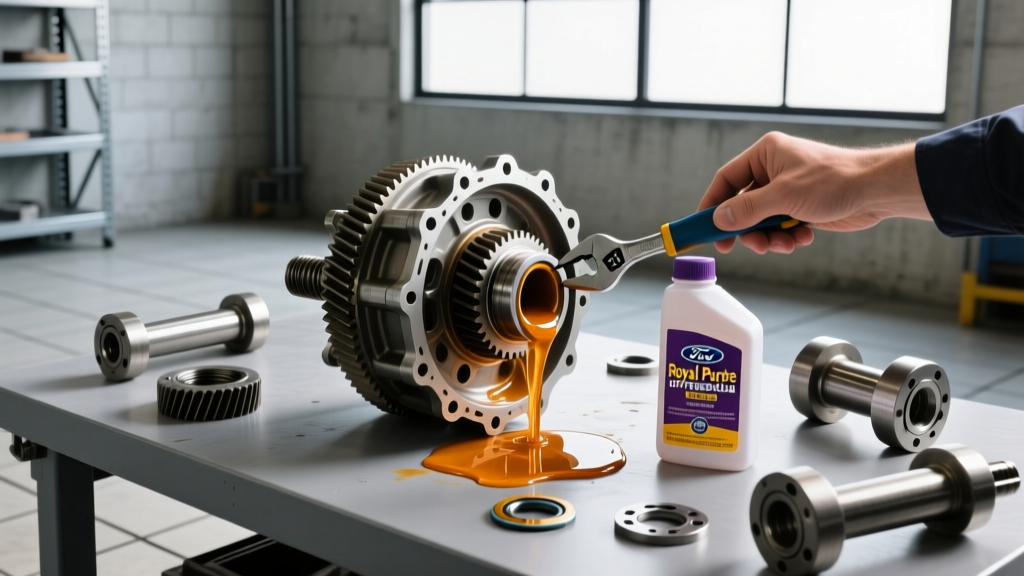
With the seals replaced and the RTV on the differential cover allowed to cure for at least 4 hours, it is time to refill the axle. For this application, we highly recommend Royal Purple Max Gear 75W-90. This synthetic fluid is formulated with Synerlec additive technology, which creates an ionic bond with the metal surfaces of the ring and pinion gears. This drastically reduces friction and operating temperatures, which is especially vital for F-150s equipped with the 3.5L EcoBoost that are frequently used for towing.
The 9.75-inch axle has a dry capacity of approximately 2.4 quarts (2.25 Liters). Always remove the fill plug (located on the upper front or side of the differential housing) before you begin pouring fluid. There is nothing worse than draining an axle, sealing it up, and realizing the fill plug is seized or stripped.
Use a fluid transfer pump to push the Royal Purple 75W-90 into the fill hole until the fluid reaches the bottom edge of the fill plug threads. Reinstall the fill plug and torque it to 22-25 lb-ft.
The Limited-Slip Friction Modifier Debate
Royal Purple officially states that Max Gear already contains the necessary friction modifiers for limited-slip differentials. However, Ford's clutch-type Trac-Lok differentials are notoriously sensitive. In real-world 2026 shop environments, mechanics note that about 20% of F-150s with clutch-type LSDs will exhibit low-speed turning chatter when using fluids that claim to have "pre-mixed" modifiers. If you experience chatter during tight figure-eight turns in a parking lot after the 500-mile break-in period, simply drain 2 ounces of the Royal Purple fluid and add one bottle of Motorcraft XL-3 friction modifier to achieve the perfect clutch slip coefficient.
Final Torque Specifications and Road Test
Before hitting the road, verify all critical fasteners. If you removed the rear brake calipers or rotors to access the axle seals, ensure the caliper bracket bolts are torqued to 150 lb-ft and the rotor set screws are secure. Top off the differential cover bolts to 24-29 lb-ft in a star pattern to ensure even RTV compression.
Drive the truck for 20 miles at highway speeds to bring the axle up to operating temperature. Park over a clean cardboard surface and let it sit overnight. A successful repair using OEM seals and high-film-strength Royal Purple fluid will leave the housing bone-dry, ensuring your F-150's drivetrain is protected for another 100,000 miles of service.