Why Ford Differential Identification Comes First
Before you ever break out the wrenches or order gear oil, accurate Ford differential identification is the most critical step in the maintenance process. Ford has utilized a vast array of axle assemblies across the F-150, Super Duty, Ranger, and Expedition lineups over the last decade. Mistaking a 9.75-inch semi-floating rear end for a 10.5-inch full-floating Sterling axle can lead to purchasing the wrong fluid capacity, missing a hidden drain plug, or applying incorrect torque specifications to the cover bolts.
As we move through the 2026 model year, Ford's drivetrain engineering continues to evolve, but the foundational method for identifying your specific differential remains rooted in the vehicle's Safety Compliance Certification Label (the door jamb sticker) and the physical axle tag. Proper identification dictates your fluid viscosity, limited-slip additive requirements, and exact service intervals.
Decoding Ford Axle Tags and Door Jam Stickers
To perform a proper fluid service, you must first know what you are working on. Open the driver's side door and locate the certification label. Look for the 'AXLE' code. This two-character alphanumeric code tells you the gear ratio and whether the differential is open or equipped with a limited-slip mechanism (Traction-Lok). For deeper technical specs, consult the metal tag bolted to the differential cover or carrier, which provides the exact Ford engineering number and ratio.
Common Ford Rear Axle Codes (2018-2026 F-150 & Super Duty)
| Axle Code | Ratio | Differential Type | Common Application |
|---|---|---|---|
| V2 | 3.31 | Open | F-150 (8.8" / 9.75") |
| B6 | 3.73 | Electronic Locking | F-150 FX4 / Super Duty |
| 3L | 3.55 | Traction-Lok (LSD) | F-150 Max Tow (9.75") |
| C2 | 4.10 | Open | F-250/F-350 (10.5" Sterling) |
| 43 | 4.30 | Electronic Locking | F-350 DRW (Dana 80 / 10.5") |
For comprehensive decoding of vintage and modern Ford axle tags, enthusiast databases like The Ranger Station Ford Axle Tech remain invaluable resources for cross-referencing engineering numbers with physical ring gear diameters.
Factory-Recommended Intervals vs. Real-World Towing
Ford's official owner manuals for many late-model trucks state that the rear axle fluid is 'filled for life' under normal driving conditions, or recommend inspection at 150,000 miles. However, as any seasoned drivetrain specialist will tell you, 'life' usually means the duration of the powertrain warranty. If your truck falls under the 'Severe Duty' or 'Trailer Tow' maintenance schedules, the interval shrinks dramatically.
- Normal Commuting (No Towing): 60,000 to 100,000 miles.
- Frequent Towing / Heavy Payloads: Every 30,000 to 50,000 miles.
- Submersion (Water Crossing): Immediate change required. Water enters through the axle vent tube, emulsifying the gear oil and destroying bearing surfaces within miles.
- Post-Rebuild or Regear: First change at 3,000 miles to remove metallic break-in debris, then resume normal intervals.
Fluid Specifications and Friction Modifier Requirements
Using the correct fluid is non-negotiable. Most modern Ford 8.8-inch and 9.75-inch axles require SAE 75W-140 Synthetic Rear Axle Lubricant (Motorcraft Part #XY-75W140-QL), especially if equipped with the Max Trailer Tow Package. Standard 75W-90 (Motorcraft #XY-75W90-QL) is typically reserved for front axles (like the Dana 60 or Dana 44) or lighter-duty Ranger applications. Always verify via Ford Owner Support Manuals for your specific VIN.
The Limited-Slip Additive Protocol
If your Ford differential identification reveals a Traction-Lok (clutch-type limited-slip) differential, you must add a friction modifier. Without it, the clutch packs will bind during low-speed turns, causing a violent chattering or hopping sensation from the rear end. Motorcraft XL-3 Friction Modifier Additive (EST-M2C118-A) is the OEM standard. Typically, 4 ounces of XL-3 is added per 2 quarts of gear oil. Note: If your truck has an Eaton Detroit Truetrac (gear-biased LSD) or an electronic locking differential, friction modifier is not required and should be omitted.
Step-by-Step Ford Differential Fluid Change Procedure
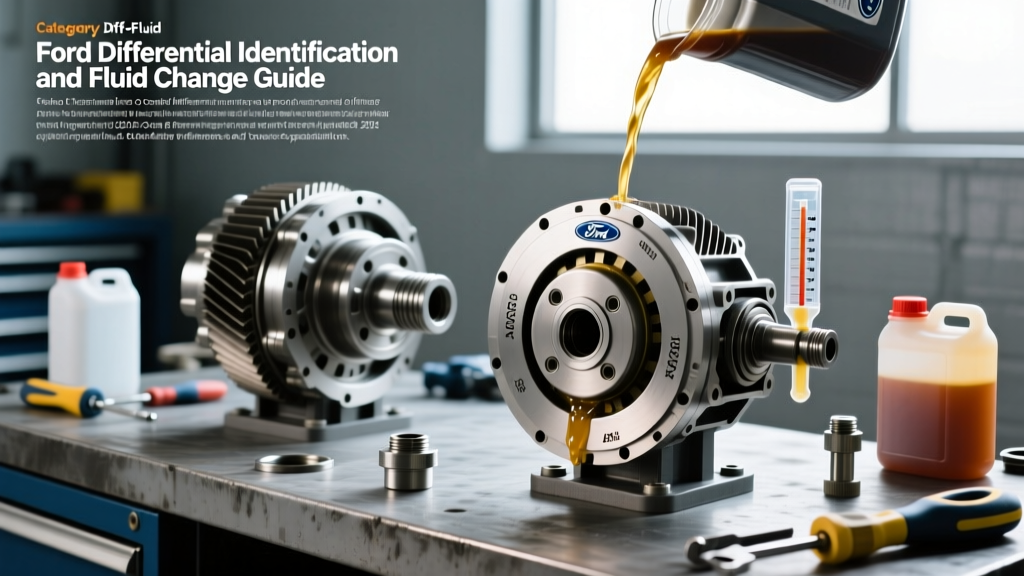
This procedure applies primarily to the ubiquitous Ford 8.8-inch and 9.75-inch rear axles, which utilize a removable cover rather than a dedicated drain plug. (Note: The Super Duty 10.5-inch Sterling axle features a bottom drain plug; simply remove it, drain, and reinstall before removing the fill plug).
Phase 1: Preparation and the Golden Rule
- Lift and Level: Raise the rear of the truck using a floor jack and secure it on jack stands placed under the axle tubes. The differential must be level to ensure an accurate fill volume.
- Remove the Fill Plug FIRST: This is the golden rule of differential service. The fill plug on Ford axles is typically a 3/8-inch drive square hole or a T40 Torx bit. If you remove the cover first and later discover the fill plug is seized or stripped, you are stranded with an open differential and no way to refill it.
Phase 2: Cover Removal and Inspection
- Drain the Fluid: Place a catch pan capable of holding at least 3 quarts beneath the axle. Using a 13mm or 15mm socket (depending on the specific axle year), loosen the bottom cover bolts first to allow the fluid to drain in a controlled stream.
- Remove the Cover: Take out all 10 or 12 cover bolts. Gently pry the cover off using a flathead screwdriver or a specialized gasket scraper. Avoid gouging the mating surface of the axle housing.
- Inspect the Magnet: Ford places a small ring magnet inside the housing. Expect a fine, glitter-like metallic paste on the magnet—this is normal clutch and gear wear. However, if you find large metal chunks, shattered needle bearings, or brass-colored debris, the differential requires a teardown and rebuild.
Phase 3: Cleaning and Sealing
- Prep the Surfaces: Scrape all old RTV silicone from both the cover and the axle housing mating surface. Wipe down with brake cleaner and a lint-free rag. The interior of the axle can be wiped out with a clean rag, but do not spray solvents directly into the carrier bearings.
- Apply RTV Silicone: Apply a continuous 1/4-inch bead of high-temperature RTV silicone (like Permatex Ultra Black or Motorcraft TA-32) to the cover. Circle every bolt hole. Allow the RTV to become tack-free (about 10-15 minutes) before mating the cover to the housing.
Phase 4: Refill and Torque
- Reinstall Cover: Hand-start all bolts to avoid cross-threading. Tighten in a star pattern to the specified torque.
- Pump the Fluid: Using a fluid transfer pump, fill the differential with the correct 75W-140 or 75W-90 synthetic gear oil (mixed with XL-3 if applicable) until the fluid level reaches the absolute bottom lip of the fill hole. Capacity is typically 2.25 to 2.75 quarts for an 8.8-inch, and up to 3.5 quarts for a 9.75-inch.
- Reinstall Fill Plug: Torque the fill plug and wipe away any excess fluid.
Crucial Torque Specifications Reference
Over-torquing differential cover bolts is a common DIY mistake that leads to warped covers, crushed gaskets, and persistent leaks. Always use a calibrated inch-pound or low-range foot-pound torque wrench.
| Axle Type | Component | Torque Specification |
|---|---|---|
| Ford 8.8" | Cover Bolts (10mm/12mm heads) | 28 - 38 lb-ft (Target 33 lb-ft) |
| Ford 8.8" | Fill Plug | 22 - 33 lb-ft |
| Ford 9.75" | Cover Bolts | 33 - 41 lb-ft |
| Ford 10.5" Sterling | Drain / Fill Plugs | 35 - 45 lb-ft |
| Dana 60 (Front) | Cover Bolts | 25 - 35 lb-ft |
Expert Drivetrain Tip: When servicing the front Dana 60 or Dana 44 axles on 4x4 Super Dutys, be aware that the fill plug is often located higher up on the differential housing due to suspension clearance. You may need a specialized angled hose or a flexible fluid pump tube to reach the fill port without making a mess.
Troubleshooting Post-Service Differential Noise
If you complete your Ford differential fluid change and immediately notice a whining or howling noise that wasn't there before, do not panic. Synthetic gear oils have different acoustic damping properties and friction coefficients compared to degraded conventional oils. It is common for the gear mesh to sound slightly louder for the first 500 miles as the new fluid penetrates the micro-pores of the ring and pinion gears.
However, if you experience heavy vibration or rhythmic clunking, you may have disturbed a worn pinion bearing during the cleaning process, or the fluid level is slightly low, causing the ring gear to pull air into the oiling galleries at high speeds. Always double-check your fluid level after a 50-mile test drive, as the oil will expand and settle into the axle tubes, occasionally requiring a few extra ounces to reach the bottom of the fill hole.
By mastering proper Ford differential identification and adhering to these precise service procedures, you ensure maximum longevity for your truck's drivetrain, whether it is daily driving or pulling a 10,000-pound trailer across the country. For OEM fluid and chemical specifications, always cross-reference with Motorcraft Official Chemicals before purchasing your service supplies.