The EcoBoost Hydraulic Bottleneck: Why Leaks Happen
The 2013-2018 Ford Focus ST remains a benchmark hot hatch, but as owners push the 2.0L EcoBoost engine well past 300 whp, the factory drivetrain reveals its weak points. Chief among these is the hydraulic actuation system. When tuning for higher torque, enthusiasts inevitably upgrade to stiffer aftermarket pressure plates (such as SPEC or ACT units). This increased clamp load places immense stress on the factory plastic hydraulics, leading to catastrophic failures. In 2026, performing a thorough Focus ST clutch master cylinder leak diagnosis is no longer just a maintenance task—it is a mandatory prerequisite for any performance clutch upgrade.
The factory setup utilizes a plastic-bodied master cylinder with a twist-lock mechanism at the firewall, paired with a Concentric Slave Cylinder (CSC) inside the bell housing of the Getrag MMT6 (6MXT-450) transmission. When leaks occur, they not only result in a spongy pedal and missed shifts but can also contaminate the dual-mass flywheel (DMF) and clutch friction material, turning a $150 hydraulic fix into a $1,500 drivetrain teardown.
Step-by-Step Clutch Hydraulic Leak Diagnosis
Diagnosing a hydraulic leak requires a systematic approach. Brake fluid (which shares the reservoir with the clutch) is highly corrosive and will strip paint and melt wiring insulation if left unchecked. Grab a UV flashlight, a mirror, and some brake cleaner. We divide the diagnosis into three critical zones.
Zone 1: The Pedal Box and Firewall
The most common external leak originates at the pedal box. The OEM Focus ST clutch master cylinder uses a pushrod seal that degrades over time, especially when subjected to the heat of the engine bay radiating through the firewall.
- Visual Check: Pull back the driver-side floor mat and inspect the carpet directly beneath the clutch pedal arm. Look for crusty, white/green residue or dampness.
- The Twist-Lock Fitting: Trace the master cylinder to the firewall. The factory uses a plastic twist-lock connection rather than a traditional threaded banjo bolt. These plastic collars crack under high-heat conditions or when the pedal is aggressively dumped during track days.
- Reservoir Cap & Hose: Check the small rubber hose connecting the shared brake/clutch fluid reservoir to the master cylinder. The OEM spring clamps often lose tension, causing slow weeping at the nipple.
Zone 2: The Flex Line and Quick-Connect Fittings
The Focus ST routes a hard line from the firewall down to a rubber flex line, which then connects to the transmission. The factory quick-connect fittings are notorious failure points.
- Retaining Clip Failure: The quick-connect relies on a small plastic retaining clip. Engine vibration and thermal cycling cause these clips to snap, leading to sudden, total fluid loss.
- Rubber Degradation: Inspect the rubber flex line for micro-cracking. If the vehicle has seen track use with high-temperature DOT 4 or DOT 5.1 fluids, the OEM rubber compound may have swollen and compromised the inner liner, restricting fluid flow and causing delayed disengagement.
Zone 3: Internal Bell Housing (CSC Failure)
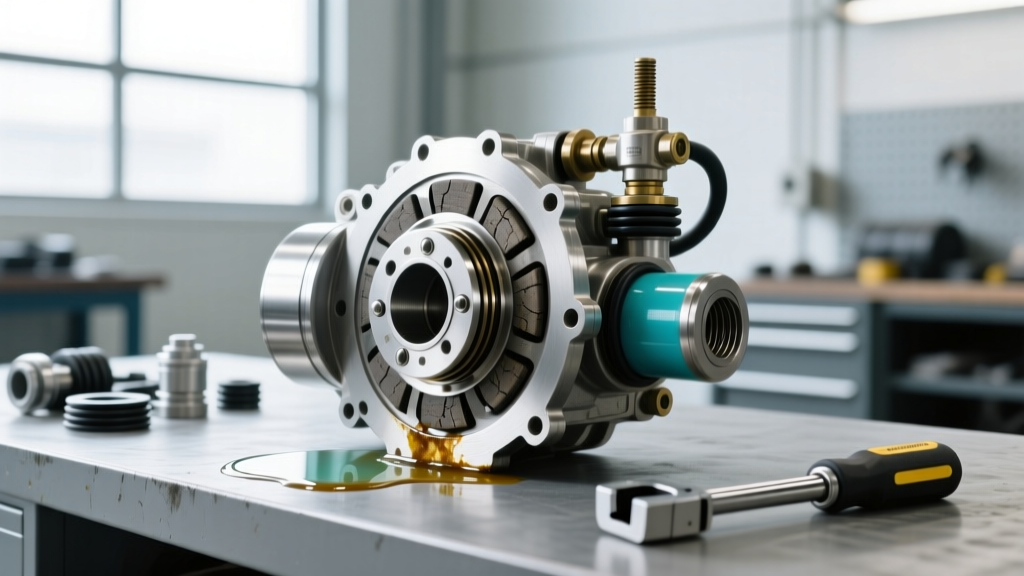
If the pedal box and engine bay lines are bone dry, but the fluid reservoir is dropping and the pedal feels inconsistent, you are likely dealing with an internal Concentric Slave Cylinder (CSC) leak.
- The Inspection Cover: Remove the small rubber inspection plug on the front of the Getrag MMT6 bell housing. Shine a UV light inside. If you see fluid pooling at the bottom of the bell housing or weeping from the CSC bearing collar, the internal seal has failed.
- DMF Contamination Risk: An internal leak is a critical emergency. DOT 4 fluid will quickly migrate to the DMF and clutch disc. If caught early, you might save the clutch pack with aggressive brake cleaner flushing, but in 90% of cases, a CSC leak mandates a full clutch and flywheel replacement.
Performance Upgrades: Fixing the Hydraulics for Good
Once the leak is diagnosed, the goal for any performance build is to eliminate the OEM plastic components entirely. Upgrading the Focus ST clutch master cylinder and associated lines ensures consistent pedal feel, faster shift times, and the hydraulic volume required to actuate heavy-duty performance clutches.
| Component | OEM Specification | Performance Upgrade | Primary Benefit | Est. Cost (2026) |
|---|---|---|---|---|
| Master Cylinder | Plastic body, twist-lock | Clutch Masters Aluminum Master Cylinder | Eliminates flex, precise bore sizing | $180 - $240 |
| Firewall Fitting | Plastic twist-lock collar | Mountune CNC Billet Firewall Adapter | Converts to standard -3 AN or banjo | $85 - $110 |
| Hydraulic Line | Rubber flex with quick-connect | Stainless Steel Braided Line (Teflon core) | Zero expansion, high burst pressure | $120 - $160 |
| Slave Cylinder | Plastic-bodied CSC | HD OEM-style CSC (Sachs / LUK) | Improved seal materials, longer lifespan | $90 - $140 |
The Quick-Connect Delete
The single most effective reliability upgrade you can perform is deleting the factory quick-connect fittings. By installing a billet firewall adapter, you convert the problematic plastic twist-lock into a secure, threaded banjo bolt or AN fitting. This guarantees the line will never blow off under the extreme hydraulic pressure generated by a Stage 3+ clutch pressure plate.
Getrag MMT6 Bleeding Procedures & Fluid Specs
Upgrading components is only half the battle; proper bleeding is where most DIYers fail. The Getrag MMT6 transmission features a specific bleed valve located on the CSC line bracket near the top of the bell housing. Because the CSC sits at the lowest point of the hydraulic circuit, air naturally rises and becomes trapped in the master cylinder and upper lines.
Fluid Selection
The factory specifies Motorcraft DOT 4 LV (Low Viscosity). However, for performance applications in 2026, we recommend stepping up to a high-boiling-point racing fluid. Motul RBF 600 (Dry Boiling Point: 626°F / 328°C) is the gold standard for track-driven EcoBoosts. It maintains a stable viscosity under extreme thermal loads, preventing vapor lock during repetitive hard launches.
The Reverse-Bleed Method
Traditional top-down bleeding often leaves micro-bubbles trapped in the master cylinder bore. For the Focus ST, pressure bleeding or reverse bleeding is mandatory.
- Prep: Ensure the reservoir is filled to the MAX line with fresh Motul RBF 600.
- Attach: Connect a pneumatic or manual reverse bleeder to the CSC bleed nipple on the Getrag MMT6.
- Push Fluid: Slowly push fluid UP through the system. Open the reservoir cap and watch for bubbles. Keep pushing until a solid stream of bubble-free fluid enters the reservoir.
- Torque Specs: The CSC bleed nipple is fragile. Torque it to exactly 10 Nm (7.4 lb-ft) to avoid snapping the brass fitting. If using a banjo bolt at the firewall adapter, torque to 15 Nm (11 lb-ft) with new copper crush washers.
- Pedal Cycling: Have an assistant slowly pump the pedal 20 times to seat the internal seals, then re-check the reservoir level. Top up to the MAX line, ensuring you do not overfill, as the fluid will expand when hot.
Cost Analysis and Sourcing
As of 2026, sourcing high-quality hydraulic components for the Focus ST is easier than ever, but beware of counterfeit quick-connect adapters on secondary marketplaces. Always source billet adapters from established EcoBoost tuners like Mountune USA or Ford Performance authorized dealers.
A complete hydraulic refresh—including an aluminum master cylinder, braided line, billet firewall adapter, and high-temp fluid—will cost between $450 and $600 in parts. While this is a significant premium over the $120 OEM plastic replacement, the elimination of pedal flex, the prevention of catastrophic fluid dumps on the track, and the ability to reliably actuate a 400+ lb-ft clutch setup make it an essential investment for any serious Focus ST build.
By methodically diagnosing the source of your leak and upgrading to motorsport-grade hardware, you transform the Focus ST's hydraulic system from a notorious weak point into a precise, bulletproof component capable of handling the limits of the EcoBoost platform.