The Getrag DPS6 PowerShift Dilemma
The 2012–2018 Ford Focus equipped with the Getrag 6DCT250 (Ford designation: DPS6) dry dual-clutch transmission remains one of the most controversial drivetrains in modern automotive history. Unlike traditional torque-converter automatics, the DPS6 operates as two electronically controlled manual transmissions sharing a common housing. At the heart of this system are two electric clutch actuators. Actuator A manages Clutch 1 (odd gears 1, 3, 5), while Actuator B manages Clutch 2 (even gears 2, 4, 6, and Reverse). When drivers experience sudden loss of even gears, reverse failure, or violent shuddering, the root cause frequently traces back to Actuator B. Understanding the precise ford focus clutch actuator b location, its failure modes, and the best replacement options is critical for accurate diagnostics and cost-effective repairs in 2026.
Pinpointing the Ford Focus Clutch Actuator B Location
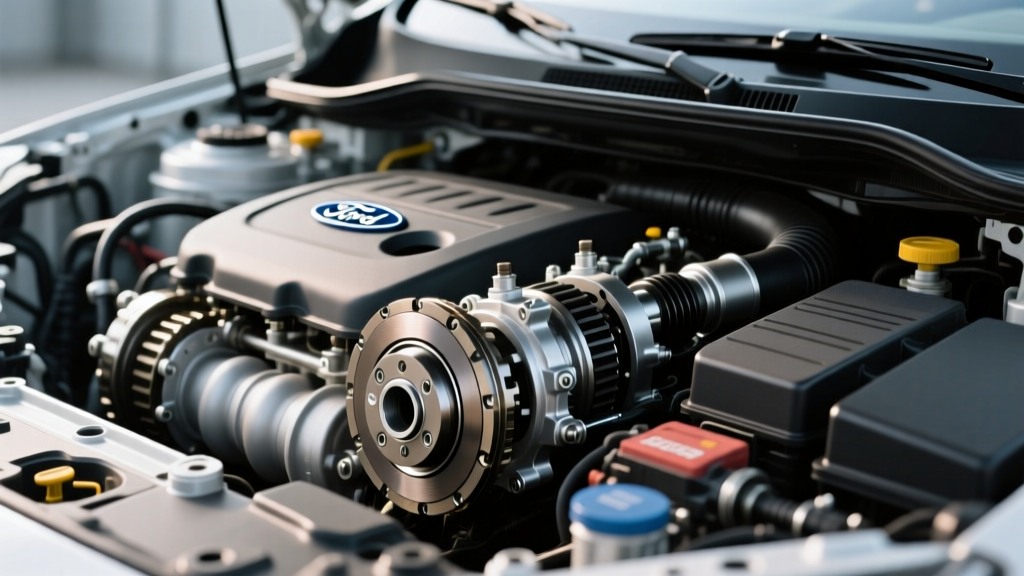
To diagnose or replace the component, you must first access it. The Transmission Control Module (TCM) and the clutch actuators are mounted externally on the front face of the transmission bell housing, directly behind the engine block and beneath the battery tray.
- Step 1: Disconnect the negative battery terminal and remove the 12V battery.
- Step 2: Unbolt the plastic battery tray (typically secured by 10mm and 13mm bolts) and remove the air intake assembly to expose the front of the transmission.
- Step 3: Locate the TCM. The two clutch actuator motors are plugged directly into the TCM housing and bolted to the transmission case. Actuator B is generally positioned on the lower right (passenger side) relative to the TCM, featuring a distinct cylindrical DC motor body with a 4-pin electrical connector.
Because the DPS6 relies on dry clutches, there is no hydraulic fluid to bleed. The actuators use a mechanical worm-gear drive to push the clutch release forks. This mechanical linkage is where the majority of catastrophic failures originate.
Root Cause Analysis: Why Actuator B Fails
Actuator B endures immense thermal and mechanical stress. Reverse and 2nd gear are the most frequently engaged ratios in stop-and-go traffic, meaning Actuator B cycles significantly more often than Actuator A. This disproportionate duty cycle leads to three primary failure modes.
1. Internal Worm Gear Stripping
The OEM actuator utilizes a nylon-composite internal worm gear mated to a steel motor shaft. Over time, the friction required to overcome the clutch diaphragm spring pressure—combined with under-hood heat cycling—causes the nylon teeth to shear or strip. When this occurs, the motor spins freely, but the clutch fork does not move. The TCM detects a position mismatch and throws codes such as P090C (Clutch Actuator Circuit Low) or P287A (Clutch B Stuck in Gear).
2. DC Motor Armature Burnout
If the clutch release bearing begins to bind, or if the clutch fork pivot ball wears excessively, the mechanical resistance spikes. The DC motor will draw excessive amperage to force the clutch engagement. Sustained current draws above 12 amps will melt the internal solder joints on the motor armature or burn out the carbon brushes, resulting in a dead motor.
3. Hall Effect Sensor Thermal Degradation
Inside the actuator housing, a Hall effect sensor tracks the exact rotational position of the worm gear to inform the TCM of the clutch touch-point. Prolonged exposure to exhaust and transmission heat can cause the sensor's internal wiring to micro-fracture, leading to erratic clutch modulation, severe shuddering at takeoff, and P091F (Clutch Actuator Position Sensor Circuit) diagnostic trouble codes.
Buyer’s Guide: OEM vs. Aftermarket Actuator Comparison
When sourcing a replacement, buyers must navigate a minefield of cheap knockoffs and revised OEM parts. Below is a 2026 market comparison of the most common replacement options for the DPS6 Clutch Actuator B.
| Brand / Type | Part Number (Ref) | Internal Gear Material | Warranty | Avg. Price (2026) |
|---|---|---|---|---|
| OEM Ford Motorcraft | AE8Z-7C600-B (Superseded) | Nylon Composite | 2 Years / Unlimited Miles | $280 - $340 |
| Dorman (OE Solutions) | 904-501 | Upgraded Billet Aluminum | Limited Lifetime | $160 - $210 |
| Generic Import (Amazon/eBay) | Various Unbranded | Low-Grade Plastic | 30 Days | $45 - $85 |
Expert Recommendation: Avoid unbranded generic actuators. The internal tolerances are often poor, leading to immediate clutch shudder. The Dorman 904-501 is widely considered the superior choice for out-of-warranty Focus models because Dorman re-engineered the internal worm gear using metal, effectively eliminating the nylon stripping issue that plagues the OEM design.
Advanced Diagnostics: Reading PIDs with FORScan
Before throwing parts at a shuddering Focus, professional-grade diagnostics are mandatory. Using a modified OBD-II adapter and FORScan software on a Windows laptop, you can monitor live actuator PIDs (Parameter Identification Data) to isolate the exact failure.
- Monitor Clutch B Current (CLT_B_CUR): With the engine running and the vehicle in Drive (foot firmly on the brake), observe the current draw. A healthy actuator draws between 4A and 8A during micro-adjustments. If you see spikes exceeding 12A–15A, the clutch fork or release bearing is mechanically binding, and replacing just the motor will result in a rapid repeat failure.
- Monitor Clutch B Position (CLT_B_POS): Command a clutch engagement via the FORScan active command tests. If the motor runs but the position PID does not change, the internal worm gear is stripped.
- Check Touch-Point Variance: If the learned clutch touch-point is consistently exceeding 11.5mm, the physical clutch friction material is worn beyond the actuator's ability to compensate, necessitating a full dual-clutch pack replacement, not just an actuator swap.
Installation Protocol and Torque Specifications
Replacing the actuator requires precision. The DPS6 TCM and actuators are highly sensitive to misalignment. If the actuator push-rod does not seat perfectly into the clutch fork recess, the motor will bind and throw a code immediately upon initialization.
- Preparation: Clean the clutch fork pivot area with brake cleaner and apply a thin layer of high-temperature synthetic grease (e.g., Motorcraft XG-1-E) to the fork contact pad.
- Alignment: Manually rotate the new actuator's worm gear using a Torx bit to retract the push-rod fully before installation. This ensures the rod seats into the fork cup without pre-loading the diaphragm spring.
- Hardware: The actuator is secured by two M6x1.0 flange bolts. Torque Specification: Tighten to exactly 9 Nm (80 lb-in). Over-torquing can crack the aluminum TCM/actuator mounting flange.
- Calibration: Post-installation, a "Clutch Touch Point Learning" routine MUST be performed using FORScan or Ford IDS. The TCM needs to physically feel where the new clutch pack engages to modulate shift pressure correctly. Skipping this step guarantees violent shuddering and premature clutch wear.
Real-World Repair Costs (2026 Estimates)
Repair economics for the DPS6 have shifted as the vehicles age and independent shops become more adept at TCM-level diagnostics.
- Dealership Replacement: $1,100 – $1,500. (Dealers often refuse to replace just the actuator motor, opting instead to sell the entire TCM/Actuator assembly or recommend a full transmission replacement).
- Independent Euro/Ford Specialist: $550 – $750. (Includes Dorman upgraded actuator, labor, and FORScan calibration).
- DIY Owner: $160 – $210. (Cost of the Dorman 904-501 part, assuming you already own an OBDLink EX or MX+ adapter and a laptop for calibration).
By understanding the root causes of DPS6 failures and leveraging upgraded aftermarket components, Focus owners can restore drivability and eliminate the dreaded even-gear dropout without incurring catastrophic dealership repair bills.