Introduction to Ring and Pinion Diagnostics
Setting up a ring and pinion gear set is a rite of passage for automotive enthusiasts and drivetrain technicians alike. Whether you are regearing a Ford 8.8-inch axle for larger off-road tires or rebuilding a classic GM 12-bolt for the drag strip, the mathematical precision required for a proper setup is immense. However, the true test of your mechanical work does not happen on the workbench; it happens on the pavement. As of 2026, while digital diagnostic tools have advanced, the most reliable, beginner-friendly method to verify the health of your new gear setup remains remarkably analog: reading the rear differential fluid color chart.
Gear oil is the lifeblood of your axle assembly. It lubricates the hypoid gear sliding action, cools the bearings, and suspends microscopic wear particles. When a ring and pinion setup is flawed—whether due to incorrect backlash, improper pinion depth, or inadequate bearing preload—the gears and bearings will physically degrade, altering the chemical and visual composition of the fluid. By learning how to interpret these visual cues, beginners can catch catastrophic failures before they leave you stranded on the side of the road.
The Ultimate Rear Differential Fluid Color Chart
Before we dive into the mechanical theory, you need a practical diagnostic tool. The following rear differential fluid color chart correlates specific fluid conditions to their underlying mechanical causes, specifically focusing on ring and pinion setup errors.
| Fluid Color / Condition | Visual Description | Setup Diagnosis & Meaning | Required Action |
|---|---|---|---|
| Honey / Amber | Clear, translucent, smells slightly of sulfur. | New or healthy fluid. Gears are meshing correctly. | None. Continue standard maintenance intervals. |
| Silver / Grey Sheen | Opaque grey, metallic flake visible only under direct light. | Normal break-in wear. High spots on new gears are polishing. | Normal for the first 500 miles. Change fluid after break-in. |
| Jet Black / Burnt | Opaque black, smells like burnt toast or acrid chemicals. | Extreme overheating. Pinion preload is too tight or backlash is zero. | Stop driving. Re-check pinion bearing preload and gear pattern. |
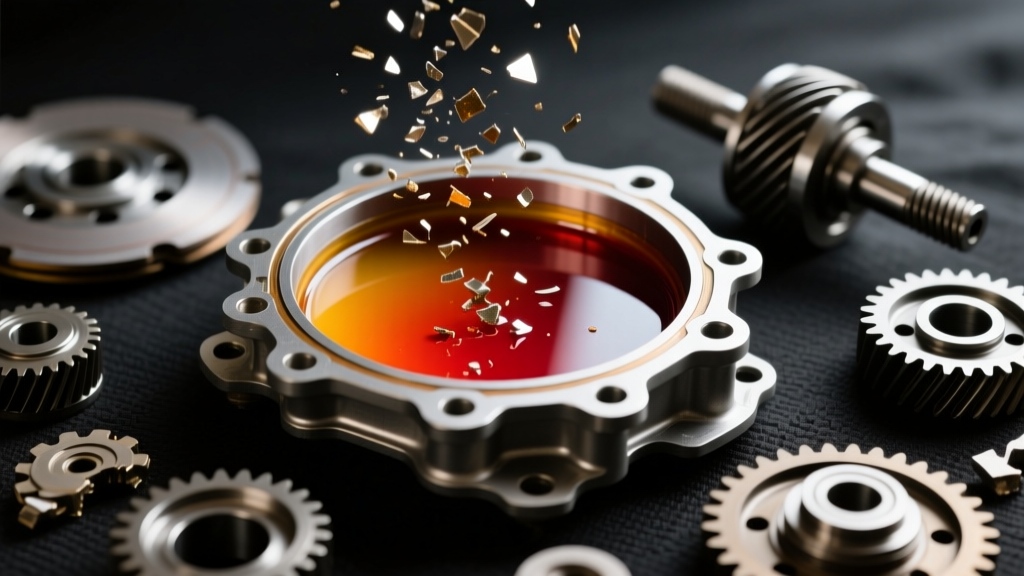
| Gold / Brass Flakes | Suspended golden glitter or distinct brass chips. | Carrier or pinion bearing cage failure. Bronze thrust washer wear. | Tear down required. Inspect bearing cages and side gears. |
| Chunky Silver / Steel | Visible metal shards, chunks, or spirals on the drain plug magnet. | Catastrophic gear failure. Backlash too loose or improper tooth contact. | Axle is condemned. Full rebuild and new ring/pinion set required. |
| Milky / Chocolate | Opaque brown or white emulsion, resembles coffee with cream. | Water intrusion. Bad axle shaft seal or submerged breather vent. | Flush immediately. Replace seals and relocate breather tube. |
How Gear Setup Dictates Fluid Health
To truly understand the rear differential fluid color chart, beginners must grasp how hypoid gear geometry interacts with lubrication. Unlike straight-cut spur gears, hypoid ring and pinion gears feature an offset centerline. This design allows for a lower driveshaft tunnel in passenger vehicles but introduces massive sliding friction across the gear teeth. This sliding action requires extreme pressure (EP) additives found in GL-5 gear oils to prevent the metal surfaces from welding together.
The Danger of Incorrect Backlash
Backlash is the amount of rotational play between the ring gear and the pinion gear. For most street-driven axles, such as the ubiquitous Ford 8.8 or the Dana Spicer 44, the target backlash specification sits between 0.006 and 0.010 inches. If a beginner sets the backlash too tight (e.g., 0.002 inches), the gears will bind under thermal expansion. As the differential heats up during highway driving, the aluminum or cast-iron housing expands, tightening the mesh further. This metal-on-metal binding generates immense friction, rapidly oxidizing the gear oil and turning it jet black. Conversely, if backlash is too loose (e.g., 0.018 inches), the gears will hammer against one another under load reversal, shearing off microscopic teeth and filling your fluid with chunky silver shards.
Pinion Bearing Preload and Heat Generation
Pinion bearing preload is the compressive force applied to the pinion bearings via a crush sleeve or solid spacer. Proper preload ensures the pinion gear does not deflect under heavy torque loads. According to setup guides from authoritative sources like Randy's Ring & Pinion, a typical new pinion bearing setup requires 15 to 25 inch-pounds of rotating torque. If a beginner overtightens the pinion nut to achieve 40+ inch-pounds of preload, the bearings will experience excessive rolling resistance. This friction acts like a brake, generating localized temperatures exceeding 300°F (149°C). At these temperatures, the fluid's viscosity breaks down, leading to the 'burnt' condition on our color chart and eventual bearing seizure.
The 500-Mile Break-In Protocol
When you install a new ring and pinion set—such as a popular Yukon Gear & Axle 4.10 ratio kit (Part # YG F8.8-410, retailing around $240 in 2026)—the gears are not perfectly matched. They require a break-in period to mate the microscopic high spots on the cast or forged steel. During the first 15 to 20 miles, differential temperatures can spike dramatically. It is highly recommended to drive for 15 miles, then stop and let the axle cool completely to ambient temperature. Repeat this cycle three times.
After 500 miles of mixed driving, the fluid will likely exhibit the 'Silver / Grey Sheen' noted in our chart. This is completely normal and indicates the lapping process is complete. At this exact mileage, you must drain the fluid to remove the suspended metallic paste. Failing to change the fluid after break-in is a common beginner mistake; leaving those metallic particles in the housing will act like liquid sandpaper, accelerating wear on the carrier bearings and spider gears.
Step-by-Step Inspection and Service
Reading the chart is only half the battle; you must know how to properly extract and inspect the sample. Here is a professional-grade procedure for a standard 10-bolt or 12-bolt differential cover:
- Preparation: Drive the vehicle for 10 minutes to warm the fluid, reducing its viscosity and ensuring all suspended particles are mobile.
- Extraction: Place a clean, white plastic drain pan beneath the axle. (A white pan provides the highest contrast for spotting brass or silver flakes). Remove the differential cover bolts, leaving the top two bolts loosely threaded to act as a hinge.
- Visual Inspection: Pry the bottom of the cover loose. Inspect the fluid as it pours out. Smell the fluid immediately—acrid, burnt odors indicate thermal breakdown.
- Magnet Analysis: Inspect the internal differential magnet. A fine, grey fuzz is normal. Any particles larger than a grain of rice, or any spiral-shaped shavings, indicate severe gear or bearing failure.
- Cleaning: Scrape all old RTV silicone from the housing and cover using a plastic gasket scraper (never use a metal razor blade on aluminum housings, as it will gouge the sealing surface). Clean with brake parts cleaner.
- Reassembly: Apply a continuous 3mm bead of high-temp RTV (like Permatex Ultra Black). Torque the cover bolts in a crisscross pattern to 25-30 lb-ft. Allow 2 hours for the RTV to skin over before filling.
Selecting the Correct Gear Oil
The insights gained from your rear differential fluid color chart are only as good as the baseline fluid you use. For modern ring and pinion setups, you must use an API GL-5 rated gear oil. GL-5 contains high levels of sulfur-phosphorus extreme pressure additives necessary to protect the sliding hypoid gear faces. Using a GL-4 fluid in a hypoid differential will result in rapid gear wear and a silver sheen that quickly degrades into chunky metal shards.
Furthermore, if your axle is equipped with a clutch-type Limited Slip Differential (LSD), such as the Ford Traction-Lok or Auburn Gear cone-style units, you must add a friction modifier (e.g., Motorcraft XL-3 or equivalent). Without this modifier, the clutches will chatter during low-speed cornering, generating excessive heat and degrading the fluid prematurely. High-quality synthetic options, such as AMSOIL Severe Gear 75W-90, offer superior thermal stability and shear resistance, maintaining their protective film even when pinion preload errors cause localized heat spikes. Expect to pay between $18 and $25 per quart for premium synthetics in 2026, a small price to pay to protect a $1,500 gear and bearing setup.
Conclusion
Mastering the mechanical setup of a ring and pinion requires precision tools, patience, and a deep understanding of drivetrain geometry. However, verifying the long-term success of your build relies on continuous monitoring. By keeping this rear differential fluid color chart in your mental toolbox, you transition from a novice parts-swapper to a true drivetrain diagnostician. The fluid never lies; it will always tell you the story of your gear pattern, your bearing preload, and your mechanical craftsmanship.