The Performance Case for Regearing the JL Dana 44 AdvanTEK
Upgrading to larger off-road tires is the most common modification for the 2018-2026 Jeep Wrangler JL and Gladiator platforms. However, jumping from stock 33-inch tires to 37-inch or 40-inch setups drastically alters your effective final drive ratio. To restore low-end torque, eliminate transmission hunting, and reduce exhaust gas temperatures (EGTs), enthusiasts turn to aftermarket ring and pinion sets. For the JL Rubicon equipped with Dana 44 AdvanTEK axles (M210 front, M220 rear), swapping from the factory 3.73 or 4.10 ratios to performance 4.88 or 5.13 gears is the gold standard.
While the mechanical benefits of regearing are undeniable, the process fundamentally changes the thermal dynamics and wear patterns inside the axle housing. This leads to a critical maintenance question for both DIY mechanics and professional shops: when should differential fluid be replaced after installing new gears, and how does the new ratio affect long-term fluid selection?
Thermal Dynamics: Why Gear Ratios Dictate Fluid Lifespan
When you install a numerically higher gear ratio (like a 5.13), the pinion gear becomes physically smaller, and the ring gear teeth operate under a different contact stress profile. During the initial mating phase, the microscopic imperfections on the cut gears wear off, generating intense localized heat and metallic particulate.
If this metallic sludge is left to circulate, it embeds into the soft bronze carrier shims and scores the pinion bearings, leading to premature catastrophic failure. Furthermore, a numerically higher ratio means the pinion is turning more times per wheel revolution, which increases fluid churning and baseline operating temperatures. According to Yukon Gear & Axle, failure to adhere to a strict break-in fluid replacement schedule is the number one cause of post-regear gear whine and bearing failure.
The Break-In Protocol: When Should Differential Fluid Be Replaced?
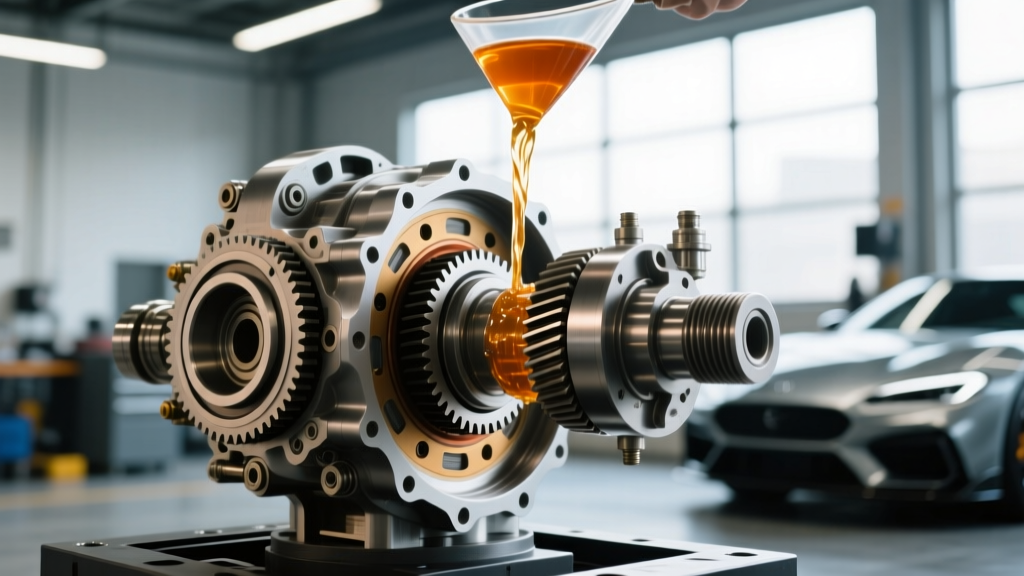
Factory maintenance schedules often list differential fluid as a 'lifetime' fill or recommend intervals exceeding 100,000 miles for stock, highway-driven vehicles. However, a regear completely resets the clock. The mating process of the new ring and pinion requires a phased fluid replacement strategy to flush out metallic debris before it causes damage.
| Milestone | Action Required | Fluid Type & Additives | Purpose |
|---|---|---|---|
| First 500 Miles | Complete Drain, Clean & Refill | 75W-140 Synthetic GL-5 | Removes initial break-in metallic paste and shaving debris. |
| 1,000 Miles | Magnetic Plug Inspection | N/A (Top-off if needed) | Verify that heavy metallic shedding has ceased. |
| 15,000 - 20,000 Miles | Second Complete Drain & Refill | 75W-140 Synthetic GL-5 | Flushes secondary wear particulates as gears fully seat. |
| Every 40,000 Miles | Standard Severe-Duty Interval | 75W-140 Synthetic GL-5 | Maintains shear stability for oversized tires and towing. |
To properly execute the initial 500-mile break-in, the vehicle must be driven under moderate loads. Avoid sustained highway speeds over 65 MPH, and do not tow heavy trailers during this window. Stop every 15-20 miles during the first 100 miles to allow the axle housings to cool, preventing the gear oil from exceeding its thermal breakdown point before the gears are fully seated.
Step-by-Step JL Rubicon Dana 44 Fluid Service Guide
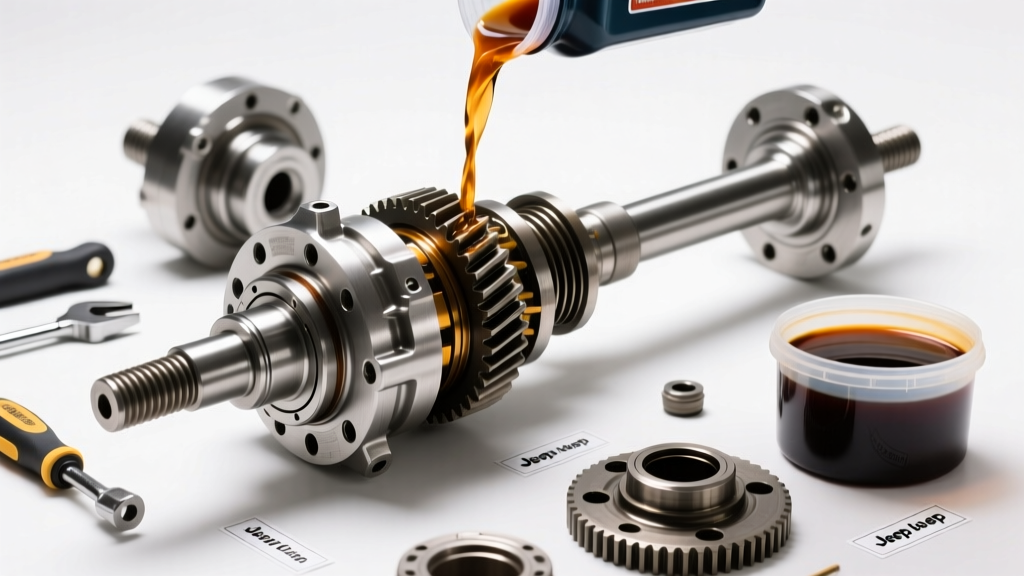
Servicing the M210 and M220 AdvanTEK axles requires precision. Unlike older Jeep axles that utilized simple rubber gaskets, the JL Dana 44 relies on a precise RTV silicone bead to seal the stamped steel or aftermarket cast aluminum covers.
Required Parts and Fluid Specifications
- Gear Oil: 5 Quarts of 75W-140 Full Synthetic GL-5 (e.g., Amsoil Severe Gear or Mobil 1). Cost: ~$90.
- RTV Sealant: Loctite 5910 Black RTV or Mopar Axle RTV (Part # 04318083AD). Cost: ~$12.
- Brake Cleaner & Shop Towels: For removing old silicone and gear oil residue.
- Capacity Note: The M210 Front holds approximately 2.0 quarts; the M220 Rear holds approximately 2.2 quarts.
Cover Removal, RTV Application, and Torque Specs
- Preparation: Jack the vehicle and support it on jack stands under the axle tubes to keep the housing at normal ride-height orientation, ensuring accurate fill levels.
- Drain & Clean: Remove the 10 perimeter cover bolts (13mm or 1/2-inch). Pry the cover gently. Scrape all old RTV from the housing and cover flange. Wipe down with brake cleaner until the metal is completely bare and dry.
- RTV Bead: Apply a continuous 3mm to 4mm bead of Loctite 5910 around the cover flange, ensuring you circle every bolt hole on the inside to prevent oil leaks.
- Torque Sequence: Reinstall the cover and hand-thread the bolts. Tighten in a crisscross star pattern to 28 ft-lbs (38 Nm). Do not overtighten, as this will squeeze out the RTV and cause immediate leaks.
- Cure Time: Allow the RTV to cure for at least 2 hours before filling with gear oil.
- Fill: Pump gear oil into the fill hole until it reaches the exact bottom edge of the threads. Reinstall the fill plug and torque to 25 ft-lbs.
The Friction Modifier Trap: Tru-Lok vs. Trac-Lok
One of the most costly mistakes made during a post-regear fluid service is the misuse of limited-slip friction modifiers. The Ring-Pinion.com technical database frequently highlights chatter and locker engagement failures caused by incorrect additive use.
- JL Rubicon (Tru-Lok): The Rubicon features front and rear Tru-Lok electronic mechanical lockers. These are gear-driven and do not use clutch packs. You must NOT add friction modifier. Adding it can cause foaming and interfere with the locker engagement collar.
- JL Sahara / Sport (Trac-Lok): If your non-Rubicon JL is equipped with the Trac-Lok clutch-type limited-slip differential, you MUST add 2.5 oz of Mopar Limited Slip Additive (Part # 04318060BB) to the rear axle to prevent clutch chatter during tight turns.
Gear Ratio vs. Fluid Viscosity: Selecting the Right Weight
As of 2026, the aftermarket support for the JL platform offers gear ratios ranging from 4.56 all the way to 5.38. The ratio you choose directly impacts the pinion bearing load and the heat generated inside the differential. While the factory recommends 75W-85 or 75W-90 for stock setups, regearing necessitates a viscosity upgrade.
| Installed Gear Ratio | Tire Size / Application | Recommended Viscosity | Why? |
|---|---|---|---|
| 3.73 - 4.10 (Stock) | 33" - 35" / Daily Driving | 75W-90 Synthetic | Adequate cooling for standard pinion bearing loads. |
| 4.56 - 4.88 | 37" / Off-Road & Light Towing | 75W-140 Synthetic | Thicker film strength protects smaller 4.88 pinion gears under high torque. |
| 5.13 - 5.38 | 40"+ / Heavy Rock Crawling | 75W-140 Synthetic | Maximum shear stability for extreme low-speed crawling and shock loads. |
Expert Troubleshooting: Post-Regear Whine and Leaks
Even with perfect fluid break-in procedures, issues can arise if the underlying gear setup was flawed. Here is how to diagnose common post-regear differential complaints:
1. Drive vs. Coast Side Whine
If the differential whines only when accelerating (drive side), the pinion depth is likely too shallow, or the backlash is too tight. If it whines only when decelerating (coast side), the pinion depth is too deep. A proper setup requires a dial indicator to verify backlash (typically 0.006" to 0.010" for Dana 44 AdvanTEK) and a gear marking compound to verify the contact pattern.
2. Pinion Seal Leaks
If you notice gear oil slinging from the pinion yoke after a regear, the pinion bearing preload may have been set incorrectly. The JL Dana 44 uses a crush sleeve (or solid spacer in aftermarket master kits). If the pinion nut was over-torqued during installation, it could have deformed the seal lip or over-compressed the bearing, leading to rapid seal failure and fluid loss. Always use an inch-pound torque wrench to verify rotational drag (typically 15-25 in-lbs of drag for used bearings, 25-35 in-lbs for new).
3. RTV Weeping
If fluid is weeping from the diff cover, the flange was likely not cleaned with brake cleaner prior to RTV application, or the cover bolts were not torqued in the correct star sequence, leading to warped flange pressure. Drain, scrape, and re-seal immediately to prevent the axle from running dry.
Understanding when should differential fluid be replaced is not just about following a mileage chart; it is about respecting the metallurgy of your new gear set. By adhering to the 500-mile break-in flush, utilizing the correct 75W-140 synthetic lubricant, and strictly following Dana 44 AdvanTEK torque specifications, your regeared Jeep JL will deliver reliable, high-torque performance on the trail and the highway for years to come.