The Thermodynamics of Axle Heat and Gear Oil Oxidation
When operating heavy-duty trucks, SUVs, and off-road vehicles, the differential is subjected to immense mechanical stress and extreme thermal loads. The hypoid gear sets found in modern axles—such as the AAM (American Axle & Manufacturing) 11.5-inch, Dana 80, and Ford 10.5-inch Sterling—rely on a precise hydrodynamic film of gear oil to prevent metal-on-metal contact. However, as ambient temperatures rise and towing loads increase, the internal axle temperature can easily exceed 250°F (121°C). According to tribology principles documented by Machinery Lubrication, the oxidation rate of petroleum and synthetic base oils doubles for every 18°F (10°C) increase in temperature above this baseline. This exponential thermal degradation is the primary catalyst for catastrophic axle failure, making thermal management via upgraded differential covers an essential modification for severe-duty applications.
Identifying the Signs of Bad Differential Fluid
Recognizing the signs of bad differential fluid early can save you from a $3,500+ ring and pinion replacement. When gear oil is subjected to prolonged thermal breakdown, the extreme pressure (EP) additives—typically sulfur-phosphorus (S-P) compounds—begin to deplete and oxidize. This chemical shift alters the fluid's physical properties and produces distinct warning signs:
- Olfactory Indicators (The Burnt Smell): Fresh 75W-90 or 75W-140 synthetic gear oil has a sharp, distinct sulfur odor. When thermally degraded, the oil smells acrid, similar to burnt marshmallows or rotting eggs. This indicates the S-P additives have oxidized and formed acidic byproducts.
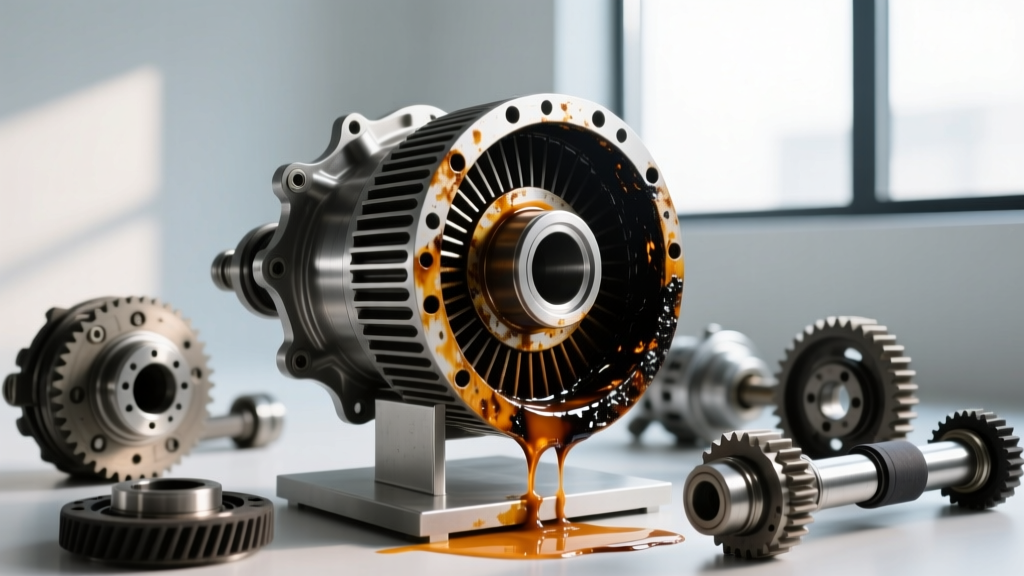
- Visual and Tactile Sludge: Upon removing the differential cover, degraded fluid will appear opaque, black, and heavily viscous. If you rub the fluid between your fingers and feel micro-grit or a metallic paste, the oil has lost its film strength, and the hypoid gears are actively wearing.
- Auditory Whining and Bearing Preload Loss: As the fluid turns to sludge, it fails to properly flow into the pinion and carrier bearings. This localized starvation causes bearing cages to score, resulting in a high-pitched whine that changes pitch during deceleration (coast side of the gear teeth).
- Acidic Corrosion (Etching): Oxidized gear oil drops in pH, becoming highly acidic. If left unchecked, this acid etches the polished faces of the ring and pinion gears, creating microscopic pitting that accelerates fatigue spalling.
Differential Covers: Thermal Dissipation Engineering
The stock differential cover on most heavy-duty axles is a stamped steel pan. While inexpensive to manufacture (costing OEMs roughly $15-$25), stamped steel offers poor thermal conductivity and minimal fluid capacity. Upgrading to a finned, cast-aluminum differential cover is the most effective passive cooling modification you can perform. Aluminum conducts heat approximately 205 W/m·K, compared to steel's 50 W/m·K. Furthermore, the external cooling fins increase the surface area exposed to ambient airflow, drastically improving convective heat transfer.
| Cover Type | Material | Surface Area Multiplier | Fluid Capacity Increase | Avg. Aftermarket Cost (2026) |
|---|---|---|---|---|
| OEM Stamped Steel | Low-Carbon Steel | 1.0x (Baseline) | 0 Quarts | $30 - $50 (Replacement) |
| Heavy-Duty Cast Flat | Nodular/Ductile Iron | 1.2x | +0.5 to 1 Quart | $120 - $160 |
| Finned Cast Aluminum | A356-T6 Aluminum | 3.5x to 5.0x | +1.0 to 2.5 Quarts | $150 - $220 |
| Active Fan-Cooled | Aluminum w/ 12V Fan | 4.0x + Forced Air | +1.0 to 2.0 Quarts | $350 - $550 |
Brands like Mag-Hytec and PPE (Pacific Performance Engineering) engineer their finned covers with internal baffling. These internal fins not only add structural rigidity to prevent casing deflection under high-torque loads but also act as internal heat sinks, drawing heat away from the gear oil sump and transferring it to the exterior casing. For an AAM 11.5-inch axle, upgrading to a finned cover typically drops steady-state highway towing temperatures by 15°F to 25°F, keeping the fluid safely below the critical 250°F oxidation threshold.
Active vs. Passive Axle Cooling Systems
While finned covers excel at highway speeds where ram-air velocity is high, they lose effectiveness in low-speed, high-load scenarios such as rock crawling, deep sand running, or heavy yard spotting. In these environments, axle temperatures can spike past 300°F (149°C) due to torque converter slip and massive gear friction, combined with zero ambient airflow.
For these extreme applications, SKF lubrication management guidelines suggest moving to active cooling systems. Active differential coolers utilize a 12-volt DC pump to draw gear oil from the differential sump, push it through a remote finned heat exchanger (often equipped with a thermostatically controlled SPAL fan), and return the cooled oil to the pinion bearing area. Alternatively, fan-assisted differential covers feature an integrated 12V fan that blows directly across the exterior cooling fins. While active systems require more complex plumbing and electrical integration, they are mandatory for competitive rock crawlers and extreme heavy-haulers operating in desert environments.
Installation Protocols and Torque Specifications
Upgrading your differential cover is not simply a matter of unbolting the old pan and slapping on a new one. Improper installation is a leading cause of post-upgrade fluid leaks and bearing contamination. When mating a thick cast-aluminum cover to an axle housing, the sealing methodology is paramount.
RTV Silicone vs. Reusable Gaskets
Historically, technicians relied on black RTV silicone (such as Loctite 598 or Permatex Ultra Black) to seal differential covers. While effective, RTV requires meticulous surface preparation (brake cleaner and scuff pads), precise bead sizing, and a 24-hour cure time before filling with oil. Furthermore, excess RTV squeezed into the housing can break off and clog the oil pickup tubes or score the carrier bearings.
In 2026, the industry standard for high-end axle builds is the reusable elastomer gasket, such as those manufactured by Lube Locker or Torque King. These gaskets feature a steel core encapsulated in high-temp Viton or HNBR rubber, utilizing localized sealing beads around the bolt holes. They allow for immediate fluid fill-up, zero cure time, and can be reused multiple times during fluid services.
Fastener Torque Specifications
Cast aluminum covers expand at a different rate than the steel or iron axle housing. Over-torquing the cover bolts will strip the threads in the housing or warp the cover flange, leading to leaks. Always use a calibrated inch-pound or low-range foot-pound torque wrench. Below are the standard torque specifications for common heavy-duty axles when installing aftermarket cast covers:
- AAM 11.5-inch (GM HD / Ram HD): M8 x 1.25 flange bolts. Torque to 27 lb-ft (37 Nm) in a crisscross pattern.
- Dana 80 (Ford / Classic GM): 3/8"-16 hex bolts. Torque to 35 lb-ft (47 Nm).
- Ford 10.5-inch Sterling: 3/8"-16 hex bolts. Torque to 35 lb-ft (47 Nm).
- Dana 60 (Front/Rear): 3/8"-16 or 10mm bolts. Torque to 30 lb-ft (40 Nm).
Expert Technician Tip: When installing a heavy cast-aluminum cover on a Dana 80 or AAM 11.5, apply a small dab of blue Loctite 243 to the upper-most bolts. Because these axles experience significant harmonic vibration, the top bolts are most prone to backing out due to the weight of the heavy cover pulling downward on the flange. Always support the cover with a jack or magnetic tray while threading the first few bolts to prevent cross-threading the soft housing.
Used Oil Analysis (UOA): The Ultimate Diagnostic Tool
While sensory clues like smell and color are useful, the most definitive way to monitor thermal breakdown is through Used Oil Analysis (UOA). By sending a 4 oz sample of your differential fluid to a lab like Blackstone Laboratories or Polaris, you receive a spectrometric breakdown of the oil's health. When evaluating the AMSOIL technical data on gear oil longevity, UOA reports will highlight the Total Acid Number (TAN) and the viscosity at 100°C. If the TAN spikes significantly above the baseline of fresh 75W-140 fluid, it confirms that the EP additives have thermally oxidized into corrosive acids. Additionally, elevated levels of iron (Fe) and chromium (Cr) in the ppm (parts per million) data will indicate that the thermal breakdown has already compromised the hydrodynamic film, resulting in active gear and bearing wear. Pairing a high-capacity finned differential cover with annual UOA testing is the gold standard for ensuring axle longevity in severe-duty towing and off-road applications.