The Dilemma: Exedy Stage 1 Clutch WRX vs. Multi-Disc Upgrades
The Subaru WRX platform remains one of the most heavily modified vehicles in the performance automotive world. Whether you are tuning the legendary EJ25 flat-four or pushing the boundaries of the newer FA24 engine, torque multiplication happens quickly. When enthusiasts search for an Exedy Stage 1 clutch WRX package, they are typically looking for a reliable, cost-effective solution to handle mild bolt-ons and a Stage 2 ECU calibration. However, as horsepower goals shift from 300 wheel-horsepower (whp) to the 450+ whp territory, the single-disc paradigm breaks down. This guide compares the entry-level Exedy Stage 1 single-disc against advanced multi-disc clutch systems, providing a technical blueprint for Subaru owners navigating the 2026 performance aftermarket.
Baseline: Analyzing the Exedy Stage 1 Clutch for WRX
The Exedy Stage 1 clutch (often referencing part numbers like SUB021 for the Heavy Duty Organic or SUB001 for OEM replacement) is engineered as a direct factory upgrade. It utilizes a reinforced nodular iron pressure plate and a high-friction organic or mild cerametallic disc. For the Subaru 5MT (TY85) and 6MT applications, this setup generally holds between 320 and 380 lb-ft of torque at the crank.
The primary advantage of the Exedy Stage 1 is drivability. It retains the factory hydraulic pedal ratio, offering a linear engagement window that makes stop-and-go traffic manageable. Furthermore, the sprung hub design absorbs the inherent torsional vibrations of the Subaru boxer engine, protecting the transmission input shaft and differential gears from shock loading. However, once you introduce aggressive E85 tunes, larger turbochargers (like an FP Green or Blouch 18G-XT), and launch control, the single friction surface will inevitably succumb to thermal degradation and slippage.
The Physics of Multi-Disc Clutch Systems
When a single disc reaches its friction coefficient limit, manufacturers have two choices: increase clamping force or increase surface area. Cranking up the pressure plate load on a single disc results in a pedal effort that can exceed 50 lbs, leading to driver fatigue and bent Subaru clutch release forks. Multi-disc systems (twin or triple) solve this by stacking friction surfaces.
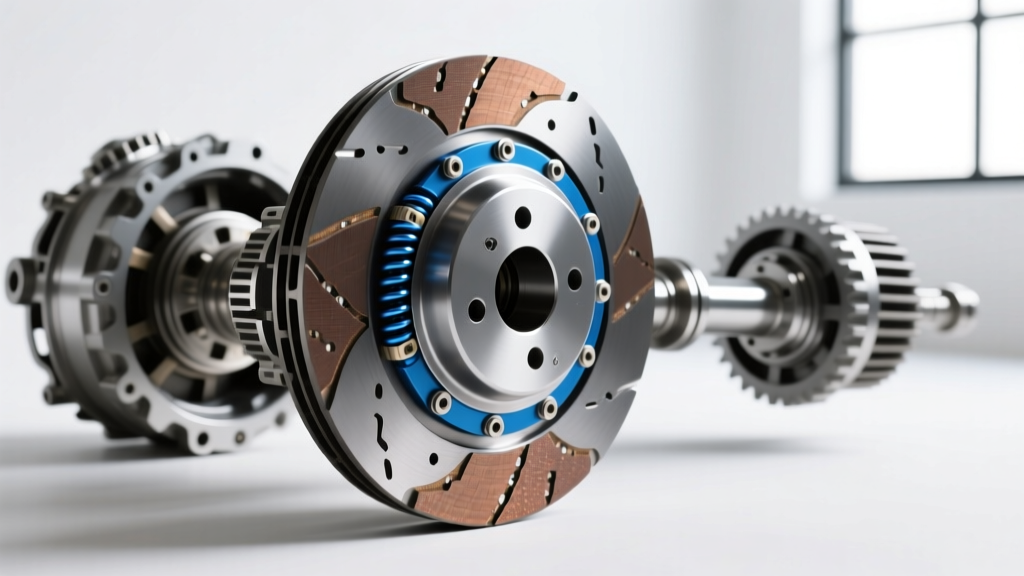
A twin-disc clutch utilizes an intermediate float plate sandwiched between two friction discs. This effectively doubles the friction area without requiring a proportionate increase in diaphragm spring pressure. Consequently, a twin-disc system can hold 600 to 800+ lb-ft of torque while maintaining a pedal effort comparable to, or even lighter than, a heavy-duty single disc. The trade-off comes in the form of rotational inertia, packaging constraints, and Noise, Vibration, and Harshness (NVH).
Material Science: Sintered Metal vs. Carbon
Multi-disc clutches for the WRX are predominantly available in two friction materials: sintered metal and carbon composite. Sintered metal (often seen in Exedy Twin Metal or ACT Twin setups) offers immense heat resistance and aggressive lock-up. It is ideal for drag racing, time attack, and heavy track abuse. However, metal-on-metal engagement is abrupt, and the unsprung nature of many racing twin-discs transfers severe shock into the drivetrain.
Carbon composite clutches (like the Exedy Carbon Twin or OS Giken Carbon) represent the pinnacle of street-to-track usability. Carbon offers a high friction coefficient that actually increases with heat, providing a surprisingly smooth engagement while weighing significantly less than steel or sintered iron. The reduced rotational mass allows the EJ25 or FA24 engine to rev freely, drastically improving throttle response.
| Feature | Exedy Stage 1 (Single Disc) | Twin-Disc Sintered Metal | Twin-Disc Carbon |
|---|---|---|---|
| Torque Capacity | ~380 lb-ft | 650 - 850+ lb-ft | 550 - 750 lb-ft |
| Pedal Effort | Stock to +20% | +30% to +50% | +10% to +25% |
| Engagement Window | Wide / Forgiving | Narrow / Aggressive | Medium / Progressive |
| NVH / Gear Rattle | Minimal (Sprung Hub) | Severe (Unsprung) | Moderate (Sprung/Dampened) |
| Approx. Cost (2026) | $450 - $600 | $1,100 - $1,600 | $2,200 - $3,500 |
The Pull-Type Trap: Subaru 5MT and 6MT Nuances
One of the most critical E-E-A-T factors when upgrading a Subaru clutch is understanding the pull-type release mechanism. Unlike 90% of the automotive market which uses a push-type throwout bearing, Subaru transmissions utilize a fork that pulls the diaphragm spring fingers outward to disengage the clutch.
When adapting a multi-disc system to a Subaru 5MT or 6MT, the aftermarket manufacturer must provide a specific pull-type adapter ring or a custom throwout bearing collar. If the collar height is miscalculated by even 1.5mm, the clutch will either fail to disengage (causing gear grinding) or ride constantly on the bearing, leading to catastrophic premature failure. Furthermore, the 5MT (TY85) is notorious for its fragile 2nd gear hub. Installing an unsprung, aggressive multi-disc metal clutch on a 5MT without a specialized limited-slip differential or careful launch modulation will shatter the 2nd gear hub under high-boost launches. The STI 6MT (TY856) and the newer FA24 6MT are vastly superior in handling the shock loads of a twin-disc setup.
Installation Realities: Torque Specs and Clearances
Proper installation of a multi-disc clutch requires precision measurement and strict adherence to torque specifications. The most common failure point in multi-disc installs is improper flywheel step height and uneven pressure plate torquing.
Critical Subaru Installation Specs:
- Flywheel to Crankshaft (EJ25): 69 lb-ft (93 Nm) plus an additional 90-degree turn. Always use new OEM Subaru torque-to-yield flywheel bolts.
- Flywheel to Crankshaft (FA24): 59 lb-ft (80 Nm) plus 90 degrees.
- Pressure Plate to Flywheel: 18 to 20 lb-ft (24-27 Nm) in a strict crisscross star pattern to prevent warping the intermediate plate.
- Flywheel Step Height: Subaru OEM flywheels are generally flat (0.000" step). However, aftermarket multi-disc flywheels may require a specific step (often 0.010" to 0.020"). Always measure with a machinist straight-edge and feeler gauge before assembly.
- Intermediate Plate Float: Multi-disc systems require the intermediate plate to float evenly (usually within 0.020" of variance) when the clutch is disengaged. Failure to set the float straps correctly will result in severe dragging and inability to shift into gear.
Troubleshooting Multi-Disc NVH and Gear Rattle
Owners transitioning from an Exedy Stage 1 to a twin-disc system frequently panic at the sound of "marbles in a can" at idle. This is transmission gear rattle, caused by the boxer engine's uneven firing pulses vibrating the unsprung transmission input shaft gears against each other. To mitigate this in a multi-disc setup:
- Use High-Viscosity Gear Oil: Switching to a heavier 75W-90 or 75W-110 synthetic gear oil (like Motul 300V or Red Line MT-90) provides a thicker fluid film to dampen gear lash.
- Idle RPM Adjustment: Raising the ECU idle speed by 50-100 RPM smooths out the flat-four's torsional harmonics, significantly reducing rattle.
- Select Sprung Hubs: If the car is a daily driver, spend the premium on a twin-disc system with a sprung (dampened) hub. While it adds slightly to the rotational mass, it saves the transmission bearings from harmonic destruction.
Final Verdict: Mapping Your WRX Build
If your WRX is a daily-driven street car making under 380 lb-ft of torque on a stock or Stage 2 tune, the Exedy Stage 1 clutch WRX configuration remains the undisputed king of value, comfort, and reliability. It bolts up, it drives like stock, and it protects your wallet.
However, if you are building a 450+ whp track monster, running E85 on a built 2.5L, or utilizing anti-lag and flat-foot shifting, the single disc is a liability. Stepping up to a twin-disc system is mandatory. For dedicated track cars, a sintered metal twin-disc offers unmatched durability. For the ultimate street-to-track weekend warrior, a carbon twin-disc provides the torque capacity of a race car with the drivability required to navigate traffic. Always respect the Subaru pull-type architecture, measure your clearances, and torque to spec—your transmission will thank you.