The Reality Behind 'Stage' Clutch Marketing
In the 2026 performance aftermarket landscape, the term 'Stage' is largely a marketing construct rather than a strict engineering standard. However, within the enthusiast community, it serves as a vital shorthand for friction material composition, clamping force, and hub design. When drivers begin searching for an Exedy Stage 1 clutch, they are typically looking for an OEM-plus replacement that can handle mild bolt-ons and aggressive street driving without sacrificing daily-driver comfort. But as horsepower goals escalate, the transition to Stage 2 and Stage 3 setups introduces complex trade-offs involving drivetrain shock, hydraulic limitations, and transmission longevity.
This guide deconstructs the actual engineering differences between Stage 1, Stage 2, and Stage 3 clutch systems, providing concrete data, torque specifications, and failure mode analysis to help you select the correct friction assembly for your specific chassis and power output.
Stage 1: The Organic Baseline (OEM+ & Mild Bolt-ONS)
A true Stage 1 clutch, such as the Exedy OEM Replacement or Stage 1 organic kits (e.g., part number KNC04 for the Nissan 350Z/370Z or KSB05 for the Subaru WRX), is designed to mirror or slightly exceed factory drivability while offering a 20% to 30% increase in torque capacity.
Material and Hub Design
Stage 1 discs utilize full-face organic friction materials woven with high-temperature resins and copper wire for heat dissipation. Crucially, they feature a sprung hub. The torsion springs integrated into the center hub act as a mechanical damper, absorbing the rotational harmonics and shock loads generated by the engine's power pulses. This protects the transmission's input shaft and synchros from premature wear.
- Torque Capacity: Typically 300 to 400 lb-ft at the crank (depending on application).
- Pedal Effort: Stock to +10% over OEM.
- Break-in Period: 300 to 500 miles of moderate city driving.
- Best Application: Daily driven vehicles, mild turbo upgrades, intake/exhaust/tune bolt-ons.
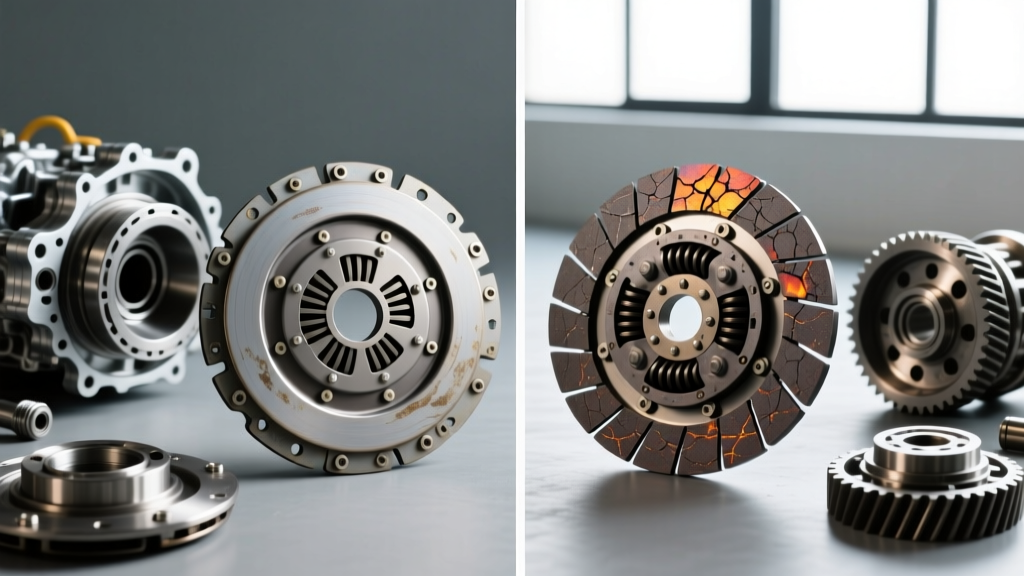
Pricing for a quality Stage 1 kit generally ranges from $350 to $550. The primary failure mode for Stage 1 clutches is not sudden catastrophic failure, but rather 'glazing'—a condition where the organic surface overheats and hardens, leading to slippage under high-load, low-RPM conditions (lugging the engine).
Stage 2: The Street/Track Crossover
When a vehicle exceeds the torque threshold of an organic disc, or when the driver requires higher thermal stability for track days, Stage 2 becomes the necessary upgrade. Stage 2 kits typically pair an upgraded, high-clamp-load pressure plate with a Kevlar, sintered iron, or carbon-kevlar blend friction disc.
The Kevlar vs. Sintered Iron Debate
Kevlar faces offer excellent thermal resistance and a progressive bite, but they require a meticulous 500-to-1000-mile break-in period to transfer an even layer of friction material to the flywheel. If bedded improperly, Kevlar will chatter violently. Sintered iron, on the other hand, offers an immediate, aggressive bite and higher sheer strength but transmits significantly more noise and vibration into the chassis.
Pressure plates in Stage 2 kits often utilize a reinforced diaphragm spring, increasing clamping force by 15% to 25%. While this prevents slip, it directly impacts the vehicle's hydraulic system. Many modern manual transmissions rely on a Concentric Slave Cylinder (CSC). The increased finger pressure of a Stage 2 pressure plate can overwhelm weak factory CSCs, leading to incomplete disengagement and synchro grind during rapid shifts.
Stage 3: The Track Boundary and Multi-Disc Setups
Stage 3 represents the absolute limit of street legality and the beginning of dedicated track hardware. These setups abandon full-face discs in favor of cerametallic 'puck' styles or multi-disc (twin/triple plate) configurations, such as the Exedy Hyper Single or Twin series.
Unsprung Hubs and Drivetrain Shock
Most Stage 3 single-disc setups utilize a solid (unsprung) hub. Without torsion springs to absorb engine harmonics, every combustion event sends a shockwave directly through the input shaft. While this provides instantaneous, on/off engagement perfect for launch control and drag racing, it is devastating to street-driven drivetrains.
Expert Insight: Installing an unsprung Stage 3 clutch in a street car will accelerate engine mount deterioration, cause gear rattle at idle, and drastically increase the risk of shearing transmission input shaft splines.
To achieve massive torque capacity (800+ lb-ft) without resorting to unsprung puck discs, engineers utilize multi-disc setups. By doubling the friction surface area (twin-disc), clamping force and pedal effort can be kept relatively manageable while handling immense horsepower. However, these setups require precise flywheel step-height machining and often cost between $1,200 and $2,500.
Technical Comparison: Stage 1 vs Stage 2 vs Stage 3
| Feature | Stage 1 (Organic) | Stage 2 (Kevlar/Sintered) | Stage 3 (Cerametallic/Puck) |
|---|---|---|---|
| Friction Material | Full-face Organic | Kevlar, Carbon, or Sintered | Cerametallic Puck or Multi-Disc |
| Hub Design | Sprung (Torsion Dampers) | Sprung or Heavy-Duty Sprung | Often Unsprung (Solid) |
| Torque Capacity | +20% to +30% over OEM | +40% to +70% over OEM | +80% to +150% over OEM |
| Pedal Effort | Stock to +10% | +15% to +35% | +30% to +60% (Single Disc) |
| Drivability | Excellent (Daily Driver) | Good (Minor Chatter) | Poor (Track Focused) |
| Estimated Cost (2026) | $350 - $550 | $600 - $950 | $800 - $2,500+ |
Drivetrain Shock and Transmission Limits
Selecting a clutch based solely on engine torque output is a critical mistake. You must factor in the mechanical limits of your specific transmission. A high-clamp Stage 3 clutch will grip instantly, transferring the entirety of the shock load to the weakest link in the drivetrain.
Notable Transmission Vulnerabilities
- Nissan CD009 (350Z/370Z): While legendary for handling 1,000+ WHP, the CD009's input shaft splines are prone to stripping if paired with an aggressive, unsprung cerametallic clutch and hard drag launches. Furthermore, as noted by the drivetrain specialists at ZSpeed Performance, the factory Nissan CSC is notoriously weak. Upgrading to a Stage 2 or 3 pressure plate without upgrading the CMC (Clutch Master Cylinder) and installing a heavy-duty slave will result in hydraulic drag, incomplete disengagement, and bent shift forks.
- Subaru 6-Speed (TY85 Series): The Subaru 6MT is robust, but the synchros are highly sensitive to clutch drag. If a Stage 2 Kevlar clutch is not properly bedded, or if the flywheel step height is incorrect, the resulting drag will shred the 2nd and 3rd gear synchros during aggressive downshifts.
- Honda K-Series (K20/K24): The K-Series relies on a relatively small input shaft. Using a puck-style Stage 3 clutch on a high-grip tire setup will frequently snap the input shaft or strip the hub splines before the clutch itself slips.
Flywheel Step Height and Machining Tolerances
When upgrading from a Stage 1 to a Stage 2 or 3 clutch, the flywheel becomes a critical variable. Multi-disc and aggressive single-disc setups require exact 'step heights'—the distance between the flywheel friction surface and the pressure plate mounting pad.
If a machine shop resurfaces a flywheel without accounting for the specific step height required by an Exedy Stage 2 or twin-disc kit, the pressure plate diaphragm will sit at an incorrect angle. This leads to a pedal that engages at the very floor, premature release bearing wear, and an inability to fully disengage the clutch. Always verify the manufacturer's required step height (often measured in thousandths of an inch) before sending your flywheel to the grinder.
Critical Torque Specifications
When installing your chosen clutch assembly, adhering to precise torque specs is non-negotiable to prevent flywheel warping and bolt failure under Stage 3 shock loads:
- Subaru EJ257 (STI) Flywheel Bolts: 69 lb-ft, followed by an additional 90-degree turn. (Must use new TTY bolts).
- Honda K20 (Civic Si / TSX) Flywheel Bolts: 83 lb-ft.
- Nissan VQ35DE/HR (350Z/370Z) Flywheel Bolts: 65 lb-ft in a crisscross pattern.
The Final Selection Framework
If your vehicle operates under 400 wheel horsepower and serves as a daily driver, the Exedy Stage 1 clutch remains the undisputed king of comfort and reliability. If you are pushing 400 to 600 WHP with plans for occasional track abuse, a Stage 2 Kevlar or carbon-kevlar setup with a sprung hub provides the necessary thermal stability, provided you respect the break-in procedure and upgrade your hydraulic master cylinder. Reserve Stage 3 unsprung puck clutches strictly for dedicated drag, time-attack, or drift applications where drivetrain shock is managed by specialized engine mapping and soft engine mounts.
For further reading on manual transmission hydraulic dynamics and clutch master cylinder upgrades, consult the technical archives at Grassroots Motorsports to ensure your pedal assembly can keep up with your friction assembly.