The Engineering Answer: Does an EV Car Have a Transmission?
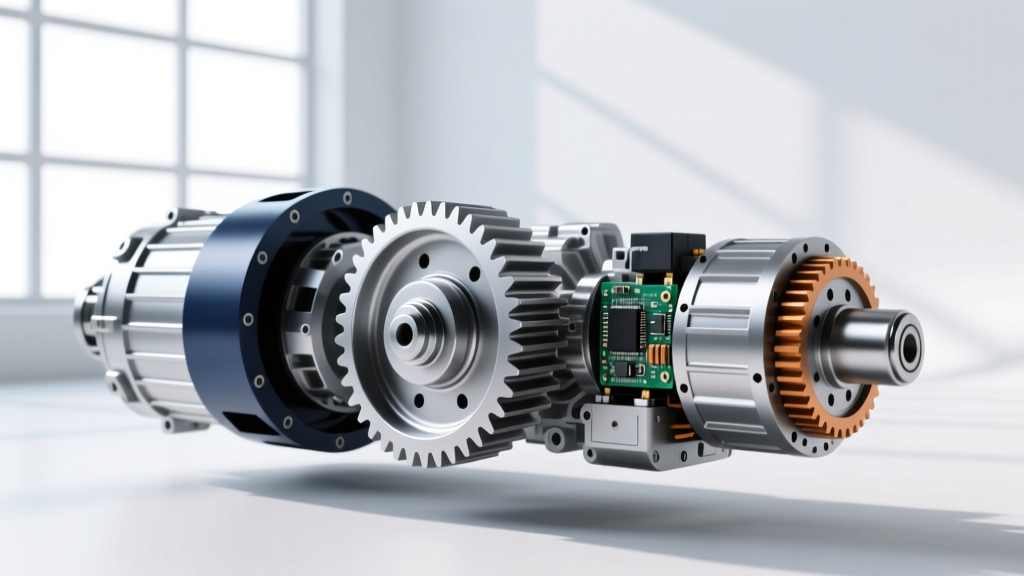
When traditional automotive technicians and enthusiasts first transition to working on battery-electric vehicles (BEVs), a fundamental question inevitably arises: does ev car have transmission systems similar to internal combustion engines? The short answer is yes, but the architecture is radically different. While a conventional vehicle relies on a complex multi-ratio gearbox—such as the ZF 8HP 8-speed automatic or the Ford 10R80 10-speed—to keep an internal combustion engine within its narrow power band, an electric vehicle utilizes a reduction gearbox. According to the U.S. Department of Energy, the electric motor's ability to generate maximum torque at zero RPM and safely rev past 20,000 RPM eliminates the need for multiple gear ratios in most applications.
Single-Speed Reduction Gears vs. ICE Automatics
To understand the electric motor and transmission relationship, we must look at the math. A typical 2.0L turbocharged ICE engine redlines at roughly 6,500 RPM and requires a transmission with ratios spanning from 4.7:1 (first gear) to 0.8:1 (overdrive), plus a final drive ratio of around 3.5:1. In contrast, the permanent magnet synchronous motors (PMSMs) found in modern EVs operate efficiently across a massive RPM spectrum.
Take the Tesla Model 3 Rear Drive Unit (RDU) as a benchmark. It utilizes a single-stage helical gear reduction with a fixed ratio of 9.734:1. Because the electric motor can safely spin up to 18,000 RPM, this single fixed ratio allows the vehicle to achieve a top speed of roughly 140 mph while still providing violent off-the-line acceleration. The transmission housing is typically cast aluminum, integrating the differential and the parking pawl mechanism directly into the drive unit casing. This eliminates the driveshaft, torque converter, and clutch packs found in traditional automatics, drastically reducing rotational mass and parasitic drivetrain loss.
Comparing Drivetrain Configurations
| Vehicle Platform | Transmission Type | Gear Ratio(s) | Max Motor RPM |
|---|---|---|---|
| Tesla Model 3 (Rear) | 1-Speed Helical Reduction | 9.734:1 | 18,000 RPM |
| Lucid Air (Grand Touring) | 1-Speed Planetary/Helical | 7.75:1 (approx) | 19,000 RPM |
| Porsche Taycan (Rear) | 2-Speed Dog-Clutch | 15.7:1 (1st) / 8.05:1 (2nd) | 16,000 RPM |
| Rivian R1T (Quad-Motor) | 1-Speed Reduction (Per Wheel) | 13.7:1 | 15,500 RPM |
The Multi-Speed Exception: Dog Clutches and 2-Speed EVs
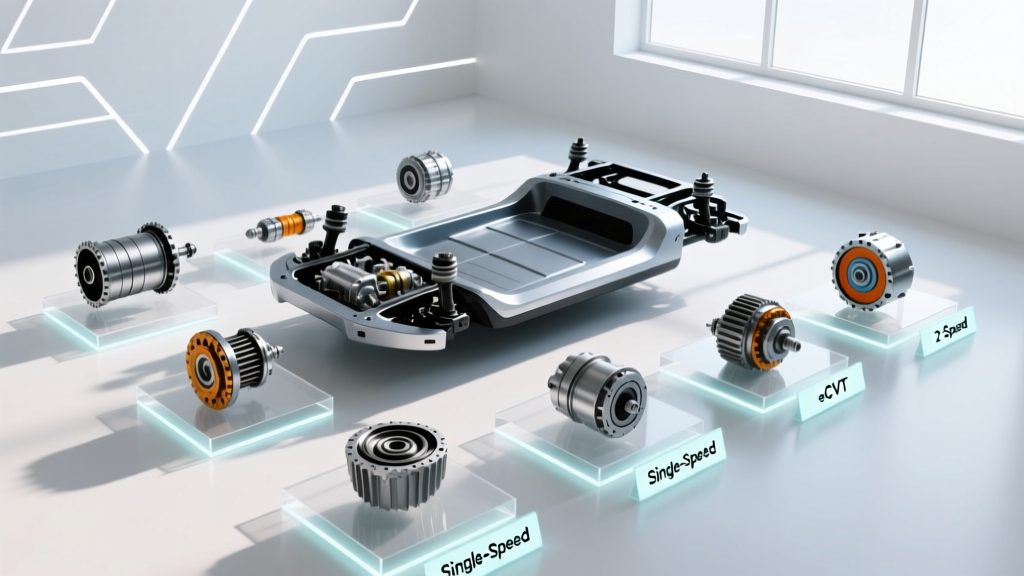
While 95% of the EV market relies on single-speed reducers, high-performance platforms demand a different approach to the electric motor and transmission integration. The Porsche Taycan and the Audi e-tron GT (sharing the J1 platform) feature a highly specialized 2-speed transmission on the rear axle. As detailed in Porsche's engineering whitepapers, the first gear features an exceptionally short ratio of roughly 15.7:1 to maximize launch control acceleration, while the second gear sits at 8.05:1 to ensure top-end efficiency and high-speed cruising capability.
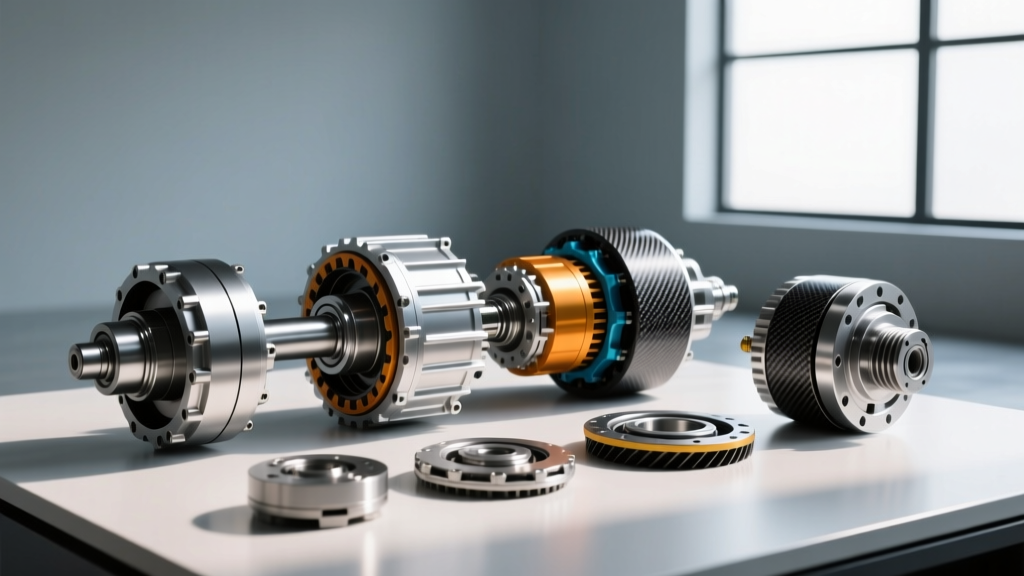
Crucially, this is not a traditional automatic transmission. It does not use a torque converter or wet friction clutches for shifting. Instead, it employs a pneumatic or electromechanical dog-clutch system. Dog clutches lock rotating components together via interlocking teeth, allowing for instantaneous, shift-shock-free gear changes without interrupting torque delivery. ZF's 2-speed EV transmission utilizes a similar concept, designed specifically to bridge the gap between the low-end torque multiplication required for heavy commercial EVs and the high-speed efficiency needed for highway cruising.
3-in-1 Drive Units and Dielectric Fluids
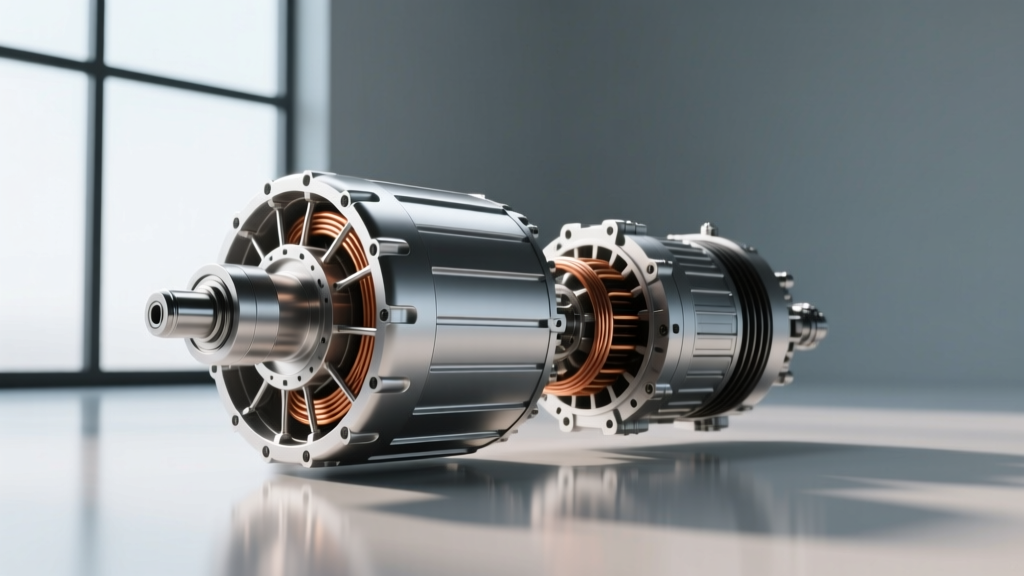
Modern EV engineering has moved away from discrete components bolted together with heavy cabling. Today, the electric motor and transmission are integrated into a '3-in-1' or 'e-Axle' drive unit, combining the motor, the power inverter, and the reduction gearbox into a single, liquid-cooled housing. This packaging efficiency reduces high-voltage cable lengths, minimizing electromagnetic interference (EMI) and weight.
This integration introduces severe tribological challenges. In many shared-sump designs, the transmission fluid must simultaneously lubricate high-speed helical gears, cool the differential bearings, and act as a dielectric coolant for the motor's copper stator windings. Standard automatic transmission fluids (ATFs) are electrically conductive and would cause catastrophic short circuits if they penetrated the motor windings. Therefore, automakers require specialized EV fluids, such as Castrol ON or Shell E-Fluids. These fluids boast high dielectric breakdown voltages (typically exceeding 30 kV) and specialized anti-wear additive packages that do not corrode the copper or the delicate polymer insulation on the motor windings.
Shop Floor Realities: Torque Specs and Failure Modes
For the drivetrain specialist, diagnosing and servicing an EV reduction gearbox requires a departure from traditional transmission rebuilding. You will not find burnt clutch packs or degraded torque converter stators. Instead, failure modes are heavily tied to NVH (Noise, Vibration, and Harshness) and high-speed bearing degradation.
- Bearing Whine and Pitting: Electric motors generate immense torque instantly, placing severe shock loads on the input and output shaft bearings. Deep groove ball bearings and tapered roller bearings in EV gearboxes often utilize ceramic hybrid designs or specialized low-viscosity greases to survive 20,000 RPM. Premature whining is often the first indicator of bearing race pitting.
- Spline Wear: The half-shafts (CV axles) mate directly into the differential side gears. The instant torque delivery, combined with regenerative braking torque reversal, can accelerate spline wear if the factory axle nut torque specs are not perfectly maintained.
- Parking Pawl Shear: Because EVs are incredibly heavy (often exceeding 5,000 lbs) and lack engine compression braking, the parking pawl inside the reduction gear housing endures massive static loads when parked on inclines without the electronic parking brake fully engaging first.
Critical Maintenance Specifications
While EV gearboxes are often marketed as 'lifetime' sealed units, severe duty cycles necessitate fluid exchange. When servicing a typical single-speed reduction gear, expect fluid capacities between 1.5 and 3.5 liters. Always use the OEM-specified dielectric fluid. For example, when reinstalling the heavy-duty rear axle nuts on a Tesla Model 3 rear drive unit to secure the CV half-shafts, the factory service manual dictates a yield-torque specification of 340 Nm. Failure to use new, single-use stretch nuts and a calibrated torque wrench will result in catastrophic spline stripping under full regenerative braking loads.
Expert Takeaway: The question 'does ev car have transmission' is fundamentally a question of terminology. EVs absolutely possess transmissions—highly engineered, precision-machined reduction gearboxes that must handle rotational speeds three times higher than any internal combustion engine, all while managing extreme thermal and electrical constraints.