The Core Question: Does an Electric Car Have a Gearbox?
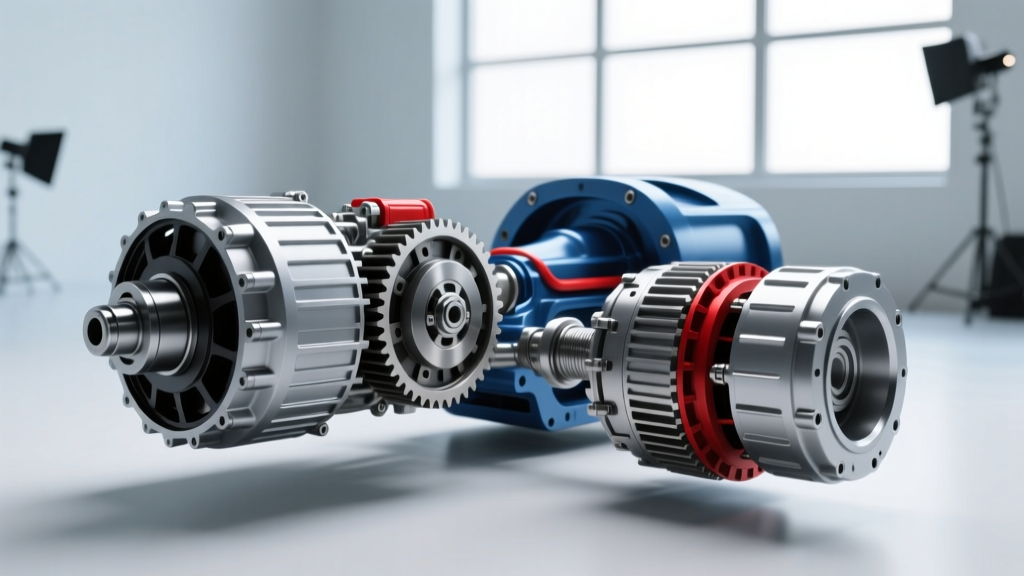
When enthusiasts transition from internal combustion engines to battery electric vehicles (BEVs), one of the most frequent technical questions asked on forums and at track days is: does electric car has gearbox components similar to a traditional manual or automatic? The short answer is yes, but the architecture is fundamentally different. Instead of a multi-speed transmission with complex planetary gear sets, clutch packs, or torque converters, the vast majority of modern EVs utilize a single-speed reduction gearbox, commonly integrated into a unit known as an eAxle.
Because electric motors produce maximum torque at zero RPM and can safely rev to 16,000–20,000+ RPM, multiple gears are generally unnecessary for daily driving. However, for performance applications, drag racing, or track duty, the single-speed EV gearbox becomes a critical bottleneck. Upgrading this reduction unit requires a deep understanding of gear ratios, high-RPM bearing limits, and instant-torque differential management.
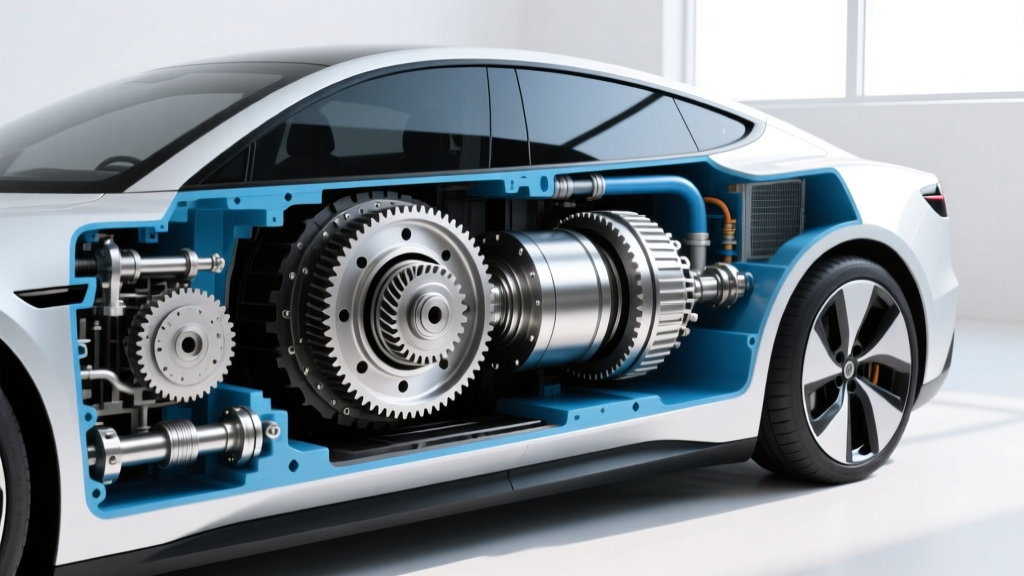
Expert Definition: An EV reduction gearbox is a single-ratio transmission that steps down the high rotational speed of the electric motor to a usable wheel speed while simultaneously multiplying torque. According to BorgWarner's eAxle engineering documentation, modern integrated eAxles combine the motor, inverter, and single-speed reduction gear into a single, oil-cooled housing to minimize parasitic loss and weight.
Anatomy of the Single-Speed eAxle
To understand how to upgrade an EV drivetrain, you must first understand the stock hardware. Most single-speed gearboxes utilize a parallel-axis or planetary gear arrangement. The motor shaft drives an input pinion, which meshes with an intermediate countershaft gear, which finally drives the differential ring gear. This two-stage reduction is necessary to achieve the high numerical ratios required to multiply the motor's torque.
Baseline Specs: Tesla Model 3 Rear Drive Unit (RDU)
The Tesla Model 3 and Model Y Rear Drive Unit is currently the most heavily modified EV gearbox in the aftermarket. Understanding its baseline specifications is crucial for any performance build.
- Stock Gear Ratio: 9.73:1 (Rear large motor configuration)
- Maximum Motor RPM: ~18,500 RPM (Stock software limit)
- Fluid Capacity: ~2.4 Liters
- Gear Cut: Helical (for NVH reduction and smooth power delivery)
- Differential: Open differential (major traction limitation)
Performance Upgrades: Manipulating the Final Drive
Unlike swapping a 4L60E for a built 4L80E in a GM V8, you cannot easily add 'gears' to a single-speed EV. Instead, performance upgrades focus on altering the final drive ratio, upgrading internal hardware to handle increased RPM and torque, and improving traction.
1. Helical Gear Ratio Swaps
If you are building an EV for drag racing or aggressive autocross, the stock 9.73:1 ratio may leave acceleration on the table. Aftermarket manufacturers like EV West and various boutique CNC machine shops offer alternative ring and pinion sets. By moving to an 11.5:1 or 12.1:1 final drive ratio, you multiply the torque delivered to the wheels significantly, dropping 0-60 mph times. The trade-off is a reduced top speed and higher energy consumption at highway cruising speeds, as the motor will spin at a much higher RPM to maintain 75 mph.
| Setup | Ratio | 0-60 mph Impact | Top Speed Impact | Highway Efficiency |
|---|---|---|---|---|
| Stock (Model 3 RWD) | 9.73:1 | Baseline (5.3s) | 140 mph | Optimal |
| Drag / Track Short | 11.50:1 | -0.6s to -0.9s | 115 mph | Reduced by 12-15% |
| High-Speed / Aero | 8.10:1 | +1.2s (Slower) | 165+ mph | Improved at 80+ mph |
2. High-RPM Bearing Upgrades
When you unlock the motor's software limits to push past 19,000 RPM, the stock deep-groove ball bearings inside the reduction gearbox become a catastrophic failure point. The axial loads generated by helical gears at extreme RPMs can cause the steel bearing cages to shatter. The mandatory upgrade for any high-RPM EV build is the installation of Ceramic Hybrid Bearings. Using Silicon Nitride (Si3N4) balls with high-temperature steel races, these bearings reduce rotational friction, run significantly cooler, and safely withstand the 22,000+ RPM limits of unlocked performance EV motors. Expect to pay between $600 and $900 for a full SKF or Timken ceramic hybrid bearing kit for a standard eAxle.
Traction Management: EV-Specific Limited Slip Differentials
The most glaring weakness of the single-speed EV gearbox is the open differential. Electric motors deliver 100% of their torque at 0 RPM. When launching a high-power EV, an open diff will instantly route power to the wheel with the least resistance, resulting in severe one-wheel peel and wasted kinetic energy. Furthermore, the abrupt torque spikes can shatter stock differential cross-pins.
Upgrading to a Limited Slip Differential (LSD) is the single most effective traction modification you can make to an EV drivetrain. However, you must choose an LSD designed for the unique torque curve of an electric motor.
- Wavetrac Torque-Biasing LSD: Excellent for track and street use. It uses a patented wave profile to prevent zero-load slip when one wheel lifts, providing seamless torque transfer without the harsh binding of a clutch-type diff.
- Cusco RS Type (1.5-Way or 2-Way): A clutch-type LSD preferred by dedicated drag and time-attack builders. It provides aggressive, immediate locking under the massive instant torque of an EV motor, ensuring both tires hook simultaneously off the line. Requires specific EV-compatible friction modifiers in the gear oil to prevent chatter.
Thermal & Lubrication Management for Track Use
The single-speed gearbox shares its lubrication fluid with the electric motor stator and rotor in many integrated eAxles. Under sustained track loads, the fluid temperature can exceed 120°C (248°F), leading to a breakdown in dielectric properties and gear scuffing. The stock Tesla Tesla Model 3 Owner's Manual specifies a proprietary fluid, but performance builders often require higher thermal stability.
For upgraded gearboxes, utilizing a dedicated EV transmission fluid like Castrol ON EV Fluid or Pentosin ATF 9 (depending on the specific OEM dielectric requirements) is critical. These fluids are engineered to maintain viscosity under high-shear conditions while remaining electrically non-conductive to protect the motor windings. For extreme builds, fabricating an external PTO-driven or electric water-to-oil heat exchanger routed to the vehicle's secondary cooling loop is necessary to keep gearbox temperatures below 90°C during consecutive track sessions.
When to Consider a Multi-Speed Conversion
While single-speed upgrades cover 95% of performance needs, the frontier of EV drivetrains includes multi-speed gearboxes. The Porsche Taycan, for example, utilizes a highly complex two-speed transmission on the rear axle (featuring a 16:1 first gear for brutal launches and an 8:1 second gear for top-speed efficiency). Retrofitting a true multi-speed gearbox into a custom EV swap or modifying an existing single-speed architecture to accept a secondary gear set is currently a bespoke, six-figure engineering endeavor. For now, manipulating the single-speed final drive and maximizing traction via LSDs remains the most viable, cost-effective path to EV performance supremacy.
Sourcing and Cost Breakdown
Building a bulletproof EV single-speed reduction gearbox requires specialized components. Below is a realistic cost breakdown for a comprehensive performance upgrade on a mainstream eAxle (e.g., Tesla Model 3 RDU or similar aftermarket swap axle).
| Component | Specification | Estimated Cost (USD) |
|---|---|---|
| Aftermarket Gear Set | 11.5:1 Ratio, CNC Billet Steel, Helical | $3,200 - $4,500 |
| Limited Slip Differential | Wavetrac or Cusco RS (EV Spec) | $1,300 - $1,800 |
| Ceramic Hybrid Bearings | Si3N4 Balls, High-Temp Steel Races | $600 - $950 |
| Heavy-Duty Axle Shafts | 300M Chromoly, Upgraded CV Joints | $1,100 - $1,600 |
| Specialty EV Dielectric Fluid | 3 Liters (Flush and Fill) | $80 - $120 |
| Specialist Labor | eAxle Teardown, Shim, and Blueprint | $1,500 - $2,500 |
Ultimately, answering the question of whether an EV has a gearbox opens the door to a highly specialized world of drivetrain engineering. By treating the single-speed reduction unit not as a sealed, untouchable component, but as a tunable final-drive system, builders can unlock the true, unadulterated performance potential of electric propulsion.