The Intersection of RPO G80 and Drivetrain Gearing
For decades, General Motors has relied on the RPO G80—officially the Eaton G80 locking differential—to provide half-ton and three-quarter-ton trucks with superior low-traction capability. Found in the Silverado 1500, Tahoe, Suburban, and Colorado, this automatic locking rear differential is a marvel of mechanical simplicity. However, its performance, lockup behavior, and overall drivetrain harmony are inextricably linked to your axle's gear ratio and the transmission it is paired with.
As we navigate the 2026 landscape of modern towing and off-road performance, understanding how the G80 interacts with numerically higher gear ratios (like 3.73 and 4.10) and advanced 10-speed transmissions (such as the GM 10L80 and 10L90) is critical for both repair professionals and advanced DIYers. This model-specific repair guide breaks down the exact specifications, gear ratio matrices, and rebuild data required to optimize your GM axle.
How the G80 Locking Mechanism Dictates Ratio Selection
Unlike electronic lockers or traditional clutch-type limited-slip differentials (LSD), the Eaton G80 utilizes a flyweight governor mechanism. When one drive wheel loses traction and spins exactly 100 RPM faster than the opposite wheel, centrifugal force throws the flyweight outward. This catches a latching bracket, which in turn forces a self-energizing clutch pack to lock the side gears to the differential case.
This mechanical threshold is where differential gear ratio and performance intersect. A numerically higher gear ratio (e.g., 4.10) multiplies torque more aggressively but also causes the slipping wheel to accelerate much faster under load compared to a highway-oriented 3.08 ratio. Consequently, a 4.10-geared axle will often trigger the G80 lockup more abruptly and rapidly than a 3.23-geared axle, altering the vehicle's traction characteristics on mixed-surface terrain.
G80 Gear Ratio & Performance Matrix
| Ring & Pinion Ratio | Primary Axle Application | Transmission Pairing | G80 Lockup Characteristic & Performance Impact |
|---|---|---|---|
| 3.08 / 3.23 | GM 8.6" 10-Bolt (Light Duty) | 6L80 / 8L45 | Delayed lockup. Wheel speed delta takes longer to reach 100 RPM. Best for highway cruising; prone to clutch slip if heavily loaded in mud. |
| 3.42 | GM 8.6" 10-Bolt (Standard Tow) | 8L90 / 10L80 | Balanced engagement. The factory 'sweet spot' for Silverado 1500s, providing predictable lockup during trailer launches on boat ramps. |
| 3.73 | GM 8.6" 10-Bolt / 9.5" 14-Bolt SF | 6L90 / 10L90 (Max Tow) | Aggressive lockup. High torque multiplication spins the slipping wheel rapidly, engaging the G80 almost instantly. Ideal for steep grade towing. |
| 4.10 | GM 9.5" 14-Bolt SF / 10.5" FF | 10L90 (HD Gas / AT4) | Instantaneous, harsh lockup. Maximum torque multiplication can cause driveline shock ('G80 Clunk') if throttle is not modulated on hard surfaces. |
Model-Specific Axle Configurations and Carrier Breaks
When servicing or upgrading the gear ratio on a G80-equipped axle, you must account for the carrier break. The differential carrier houses the G80 mechanism, and its physical dimensions change depending on the ring gear thickness required for different ratios.
GM 8.5-Inch and 8.6-Inch (10-Bolt) Axles
Common in the Silverado 1500, Tahoe, and GMC Sierra, these axles feature a critical carrier break at 3.08.
- Ratios 2.73 to 3.08: Require Eaton Carrier Part # 19585-010. The ring gear is thicker, requiring a carrier with a thinner mounting flange.
- Ratios 3.42 to 5.13: Require Eaton Carrier Part # 19586-010. The ring gear is thinner, necessitating a carrier with a thicker mounting flange to maintain proper gear mesh.
Repair Note: Attempting to install a 3.73 ring and pinion onto a 3.08 G80 carrier will result in severe backlash and ring gear bolt interference. Always verify the carrier part number stamped on the G80 housing before ordering ratio components.
GM 9.5-Inch (14-Bolt Semi-Floating) Axles
Found in older 1500HD, 2500 gas, and select Colorado ZR2 models, the 9.5-inch axle utilizes a much larger G80 unit. The carrier break here is typically at 3.73. Upgrading a 3.42 9.5-inch axle to a 4.10 ratio for larger off-road tires requires swapping the entire G80 carrier assembly, as the internal governor and clutch packs are specific to the carrier casting.
Fluid Specifications: The Friction Modifier Trap
The most common cause of G80 failure and delayed lockup is incorrect fluid maintenance. According to ACDelco Fluid Specifications, the Eaton G80 requires a standard 75W-90 GL-5 Synthetic Gear Oil (ACDelco Part # 88862624).
CRITICAL WARNING: Never add Limited-Slip Friction Modifier to a G80-equipped axle. The G80 is an automatic locker, not a clutch-type LSD. Friction modifiers reduce the coefficient of friction on the G80's self-energizing clutch pack, causing it to slip, overheat, and ultimately fail to lock, resulting in severe internal case galling.
Fluid Capacities:
- GM 8.6" 10-Bolt: 2.1 Quarts (approx. 2.0 Liters)
- GM 9.5" 14-Bolt Semi-Float: 2.75 Quarts (approx. 2.6 Liters)
Rebuilding the G80: Torque Specs and Setup Data
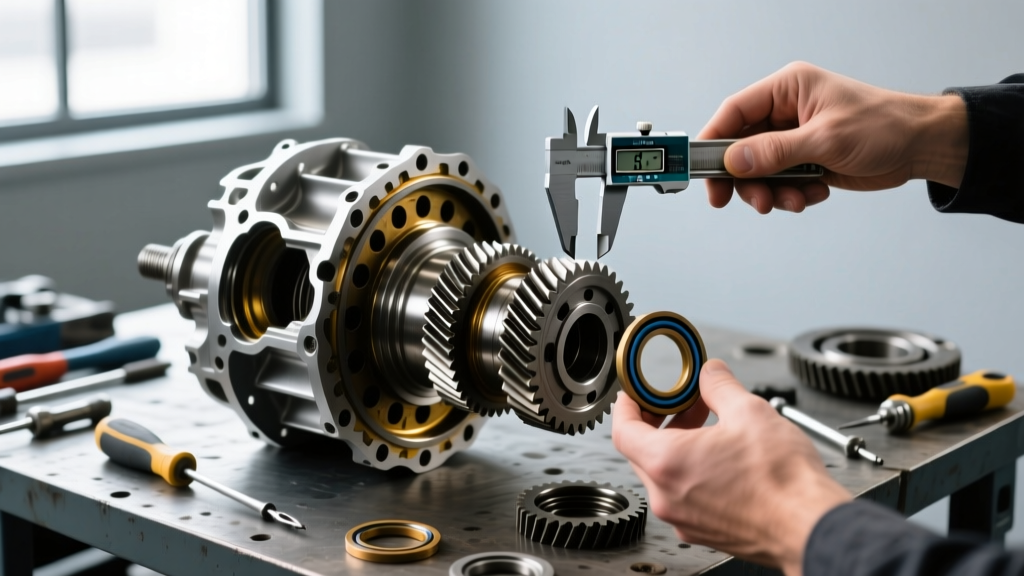
When performing a ring and pinion swap to alter your gear ratio, the G80 carrier must be removed, shimmed, and reassembled with exact precision. As detailed by Eaton's Official Drivetrain Division, the internal components are robust but intolerant of improper setup.
Essential Setup Measurements
- Ring Gear Backlash: 0.006" to 0.010" (0.15mm - 0.25mm). Measured at three equidistant points on the ring gear.
- Pinion Bearing Preload: 20 to 35 in-lbs (new bearings).
- Carrier Bearing Preload: Achieved via selective side shims. Target 15-25 in-lbs of rotational drag.
Fastener Torque Specifications
- Ring Gear Bolts (10-Bolt 7/16"-20): 74 lb-ft (100 Nm). Must use Loctite 272 (Red) or equivalent high-strength threadlocker.
- Carrier Bearing Cap Bolts: 60 lb-ft (81 Nm). Ensure cap alignment marks are perfectly matched to the housing to prevent bearing bore distortion.
- Pinion Nut (Crush Sleeve Axles): Torque to achieve specified preload (typically 250-350 lb-ft to crush the sleeve; do not overtighten once preload is met).
Diagnosing Ratio-Related G80 Noise and Clunking
A frequent complaint after altering gear ratios or servicing the G80 is a loud 'clunk' during engagement, or a persistent whine under load. Differentiating between a gear setup error and a G80 mechanical fault is vital.
The 'G80 Clunk' vs. Driveline Slack
When the flyweight engages the latching bracket, a mechanical clunk is normal, especially with 3.73 and 4.10 ratios where driveline torque is high. However, if the clunk is accompanied by a harsh shudder that shakes the chassis, inspect the following:
- Excessive Backlash: If ring gear backlash exceeds 0.012", the rotational slack will compound with the G80's internal lockup travel, creating a violent engagement. Re-shim the carrier.
- Worn Governor Spring: Over time, the governor return spring weakens. This causes the flyweight to flutter at the 100 RPM threshold, resulting in a 'ratcheting' or 'machine-gun' clunking noise before full lockup. Rebuild kit Part # 19586-010 (or equivalent master kit) includes updated spring tensions.
- U-Joint and Slip Yoke Wear: High numerical ratios multiply the torque applied to the driveshaft. What was a minor slip-yoke spline clunk with 3.08 gears becomes a major noise issue with 4.10 gears. Grease the slip yoke with GM-specific PTFE grease (Part # 12377985).
Final Thoughts on Drivetrain Optimization
The Eaton G80 locking differential remains one of the most reliable, purely mechanical traction devices ever put into mass production. By carefully matching your ring and pinion gear ratio to your specific transmission, tire size, and towing requirements, you can maximize the G80's lockup efficiency. Whether you are rebuilding a GM 8.6-inch 10-bolt for a daily-driven Silverado or re-gearing a 9.5-inch 14-bolt for a dedicated off-road Tahoe, adhering strictly to carrier break specifications, fluid purity, and torque data will ensure your drivetrain performs flawlessly for hundreds of thousands of miles.