The S54 Engine and the Reality of Clutch Plate Wear
The BMW E46 M3, powered by the legendary 3.2L S54 inline-six, produces 333 horsepower and revs to a stratospheric 8,000 RPM. While the Getrag 420G 6-speed manual transmission is incredibly robust, the engine's aggressive torque curve and high-RPM engagement frequently accelerate clutch plate wear. For owners tracking their M3 or pushing it on canyon roads, understanding the metallurgy of clutch disc types and materials is not just academic—it is the difference between seamless power transfer and catastrophic driveline failure.
In 2026, the aftermarket support for the E46 M3 remains vast, but selecting the wrong friction material for your specific flywheel setup can lead to immediate chatter, destroyed input shafts, or premature slip. This model-specific repair guide breaks down exactly how to diagnose wear, select the correct disc material, and execute a factory-grade replacement on the Getrag 420G platform.
Diagnosing Clutch Plate Wear on the Getrag 420G
Unlike modern hydraulic systems with self-adjusting clutch pedals, the E46 M3's clutch wear presents distinct mechanical symptoms. Before dropping the transmission, verify the failure mode:
- High-RPM Slip: If the engine RPM flares in 4th or 5th gear above 6,500 RPM under heavy load, the organic friction material has glazed or worn past its thermal threshold.
- Pedal Engagement Point: A worn disc pushes the diaphragm spring fingers outward, causing the engagement point to rise to the very top of the pedal travel.
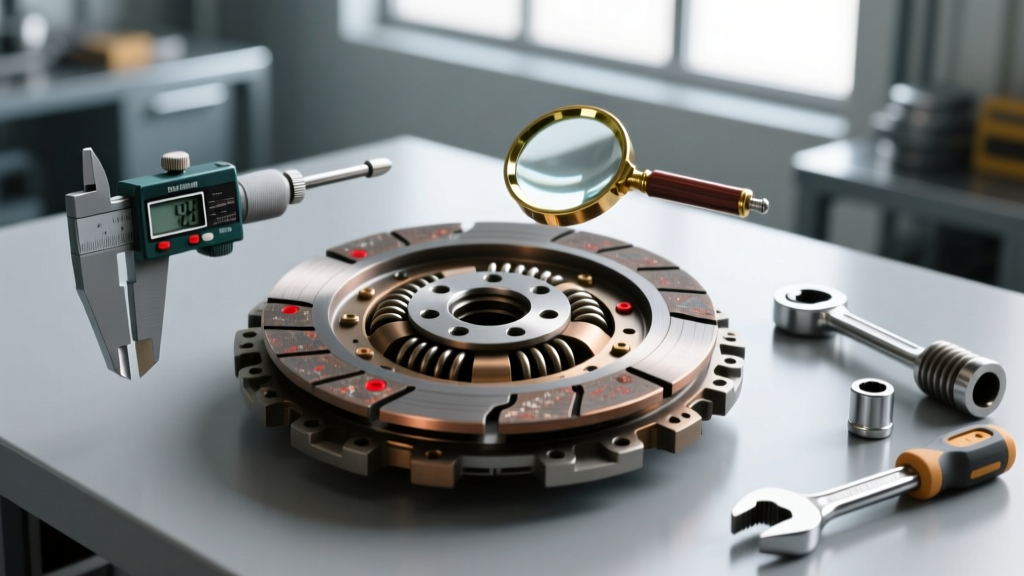
- Physical Measurement: Remove the rubber inspection plug on the lower bellhousing. Using a digital caliper, measure the friction material thickness. A brand-new E46 M3 clutch disc measures between 7.8mm and 8.2mm. The absolute service limit is 6.5mm. If you are at or below 6.8mm, replacement is mandatory.
Expert Insight: Never rely solely on pedal feel to diagnose clutch plate wear on an S54. The heavy-duty ZF Sachs pressure plate can mask up to 1.5mm of friction material loss before slip becomes obvious on the street.
Flywheel Dynamics: DMF vs. SMFW
Your choice of clutch disc material is entirely dictated by your flywheel. The factory E46 M3 utilizes a Dual Mass Flywheel (DMF) to dampen the S54's high-frequency torsional vibrations. DMFs require full-faced organic or mild Kevlar discs. Using aggressive sintered iron or ceramic 'puck' style discs on a DMF will destroy the internal arc springs within 500 miles due to the lack of friction dampening.
If you are upgrading to a Single Mass Flywheel (SMFW) setup (such as the aluminum or lightweight steel units from UUC Motorwerks or BimmerWorld), you unlock the ability to run sintered, ceramic, and multi-plate materials, though you will introduce gear rattle at idle.
Clutch Disc Types and Materials: What Fits the E46 M3?
When sourcing a replacement, you must match the friction coefficient to your torque output and drivability requirements. Below is a comparative analysis of the primary materials available for the 23-spline Getrag 420G input shaft.
| Material Type | Torque Capacity | Engagement Quality | Flywheel Requirement | Best Application |
|---|---|---|---|---|
| Full-Faced Organic | 400 - 450 lb-ft | Smooth, OEM-like | Dual Mass (DMF) | Daily Driving, Auto-X |
| Kevlar / Organic Blend | 450 - 500 lb-ft | Slightly aggressive | DMF or Heavy SMFW | Canyon Carving, Track Days |
| Sintered Iron (Puck) | 550 - 700+ lb-ft | Harsh, On/Off switch | Steel SMFW Only | Dedicated Track, Drift |
| Ceramic / Carbon Twin | 800+ lb-ft | Predictable but stiff | Multi-disc SMFW | Time Attack, Forced Induction |
1. OEM-Style Full-Faced Organic
The gold standard for the street-driven E46 M3 is the Sachs Performance Organic Kit (often cross-referenced under ZF part numbers). The organic resin and fiberglass weave provide excellent thermal recovery and smooth engagement, protecting the factory DMF and the Getrag 420G's synchros from shock loads. Expect a lifespan of 60,000 to 80,000 miles under normal driving conditions.
2. Sintered Iron and Puck-Style Discs
Sintered iron is created by fusing metallic powders under extreme heat and pressure. It offers immense clamping force and heat resistance, making it ideal for supercharged or turbocharged S54 builds pushing 600+ whp. However, sintered materials lack the marcel (wave) springs found in organic discs. When paired with an aftermarket steel SMFW from UUC Motorwerks, you gain immediate engagement but must accept significant driveline shock and idle gear rattle.
3. Ceramic and Multi-Plate Configurations
For extreme track use, twin-disc ceramic setups (like those from OS Giken or Tilton) distribute the clamping load across four friction surfaces. This allows for smaller disc diameters (reducing rotational mass and improving engine rev speed) while maintaining massive torque capacity. Ceramic materials are highly abrasive; slipping the clutch to manage low-speed maneuvers will rapidly gouge the flywheel mating surface.
Step-by-Step Repair & Installation Protocol
Replacing the clutch on an E46 M3 requires precision. The Getrag 420G is heavy (approx. 95 lbs), and misalignment during installation will score the input shaft splines or crack the bellhousing.
- Support and Removal: Support the engine with an under-hood bar. Drop the exhaust from the headers back, remove the driveshaft (mark the guibo and flex disc orientation), and unbolt the transmission crossmember.
- Flywheel Inspection: If retaining the DMF, check for radial play. If the outer mass moves more than 2mm side-to-side, or if there is visible grease leaking from the internal bearings, the DMF is condemned. DMFs cannot be resurfaced.
- Surface Preparation: If installing a new or resurfaced SMFW, clean the mating surface with CRC Brakleen and a lint-free cloth. Any oil residue will instantly contaminate the new organic or Kevlar disc.
- Disc Alignment: The Getrag 420G uses a specific 23-spline alignment tool. Do not rely on 'eyeballing' it. Insert the tool through the disc hub into the pilot bearing to ensure the transmission input shaft will slide in without binding.
- Pressure Plate Torquing: Install the pressure plate and hand-thread all M8 bolts. Tighten in a star pattern to prevent warping the diaphragm spring.
Critical Torque Specifications
Adhering to BMW TIS (Technical Information System) torque specs is non-negotiable to prevent fastener failure under the S54's harmonic vibrations.
- Flywheel to Crankshaft (M10x1.25): 100 Nm (74 lb-ft) + 90-degree turn. (Always use new stretch bolts).
- Pressure Plate to Flywheel (M8x1.25): 25 Nm (18 lb-ft).
- Transmission to Engine Block (M10): 45 Nm (33 lb-ft).
- Clutch Slave Cylinder (M6): 10 Nm (7 lb-ft).
- Driveshaft Guibo to Transmission Output Flange (M10): 65 Nm (48 lb-ft).
2026 Cost Breakdown & Sourcing
Pricing for high-quality driveline components has stabilized, but counterfeit parts remain a risk. Always source from authorized FCP Euro or direct-from-manufacturer channels to guarantee genuine ZF/Sachs metallurgy.
- OEM Sachs DMF & Organic Kit: $550 - $700 (Includes DMF, disc, pressure plate, release bearing, and pilot bearing).
- Aftermarket SMFW Conversion (Steel): $600 - $850 (Flywheel only).
- Sintered/Ceramic Disc & HD Pressure Plate: $450 - $650.
- Professional Labor (Independent BMW Specialist): 7 to 9 hours at $160/hr = $1,120 - $1,440.
Ultimately, mitigating clutch plate wear on the E46 M3 comes down to respecting the physics of the S54 engine. Match your disc material to your flywheel, adhere strictly to the torque sequence, and the Getrag 420G will reliably handle the abuse for years to come.