The Core Question: Is the Transmission Part of the Drivetrain?
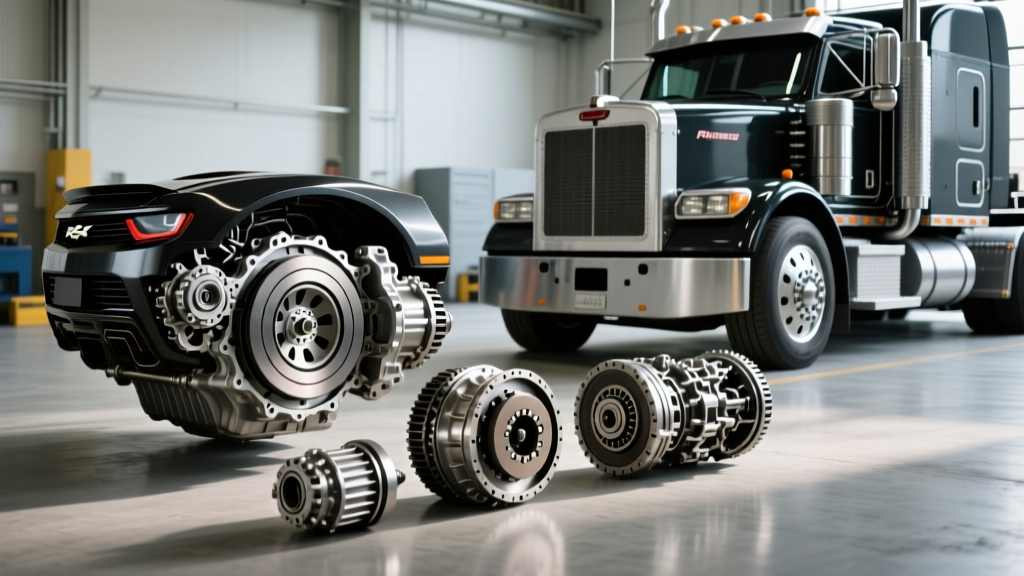
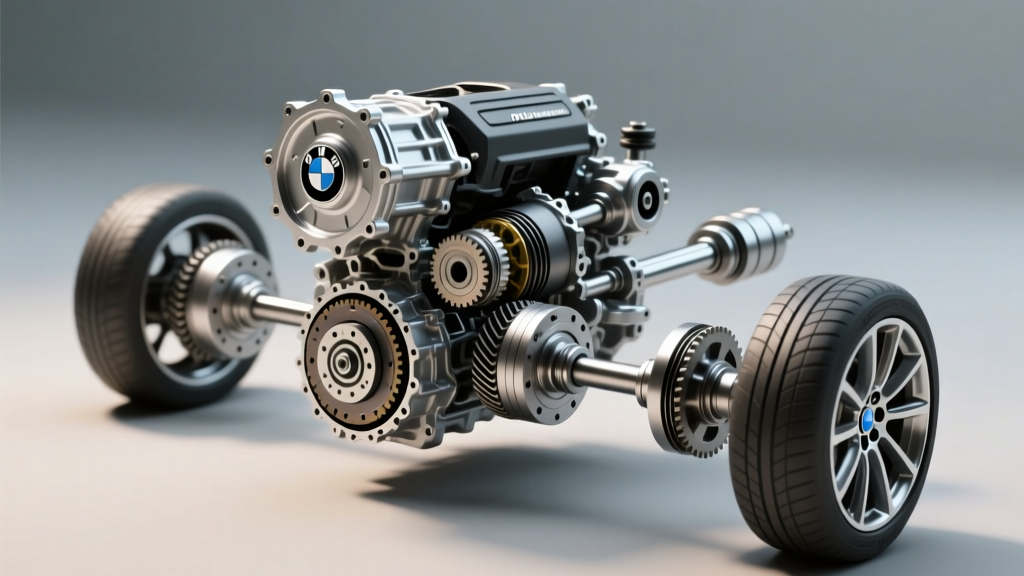
When a vehicle develops a harsh clunk, a high-speed vibration, or a slipping sensation, the immediate question for both technicians and owners is often: is the transmission part of the drivetrain? From a strict mechanical engineering perspective, the answer is an absolute yes. The drivetrain encompasses every component that transfers kinetic energy from the engine's crankshaft to the drive wheels. This includes the transmission, torque converter, driveshaft, U-joints, CV axles, differentials, and transfer cases.
However, from a diagnostic and warranty perspective, the distinction becomes critical. In modern automotive service, the 'Powertrain' typically refers to the engine and the transmission (including the torque converter and internal mechatronics). The 'Drivetrain' or 'Driveline' is often isolated to the components downstream of the transmission output shaft: the driveshaft, axles, and final drive. Understanding this boundary is the first step in accurate symptom diagnosis and troubleshooting.
Powertrain vs. Drivetrain: Why the Boundary Matters in Diagnosis
Misidentifying the source of a fault can lead to catastrophic misdiagnosis. A vibration at 55 mph might feel like a failing transmission torque converter, but could actually be an out-of-phase driveshaft. Modern OBD2 scanners isolate these systems into distinct modules. For example, in BMW's ISTA+ diagnostic suite, the EGS (Electronic Transmission Control) handles the ZF 8HP transmission, while the VTG module handles the transfer case, and the DSC module monitors individual wheel speed anomalies related to CV axles and final drives.
Furthermore, warranty coverage heavily relies on this distinction. Under the Magnuson-Moss Warranty Act and standard manufacturer contracts, a 'Powertrain Warranty' (often 100,000 miles) will cover a failed GM 6L80 valve body. However, a 'Drivetrain Warranty' might only cover the transfer case and differentials, leaving the transmission excluded if the contract defines the drivetrain strictly as the post-transmission components. Always consult the specific OEM warranty manual, but for mechanical troubleshooting, we treat the entire kinetic pathway as one integrated system.
Drivetrain Component Identification & Symptom Matrix
Effective troubleshooting requires isolating the symptom to the specific physical component. Below is a diagnostic matrix mapping common drivetrain components to their primary failure modes and diagnostic tests.
| Component | Common Failure Mode | Primary Symptom | Diagnostic Test / Verification |
|---|---|---|---|
| Torque Converter | Stator clutch slip / TCC shudder | Rhythmic shudder at 40-50 mph under light throttle | Monitor TCC Slip RPM via OBD2; should be < 20 RPM when locked. |
| Transmission Valve Body | Solenoid bore wear / debris | Harsh 2-3 shifts, delayed engagement in Reverse | Line pressure test; check for adaptive shift value limits in TCM. |
| Driveshaft U-Joint | Needle bearing brinelling | Metallic 'clunk' on gear engagement; squeak at idle | Visual play check; rotate shaft by hand while listening for grinding. |
| CV Axle (Outer) | Cage and race pitting | Rhythmic clicking on tight, low-speed turns | Full-lock figure-8 test in an open lot; inspect boot for grease sling. |
| Ring & Pinion (Diff) | Improper backlash / gear wear | Coast-side whine or howl during deceleration | Deceleration load test; verify gear oil for metallic glitter on drain plug. |
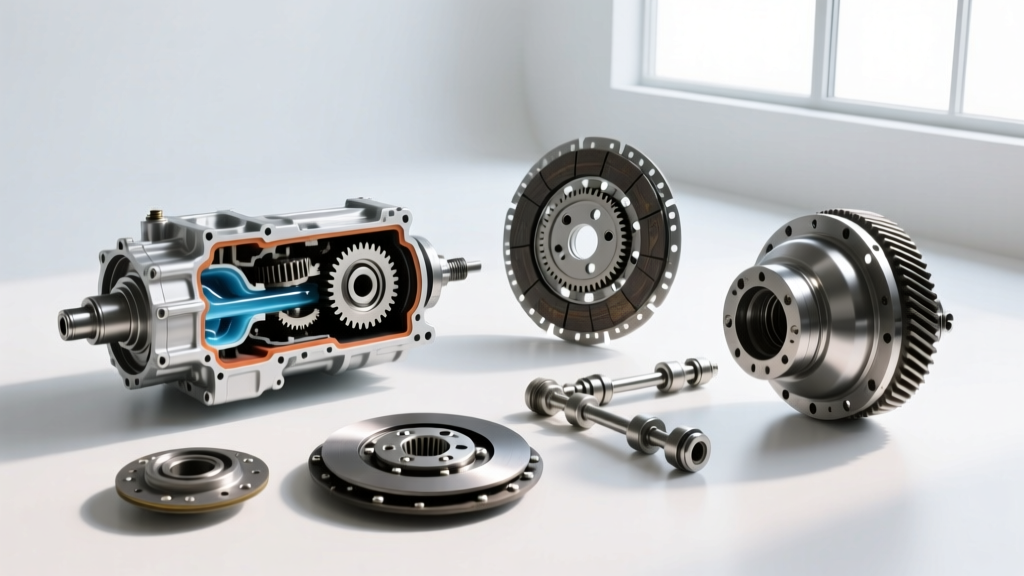
Deep Dive: Diagnosing Transmission Internals
When the fault lies within the transmission housing, the symptoms are usually load-dependent and tied to specific gear ratios or shift events. Let us look at two of the most common transmissions on the road today and their specific diagnostic signatures.
GM 6L80 / 6L90: The 3-5-Reverse Clutch Hub
The GM 6L80 is notorious for 3-5-Reverse clutch wave plate failure, which sends metallic debris into the TEHCM (Transmission Electro-Hydraulic Control Module). If a driver reports a loss of Reverse, 3rd, and 5th gears simultaneously, the transmission is the confirmed culprit, not the downstream driveline.
- Fluid Spec: Dexron VI (Capacity: 11.2L total, 6.0L service fill).
- Torque Spec: Bellhousing-to-engine bolts must be torqued to 50 Nm (37 lb-ft) in a star pattern to prevent case distortion.
- Diagnostic Step: Drop the pan. If you find metallic 'glitter' and fractured steel fragments, the 3-5-R hub is destroyed. Rebuilding or replacing the unit will cost between $2,800 and $4,200 in 2026 labor and parts markets.
ZF 8HP45 / 8HP70: Mechatronic Adaptation & Leaks
The ZF 8-speed is a masterpiece of engineering but is highly sensitive to fluid degradation and mechatronic sleeve leaks. A common symptom mistaken for a driveline vibration is actually a torque converter lockup issue caused by low fluid volume from a leaking mechatronic sleeve seal.
- Fluid Spec: ZF LifeguardFluid 8 (Capacity: ~9.5L dry, ~5.5L service fill).
- Torque Spec: ZF 8HP plastic transmission pan bolts are easily stripped. Torque spec is strictly 10 Nm (88 lb-in).
- Diagnostic Step: Perform a ZF adaptation reset via an advanced bi-directional scanner. If harsh shifts persist, check for bridged adapter seal leaks at the mechatronic-to-case interface. According to ZF Aftermarket guidelines, fluid must be checked at exactly 30°C to 50°C with the engine running and the vehicle perfectly level.
Deep Dive: Diagnosing Downstream Driveline Faults
If the transmission shifts smoothly and the torque converter locks up properly, the fault lies in the mechanical driveline. These components do not have electronic sensors; they must be diagnosed through NVH (Noise, Vibration, and Harshness) analysis.
Driveshaft and U-Joint Resonance
A driveshaft spinning at 3,000 RPM will amplify even a 0.050-inch imbalance into a severe cabin vibration. According to Dana Spicer engineering data, a failing 1310 or 1350 series U-joint will exhibit 'brinelling'—small indentations in the bearing races caused by static loading and lack of lubrication.
- Symptom: A high-frequency vibration peaking between 50-60 mph that disappears when you let off the throttle (coasting).
- Troubleshooting: Use a chassis ear or an NVH smartphone app mounted to the differential housing. If the vibration frequency matches the driveshaft RPM (which is faster than wheel speed but slower than engine speed), the driveshaft is out of phase or the U-joints are binding.
- Repair Cost: U-joint replacement is relatively inexpensive ($150-$300), but if the yoke is scored, a new shaft assembly can exceed $800.
Differential and Final Drive Wear
The differential reduces the high-speed, low-torque input from the driveshaft into low-speed, high-torque output for the axles. In a Ford 8.8-inch or Dana 44 differential, the ring and pinion gear set is highly dependent on precise backlash (typically 0.006 to 0.010 inches).
- Symptom: A distinct 'howl' or 'whine' that changes pitch with vehicle speed, specifically when 'coasting' (deceleration load). Drive-side noise usually indicates a tight pinion depth, while coast-side noise indicates wear or improper backlash.
- Torque Spec: Ring gear bolts on a Ford 8.8 must be torqued to 70-85 lb-ft with red Loctite. Left-hand thread on the pinion nut requires a specialized holding tool to prevent yoke rotation during removal.
Real-World Troubleshooting Framework
When a vehicle arrives with an ambiguous 'drivetrain' complaint, follow this strict isolation framework to avoid misdiagnosis:
- The Lift Test (Static): Raise the vehicle on a hoist. Run the engine and shift through gears. Listen for U-joint clunks and check for CV axle binding. If the vibration is present on the lift, it is rotational (driveshaft, flexplate, or torque converter).
- The Road Test (Dynamic Load): Drive the vehicle to the speed where the symptom occurs. Shift into neutral and coast. If the noise/vibration disappears, the fault is load-dependent (engine mounts, transmission internals, or differential gear mesh). If it persists, it is speed-dependent (wheel bearings, driveshaft imbalance, or tire runout).
- The OBD2 Slip Test: Monitor the Torque Converter Clutch (TCC) slip RPM. If the scanner shows the TCC commanding 'Locked' but slip RPM is fluctuating wildly (e.g., 50-150 RPM), the transmission torque converter is shuddering, not the driveline.
Summary: The Drivetrain as an Integrated System
So, is the transmission part of the drivetrain? Mechanically, yes. Diagnostically, it is the gateway to the rest of the system. As the Society of Automotive Engineers (SAE) outlines in their powertrain topology standards, the transmission modulates the torque that the downstream driveline must endure. A failing transmission (e.g., erratic line pressure) can easily shatter a downstream U-joint or strip differential side gears. Always diagnose the transmission's electronic and hydraulic health first, before condemning the mechanical driveline components. Understanding this hierarchy will save thousands of dollars in misdiagnosed parts and wasted labor hours.