Understanding the Honda CR-V Hybrid Drivetrain Architecture
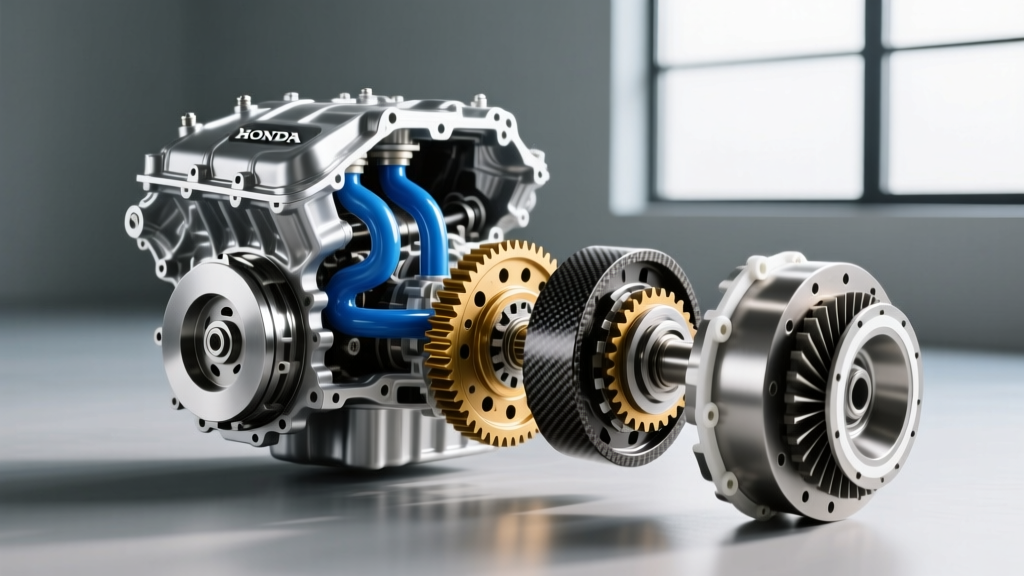
Before initiating a warranty claim, it is critical to understand the unique engineering of the honda cr v hybrid drivetrain. Unlike traditional automatic transmissions or the push-belt CVTs found in older vehicles, the CR-V Hybrid utilizes a sophisticated 2-motor e-CVT system. This assembly lacks a traditional torque converter and instead relies on a generator motor, a primary drive motor, and an engine direct-drive lock-up clutch. Furthermore, unlike some competitors that use an independent rear electric motor for all-wheel drive, Honda’s Real-Time AWD hybrid system employs a mechanical transfer case bolted directly to the e-CVT, sending power via a physical driveshaft to the rear differential.
This mechanical complexity means your drivetrain warranty covers a diverse array of high-voltage and mechanical components. In this 2026 guide, we break down exactly how to audit your coverage, document maintenance, and successfully execute a warranty claim at your local Honda dealership.
Step 1: Map Your Drivetrain Components to Warranty Tiers
Honda segments its warranty coverage into distinct tiers. A common mistake owners make is assuming the entire drivetrain falls under a single 'Powertrain' umbrella. The high-voltage components are governed by separate federal and state emissions/hybrid mandates.
| Component Category | Specific Parts Covered | Standard Warranty Term | CARB State Warranty Term |
|---|---|---|---|
| Mechanical Powertrain | e-CVT geartrain, AWD transfer case, mechanical driveshaft, rear differential, axles | 5 Years / 60,000 Miles | 5 Years / 60,000 Miles |
| Hybrid System (High Voltage) | Drive Motor, Generator Motor, Power Control Unit (PCU), High-Voltage Battery | 8 Years / 100,000 Miles | 10 Years / 150,000 Miles |
| Emissions Controls | Catalytic converter, hybrid-specific ECU mapping | 8 Years / 80,000 Miles | 15 Years / 150,000 Miles |
Note: If you reside in a CARB (California Air Resources Board) compliant state, your hybrid battery and motor coverage extends significantly. Always verify your state's emissions adoption status via the EPA's CARB guidelines.
Step 2: Audit Your Maintenance Records for Fluid Compliance
Dealerships will immediately pull your vehicle's service history when a major drivetrain claim is submitted. The most frequent reason for denied e-CVT or rear differential claims is improper fluid maintenance. Because the CR-V Hybrid AWD uses a mechanical rear differential, it requires strict adherence to Honda's fluid specifications.
Critical Fluid Specifications & Torque Specs
- e-CVT Transmission Fluid: Requires Honda HCF-2 (Part # 08200-HCF2). Do not use standard ATF or push-belt CVT fluids, as they lack the necessary dielectric properties and friction modifiers for the hybrid motor integration.
- Rear Differential Fluid (AWD Models): Requires Honda Dual Pump System Fluid II (DPSF-II, Part # 08200-9007). This fluid is specifically engineered for the dual-pump clutch mechanism in the rear differential.
- Service Intervals: While Honda's Maintenance Minder may suggest longer intervals under 'normal' driving, severe driving (towing, snow, mountain passes) dictates changing the rear DPSF-II every 30,000 miles.
- Torque Specifications: If you perform DIY maintenance, the rear differential drain and fill plugs require a torque of 32 lb-ft (43 Nm). You must replace the 18mm aluminum crush washer (Part # 90471-PX4-000) at every service to prevent seepage.
If a dealer denies a rear differential whine claim citing 'lack of maintenance,' but you used the correct DPSF-II fluid at an independent shop, you are protected under federal law (see Step 5).
Step 3: Perform Pre-Dealer OBD2 Diagnostics
Never tow your CR-V Hybrid to the dealer without first pulling the diagnostic trouble codes (DTCs). Hybrid drivetrain malfunctions often trigger specific high-voltage codes that generic auto parts store scanners cannot read. Invest in a bi-directional OBD2 scanner capable of reading Honda-specific hybrid modules.
Common Drivetrain & Hybrid Codes:
- P0A7D: Motor Generator Control Module 'A' Range/Performance (Indicates an issue with the PCU or drive motor stator).
- P0A0F: Engine Failed to Start (Often related to the high-voltage battery failing to engage the generator motor to crank the engine).
- P0AA6: Hybrid/EV Battery Voltage System Isolation Fault (A critical safety code indicating high-voltage leakage to the chassis, often from a degraded e-CVT seal or PCU coolant leak).
Document these codes, along with the exact driving conditions when the malfunction occurred (e.g., 'occurs only during regenerative braking above 45 mph'). This data is vital for the dealership's master technician.
Step 4: Navigate the Dealership Claim Process
When you arrive at the service drive, your phrasing dictates the trajectory of the claim. Do not say, 'I think my transmission is slipping.' Instead, state: 'I am experiencing a drivetrain malfunction characterized by [specific symptom], accompanied by DTC [Code]. I am submitting this for warranty diagnosis under the 8-year/100,000-mile Hybrid System warranty.'
The Diagnostic Fee Trap
If the vehicle is within warranty parameters, the diagnostic fee is covered. However, if the technician finds that an aftermarket modification (like an unapproved software tune or incorrect third-party fluid) caused the failure, you will be billed for the diagnostic time (typically $150–$225). Ensure your vehicle is entirely stock before submitting the claim.
Step 5: Appeal Denied Claims Using the Magnuson-Moss Act
If your claim is denied because you had your HCF-2 or DPSF-II fluid changed at an independent mechanic or performed it yourself, the dealership may attempt to void the warranty. This is illegal under the Magnuson-Moss Warranty Act. The burden of proof is on Honda to prove that your specific independent maintenance directly caused the drivetrain failure. If you have receipts showing you purchased OEM Honda HCF-2 and DPSF-II fluids, Honda Corporate's Zone Representative will almost always authorize a 'Goodwill' or full warranty repair to avoid FTC scrutiny.
Out-of-Pocket Cost Estimates (2026 Market Data)
If your vehicle is outside the warranty window, or if a claim is legitimately denied due to abuse, you must be prepared for the financial reality of Honda's hybrid drivetrain components. Below are the current 2026 national average estimates for parts and labor at a franchised Honda dealer.
| Component | Part Number (Reference) | Estimated Part Cost | Estimated Labor | Total Replacement Cost |
|---|---|---|---|---|
| e-CVT Assembly (2-Motor) | 28100-6B8-A00* | $4,200 - $5,500 | $900 - $1,200 | $5,100 - $6,700 |
| Power Control Unit (PCU) | 38897-6B8-A02* | $2,100 - $2,800 | $600 - $800 | $2,700 - $3,600 |
| Rear Differential (AWD) | 20100-6B8-A00* | $1,400 - $1,900 | $400 - $600 | $1,800 - $2,500 |
| High-Voltage Battery | 1D200-6B8-A00* | $2,500 - $3,200 | $500 - $700 | $3,000 - $3,900 |
*Part numbers are representative of the 2023-2026 generation 2-motor hybrid platform and vary by exact VIN. Always verify via Honda Owners Portal using your specific VIN.
Final Advice: Document Everything
The Honda CR-V Hybrid drivetrain is a marvel of mechanical and electrical engineering, but its integration means a failure in a $50 sensor can ground the entire high-voltage system. Keep a dedicated folder in your glovebox with every fluid change receipt, OBD2 scan log, and service invoice. If a drivetrain malfunction warning illuminates, pull over safely, capture the dash cluster with your smartphone, and follow this step-by-step protocol to ensure your warranty works for you, not against you. For persistent, unresolvable defects across multiple dealership visits, do not hesitate to file a formal complaint with the National Highway Traffic Safety Administration (NHTSA) to trigger a federal engineering analysis.