The True Cost of Searching 'Differential Oil Change Near Me'
When your maintenance minder trips or you hear a faint whine from the rear axle at highway speeds, the modern instinct is to pull out your phone and search for a differential oil change near me. It seems like a simple, routine service. However, as we navigate the 2026 automotive service landscape, the gap between a proper differential fluid service and a catastrophic drivetrain mistake has never been wider. Quick-lube chains and even some general repair shops frequently treat all gear oil as interchangeable, leading to destroyed limited-slip clutches, corroded yellow metals, and stripped aluminum drain plugs.
At AutoGearNexus, we believe in empowering drivers with exact specifications, real-world pricing, and mechanical transparency. Before you book that local appointment, you need to understand the cost breakdown of differential maintenance and the critical chemistry of API gear oil specifications. Let us break down exactly what you should be paying, and more importantly, what fluid should actually be going into your axle housing.
2026 Differential Service Cost Analysis: Dealer vs. Indy vs. DIY
The price of a differential fluid change varies wildly based on who is turning the wrench and what fluid they are pumping from the bulk tank. Below is a realistic cost breakdown for a standard rear differential service (e.g., Ford 8.8, GM 10-bolt, or Dana 44) in 2026.
| Service Provider | Estimated Cost (Front/Rear) | Fluid Type Typically Used | Risk Factor |
|---|---|---|---|
| DIY (Home Garage) | $35 - $65 | Premium Full Synthetic (e.g., Mobil 1, Red Line) | Low (if torque specs are followed) |
| Independent Shop | $110 - $160 | Bulk Conventional 80W-90 or Shop-Brand Synthetic | Medium (often miss LS additives) |
| Franchise Quick-Lube | $90 - $130 | Bulk 80W-90 GL-5 | High (frequent cross-contamination) |
| OEM Dealership | $180 - $275 | OEM Branded Synthetic + Exact Friction Modifier | Low (but highest labor rate) |
Where the Money Actually Goes
If you opt for the DIY route, a high-quality full synthetic 75W-90 gear oil (like Mobil 1 Synthetic Gear Lube, Part #104361) costs roughly $16 to $22 per quart. Most standard rear axles require between 2.0 and 3.5 quarts. Add in a $9 bottle of Limited-Slip (LS) friction modifier if your axle requires it, and a few dollars for new aluminum crush washers, and your total out-of-pocket is under $60.
Conversely, dealerships in 2026 are averaging $160 to $190 per hour for drivetrain labor. A dealership will charge you a premium for OEM-branded fluid (such as Mopar 75W-85 Synthetic, Part #68218655AA), which is often just a rebranded Valvoline or Pennzoil formulation. You are paying for the guarantee of the correct specification, but at a 300% markup over doing it yourself.
Decoding API Gear Oil Specifications: GL-4 vs. GL-5
The most common mistake made by shops advertising a cheap 'differential oil change near me' is ignoring the American Petroleum Institute (API) service classifications. Gear oil is not just about viscosity; it is about extreme pressure (EP) additive chemistry.
The Chemistry of Extreme Pressure (EP)
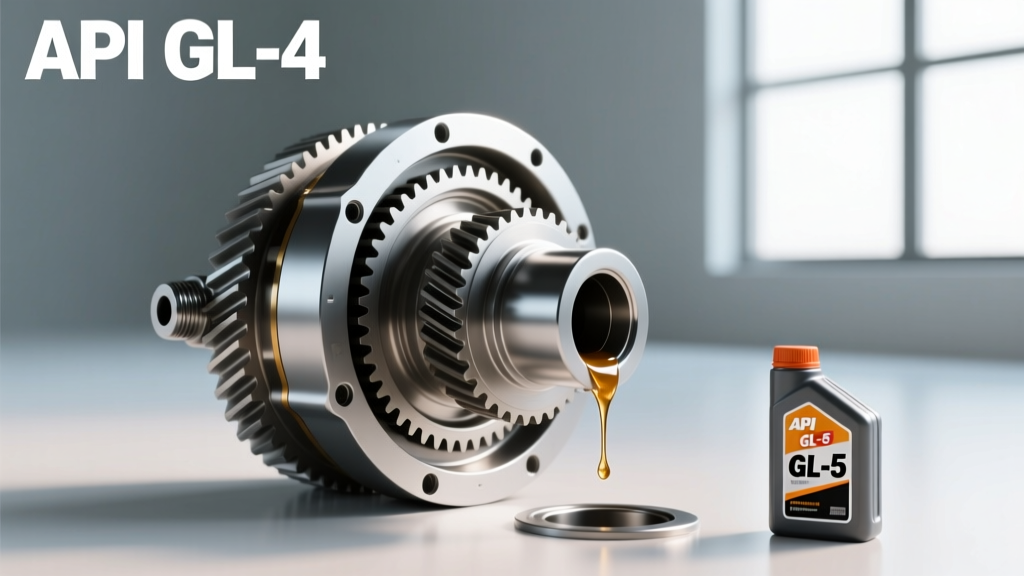
Hypoid gear sets (the ring and pinion in your axle) operate under immense sliding friction. To prevent the gears from welding together under load, gear oils rely on sulfur-phosphorus EP additives. According to API classification standards, GL-5 gear oil contains roughly twice the amount of these sulfur-phosphorus additives compared to GL-4.
- API GL-4: Designed for manual transmissions and transaxles where yellow metals (brass, bronze, copper synchronizers) are present. The lower EP additive count prevents sulfur from corroding the soft metals at high operating temperatures.
- API GL-5: Mandatory for hypoid differentials (rear and front axles). The high sulfur content protects the steel ring and pinion but will aggressively corrode yellow metals if used in an incompatible transaxle or transfer case.
Expert Warning: Never let a shop dump bulk GL-5 into a manual transmission or a transfer case with brass shift forks. The sulfur will eat the synchronizers, turning a $50 fluid change into a $3,500 transmission rebuild. Always verify the exact API requirement in your owner's manual.
Viscosity Grades and the Limited-Slip Additive Trap
Viscosity, measured by SAE International, dictates the fluid's film strength and flow characteristics. The most common grades are 75W-90 and 75W-140.
For 90% of daily-driven trucks and SUVs, a 75W-90 full synthetic is the optimal choice. It provides excellent cold-weather flow (reducing morning driveline bind) while maintaining a robust protective film at 100°C. However, if you are towing heavy trailers in high ambient desert heat, or running oversized 35-inch tires on a modified axle, stepping up to a 75W-140 provides a thicker shear-stable film that resists thermal breakdown.
The Limited-Slip (LS) Chatter Phenomenon
If your vehicle is equipped with a clutch-type Limited-Slip Differential (LSD) like the Ford Traction-Lok or Eaton Positraction, the base gear oil is only half the equation. Clutch packs require a specific friction modifier (often containing long-chain organic friction-reducing compounds) to allow the clutches to slip smoothly during tight cornering. If a local shop skips the $8 bottle of LS additive to save time, your differential will experience 'stick-slip' chatter—a violent shuddering that feels like the rear axle is skipping across the pavement. Over time, this shuddering glazes and destroys the clutch packs.
Real-World Application: Torque Specs and Capacities
When performing the service yourself, or auditing the shop that does it for you, precision matters. Over-torquing a fill plug on an aluminum differential cover will strip the threads, requiring a costly helicoil repair or full cover replacement. Below are exact specifications for three of the most common axles on the road today.
1. Ford 8.8-Inch Rear Axle (F-150, Mustang, Ranger)
- Capacity: 2.5 to 3.0 Quarts (varies by cover depth)
- Spec: API GL-5, SAE 75W-90 Synthetic
- Friction Modifier: Required for Traction-Lok (Ford XL-3 or equivalent)
- Fill Plug Torque: Many are 3/8-inch square drive friction-fit; if threaded, torque to 20 lb-ft.
2. GM 8.5 / 8.6-Inch 10-Bolt & 12-Bolt (Silverado, Tahoe, Camaro)
- Capacity: 2.0 to 2.5 Quarts
- Spec: API GL-5, SAE 75W-90
- Friction Modifier: Required for Eaton G80/Locking diffs (GM EOS Additive)
- Fill/Drain Plug Torque: 15mm Hex or 3/8-inch drive, torque to 22 lb-ft.
3. Dana Spicer 44 (Jeep Wrangler, Ford Super Duty Front)
- Capacity: 2.0 Quarts (Rear), 2.5 Quarts (Front)
- Spec: API GL-5, SAE 75W-90 or 80W-90
- Fill/Drain Plug Torque: 3/8-inch square drive or 1/2-inch NPT, torque to 25-30 lb-ft (Reference: Dana Spicer Service Manuals).
Final Verdict: Should You Book That Local Appointment?
Typing 'differential oil change near me' into your search engine is a great way to find a shop, but it is a terrible way to guarantee your drivetrain's longevity. The convenience of a local quick-lube often comes at the expense of specification accuracy. Shops that rely on a single bulk tank of 80W-90 GL-5 are gambling with your limited-slip clutches and transfer case synchros.
If you choose to use a professional shop, treat it like a surgical procedure: call ahead, ask them exactly what brand and API rating of fluid they use, and explicitly confirm whether they will add the required friction modifier for your specific axle. If they hesitate, or if they tell you 'gear oil is just gear oil,' hang up the phone. For the mechanically inclined, a DIY differential service remains one of the highest-ROI maintenance tasks you can perform in your driveway, saving you over $150 while guaranteeing the exact chemical protection your ring and pinion gears demand.