The Evolution of Differential Noise Diagnosis
When a customer rolls into the service bay complaining of rear axle noise, the traditional diagnostic path is well-worn: check the fluid level, inspect for metallic glitter on the drain plug, and listen for ring-and-pinion whine or bearing growl. However, in the modern automotive landscape of 2026, the rear axle is rarely just a collection of mechanical gears. The proliferation of torque-vectoring differentials—such as the GKN Twinster, Audi Sport Differential, and BMW's Dynamic Performance Control (DPC)—has transformed the differential into a complex mechatronic system.
For the expert technician, differential noise diagnosis now requires a dual-pronged approach. You must differentiate between true acoustic noise (mechanical wear, gear backlash, bearing spalling) and electronic 'noise' that manifests as physical symptoms. Specifically, signal degradation in actuator position sensors can cause the electronic control module to rapidly cycle the clutch packs, resulting in a severe mechanical chatter that mimics a failing limited-slip unit. To accurately diagnose these systems, technicians must understand the intersection of mechanical hydraulics and digital signaling, including the role of differential pulse code modulation in sensor feedback loops.
Acoustic Noise vs. Electronic Signal Noise
Before tearing down a rear axle assembly, it is critical to categorize the noise. Mechanical faults typically present as frequency-dependent sounds. A pinion bearing whine will change pitch precisely with vehicle speed, while a clutch pack chatter will occur during specific load transitions (e.g., trail-braking into a corner).
Electronic faults, however, occur when the Chassis Control Module or AWD ECU receives corrupted data regarding the physical position of the differential's internal clutch packs. When the ECU commands a specific clutch clamping force, it relies on a position sensor to verify the actuator motor's rotation. If the feedback signal is corrupted, the ECU assumes the clutch is slipping or out of position. It will then rapidly pulse the actuator motor to correct the perceived error. This rapid micro-cycling causes the clutch friction plates to slip and grab hundreds of times per second, generating a low-frequency acoustic chatter or binding sensation that feels exactly like a mechanical failure.
Understanding Differential Pulse Code Modulation in Axle Sensors
To prevent electromagnetic interference (EMI) from the vehicle's braking systems, alternators, and high-voltage architectures, modern active differentials do not rely on simple analog voltage signals for actuator feedback. Instead, they utilize digital encoding transmitted over a twisted-pair wiring harness. This is where differential pulse code modulation becomes a vital concept in drivetrain diagnostics.
The actuator position sensor encodes the physical angle of the clutch cam ring into a digital pulse stream. By transmitting this data over a differential pair (where one wire carries the signal and the other carries the inverse signal), the receiving ECU can subtract the two signals. This mathematical subtraction cancels out any common-mode noise induced by the harsh undercarriage environment. The pulse code modulation ensures that the precise position of the clutch pack is communicated with zero latency and high fidelity.
Expert Insight: If the twisted-pair wiring harness chafes against the rear subframe, or if internal fluid contamination degrades the sensor's magnetic encoder ring, the differential pulse code modulation signal will experience bit errors. The ECU will flag a rationality fault, default the axle to open-differential mode, and the driver will experience erratic handling and physical clunking as the actuator motor violently resets to its home position.
Fluid Specifications: The Mechatronic Link
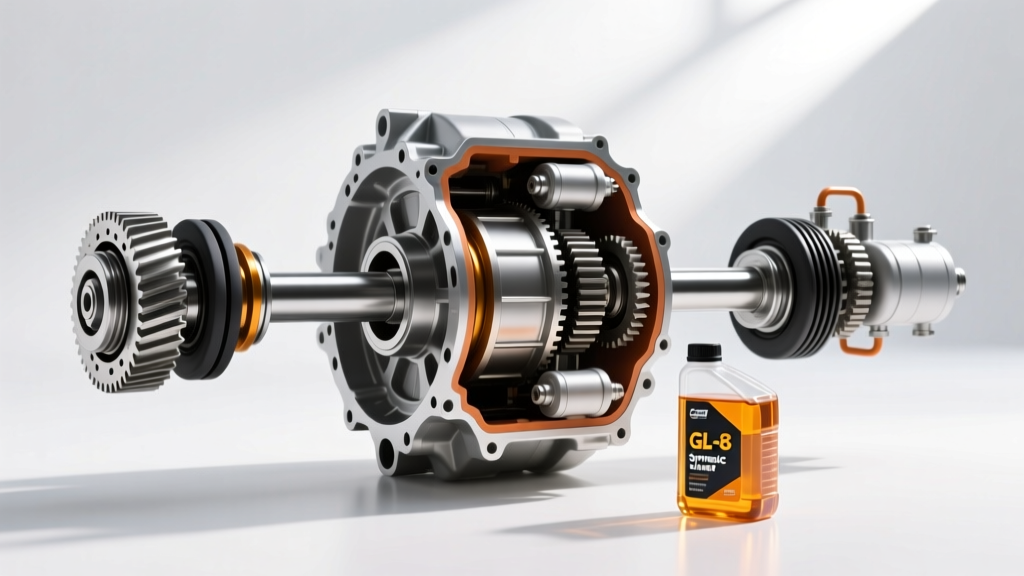
You cannot diagnose an electronic active differential without evaluating its fluid. The fluid in a torque-vectoring axle is not merely a lubricant for the hypoid gears; it is a critical hydraulic and friction medium for the wet clutch packs. Using the incorrect fluid alters the friction coefficient, which directly triggers the electronic signal faults described above.
- Audi Sport Differential (0BA): Requires exactly 1.1 Liters of G 052 145 S2. This fluid contains proprietary friction modifiers designed for the ZF-supplied twin-clutch vectoring packs. Drain plug torque: 45 Nm. Fill plug torque: 45 Nm.
- GKN Twinster (e.g., Ford Focus RS, Opel Insignia): Requires approximately 1.8 Liters of WSS-M2C942-A equivalent. Standard 75W-90 GL-5 will cause severe clutch chatter. Drain/Fill torque: 35 Nm.
- BMW Dynamic Performance Control (ZF): Requires specific DTF 1 or OEM-specified transfer case/diff fluid depending on the exact G-chassis variant. Drain plug torque: 60 Nm.
If a technician mistakenly services an Audi Sport Differential with standard 75W-85 GL-5 gear oil, the lack of specific friction modifiers will cause the clutch packs to slip. The actuator position sensor will report a physical position that does not match the ECU's commanded hydraulic pressure. The ECU will interpret this as a sensor fault, corrupting the differential pulse code modulation data stream, and ultimately setting a permanent DTC (e.g., Audi code 0226A - Clutch Position Sensor Implausible Signal).
Troubleshooting Matrix: Mechanical vs. Electronic Faults
| Symptom | Mechanical Cause | Electronic / Signal Cause | Diagnostic Tool |
|---|---|---|---|
| High-pitch whine on deceleration | Pinion bearing preload loss or gear wear | N/A (Strictly mechanical) | Chassis ears / Stethoscope |
| Low-frequency chatter in tight turns | Glazed clutch plates, wrong fluid | Actuator motor hunting due to signal dropout | Oscilloscope / Scan Tool |
| Binding / Axle hop at low speed | Seized cam ring, broken thrust bearing | ECU defaulting to locked state due to CAN fault | Bi-directional Scan Tool |
| Intermittent clunk on throttle lift | Excessive ring gear backlash | Actuator gear train backlash (motor side) | PicoScope & Breakout Box |
Scoping the Actuator: Best Practices for Signal Verification
To definitively rule out electronic noise masquerading as mechanical noise, you must view the live data stream. Relying solely on an OBD2 scan tool is insufficient, as scan tools only display the ECU's final interpreted value, not the raw signal quality.
Step 1: Access the Sensor Harness
Locate the actuator motor and position sensor assembly on the differential housing. On GKN Twinster units, this is typically a cylindrical motor mounted directly to the side of the axle casing. Identify the twisted-pair signal wires in the connector.
Step 2: Connect the Oscilloscope
Using a high-quality automotive oscilloscope like the PicoScope 4425A, connect Channel A and Channel B to the differential signal pair using piercing probes or a breakout box. Set your timebase to capture the pulse width modulation or digital pulse code stream as the actuator moves.
Step 3: Analyze the Waveform
Command the differential clutch actuator to cycle using a bi-directional scan tool. Observe the waveform. A healthy differential pulse code modulation signal will display crisp, square waves with uniform amplitude (typically 0-5V or 0-12V depending on the architecture). The inverse channel should perfectly mirror the primary channel. If you see rounded edges, voltage drops, or common-mode noise bleeding into the signal trace, you have identified the root cause of the mechanical chatter. The ECU is starving for accurate position data.
Step 4: Inspect the Physical Encoder
If the wiring harness tests perfectly, the fault lies inside the differential. The magnetic encoder ring attached to the actuator shaft may be contaminated with metallic debris suspended in the gear oil. This debris disrupts the magnetic field, causing the Hall-effect sensor to misread the position and corrupt the pulse code modulation data. In this scenario, a complete differential flush, internal cleaning, and fluid replacement with the exact OEM friction-modified fluid is required.
Industry Standards and Future-Proofing Your Diagnostics
As vehicles continue to integrate chassis dynamics with powertrain management, the line between 'drivetrain' and 'network' will entirely vanish. Organizations like SAE International continuously update standards regarding axle lubricants and electronic interfaces, emphasizing that fluid chemistry directly impacts sensor viability and clutch actuation speeds. Furthermore, tier-1 suppliers like Bosch Mobility Solutions are increasingly embedding the position sensors directly into the ECU's silicon logic, requiring module-level replacements if the internal encoder fails.
Mastering differential noise diagnosis in the modern era means looking beyond the gears. By understanding how mechanical friction, specialized fluid chemistry, and differential pulse code modulation signals interact, you can accurately diagnose active axle faults, save customers from unnecessary $3,000 differential replacements, and restore the precise torque-vectoring dynamics the vehicle was engineered to deliver.