The Economics of Hypoid Gear Protection
When evaluating the lifecycle of modern drivetrains, the intersection of mechanical stress and lubrication chemistry is where your wallet either thrives or bleeds. The hypoid gear sets found in solid axles and independent rear suspensions operate under extreme sliding friction. Protecting these differential gears requires specialized extreme pressure (EP) additives that inevitably break down over time. As of 2026, the automotive lubricant market has seen a stabilization in synthetic base oil pricing, yet dealership service centers continue to apply massive markups on routine axle services. Understanding the exact specifications, fluid capacities, and hardware costs is the only way to accurately forecast your drivetrain maintenance budget and avoid catastrophic ring-and-pinion failures.
Decoding Gear Oil Specifications: GL-5 and SAE J306
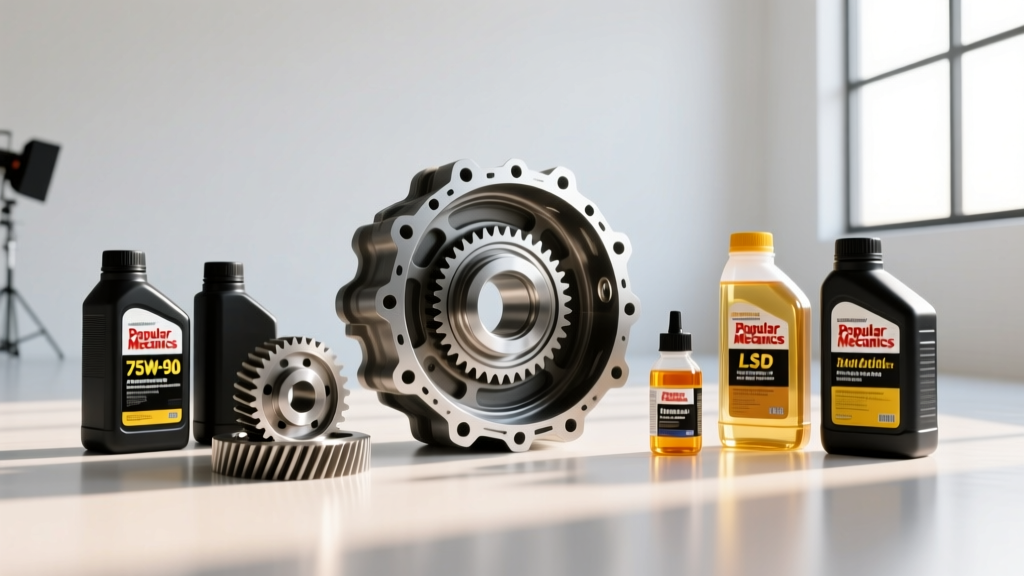
Before analyzing costs, we must establish the baseline engineering requirements. The SAE J306 standard dictates the viscosity grading for automotive gear oils, ensuring that a 75W-90 fluid maintains its protective film strength across extreme temperature variances. However, viscosity is only half the battle. The American Petroleum Institute (API) classifies gear oils by performance, and for modern hypoid differentials gears, API GL-5 is the mandatory minimum.
GL-5 fluids contain high levels of sulfur-phosphorus EP additives. Under the immense shear forces of a hypoid ring and pinion gear, these additives react with the metal surface to create a sacrificial solid film, preventing metal-on-metal welding. Using a GL-4 fluid in a GL-5 application will starve the gears of this protection, leading to rapid pitting and a $2,500+ rebuild bill. You can verify current API licensing and certification standards via the API EOLCS database.
2026 Fluid Price Breakdown: Synthetics vs. Conventional
The cost of the fluid itself varies wildly depending on the base stock and additive package. While conventional mineral-based 80W-90 oils are cheap upfront, they suffer from rapid oxidation when subjected to the 200°F+ bulk oil temperatures generated during towing or highway driving. Full synthetics offer superior shear stability and extended drain intervals.
| Brand & Product | Viscosity / Spec | Base Type | Price Per Qt (2026) | Cost for 3-Qt Service |
|---|---|---|---|---|
| Valvoline High Performance | 80W-90 GL-5 | Conventional | $7.50 | $22.50 |
| Mobil 1 Synthetic Gear Lube | 75W-90 GL-5 | Full Synthetic | $11.99 | $35.97 |
| Red Line ShockProof Gear Oil | 75W-90 GL-5 | Synthetic / Solid Dispersant | $19.50 | $58.50 |
| OEM Dealer Fluid (e.g., Toyota) | 75W-85 GL-5 | Semi-Synthetic | $16.00 | $48.00 |
For daily drivers and light-duty trucks, a high-quality full synthetic like Mobil 1 or Amsoil Severe Gear offers the best cost-to-protection ratio. Reserve ultra-premium fluids like Red Line ShockProof for dedicated off-road rigs or high-horsepower drag applications where shock-loading is severe.
The Hidden Cost of Limited-Slip Friction Modifiers
If your vehicle is equipped with a clutch-type limited-slip differential (LSD)—such as the Ford Traction-Lok, Dana Trac-Lok, or GM G80 Eaton locker—standard GL-5 gear oil is not enough. The clutch packs require a specific friction modifier to prevent binding, shuddering, and premature wear during low-speed cornering.
- Motorcraft XL-3 Friction Modifier: ~$8.50 per 4oz bottle.
- ACDelco Limited Slip Axle Lubricant Additive (10-9004): ~$11.00 per 4oz bottle.
- Pre-Modified Synthetics: Some oils, like Red Line 75W-90, already contain friction modifiers, saving you the $10 additive cost and the hassle of measuring.
Warning: Skipping the $10 friction modifier to save money will result in aggressive clutch pack chatter within 500 miles. The resulting shudder not only degrades driving comfort but generates metallic debris that will contaminate the axle bearings, turning a $45 DIY fluid swap into a $1,200 differential teardown.
Axle-Specific Capacities, Torque Specs, and Hardware
One of the most common mistakes in driveway differential services is misjudging fluid capacity or over-torquing drain and fill plugs. Stripping the threads on an aluminum differential cover (common on modern ZF and GM 9.5-inch axles) necessitates a complete cover replacement or helicoil repair, adding $150+ to your project cost.
| Axle Model | Approx. Capacity | Fill/Drain Plug Torque | Sealing Method |
|---|---|---|---|
| Ford 8.8 (Solid) | 2.5 - 3.0 Qts | 35 lb-ft | RTV or Gasket |
| Dana 44 (JK/JL Rubicon) | 2.0 - 2.5 Qts | 25 lb-ft (Aluminum Cover) | RTV or Gasket |
| GM 10-Bolt (8.5/8.6) | 2.0 - 2.2 Qts | 22 lb-ft | RTV Silicone |
| Toyota 8" (Solid Rear) | 3.0 - 3.2 Qts | 30 lb-ft (M12 Bolt) | Crush Washer |
Gaskets vs. RTV Silicone: A Long-Term Cost Analysis
When dropping a differential cover for a thorough cleaning or gear inspection, you must reseal the mating surface. The traditional method involves scraping the old gasket and applying a bead of RTV silicone.
Pro-Tip: Permatex Ultra Black (Part #81182) costs around $9.00 per tube and is highly resistant to synthetic gear oils. However, it requires a 24-hour cure time before filling with fluid, which means your vehicle is out of commission for a full day.
For a higher upfront cost but massive long-term ROI, reusable elastomer gaskets like the Lube Locker series (e.g., LL-F88 for Ford 8.8, retailing at ~$32.00) are a game-changer. They seal instantly with no RTV, require no cure time, and can be reused indefinitely. Over the lifespan of a truck that sees differential services every 30,000 miles, a Lube Locker gasket pays for itself by the second oil change while eliminating the risk of RTV beads breaking off and clogging the oil pickup or pinion bearings.
DIY vs. Dealership: Labor Margins and Shop Fees
The financial disparity between performing a differential gear oil service yourself versus visiting a dealership in 2026 is staggering. A typical rear differential service at a franchised dealership involves 0.5 to 0.7 hours of billed labor. At an average dealer rate of $175/hour, plus a 10% shop supplies fee and OEM fluid markups, a simple drain-and-fill easily exceeds $160. If the vehicle requires a rear cover removal (no drain plug), the labor time jumps to 1.2 hours, pushing the bill past $250.
Conversely, the DIY cost for a synthetic fluid swap on a standard solid axle is roughly $45 (including fluid, a new crush washer, and a pump). The only specialized tool required is a fluid transfer pump ($12) and the correct socket or 3/8-inch square drive for the fill plug. By investing two hours of your own time, you keep over $100 in your pocket while guaranteeing that the correct GL-5 synthetic fluid and exact torque specifications are applied to your drivetrain.
Final Verdict: Maximizing Drivetrain ROI
Maintaining the differential gears and axle bearings is an exercise in preventative economics. The cost of a premium 75W-90 synthetic gear oil and a high-quality friction modifier is a fraction of a percent of the cost of a replacement ring-and-pinion set or a complete crate axle. By understanding the SAE J306 viscosity requirements, respecting the torque limits of modern aluminum axle housings, and leveraging reusable gasket technology, you can execute a dealership-quality service in your own garage for under $50. In an era of rising labor rates, mastering your axle fluid specifications is one of the highest-yield maintenance investments you can make.