The Core Debate: Open vs. Limited Slip in Ford Axles
When evaluating a Ford rear differential for your F-150, Mustang, or Super Duty, the choice between an open differential and a limited slip (LS) unit fundamentally dictates your vehicle's traction, maintenance schedule, and drivetrain longevity. As we move through 2026, Ford's drivetrain ecosystem—dominated by the legendary 8.8-inch, the robust 9.75-inch, and the heavy-duty 10.5-inch ring gears—offers distinct pathways for both daily drivers and off-road enthusiasts. Understanding the mechanical realities, fluid requirements, and failure modes of these setups is critical before you drain your first drop of gear oil or swap a carrier.
Deep Dive: Ford's Open Differential (The Baseline)
The open differential is the factory baseline for most non-towing, non-off-road Ford trucks and passenger cars. Its primary engineering goal is to allow the outer wheel to spin faster than the inner wheel during cornering, preventing tire scrubbing and drivetrain binding. However, its fatal flaw is torque distribution: an open diff always sends power to the wheel with the least resistance.
The Infamous 8.8-Inch S-Spring Failure
If you are running a Ford 8.8-inch open differential (common in 1986-2014 Mustangs and older F-150s), you must be aware of the S-spring (spider gear retaining spring). Under severe shock loads—such as dropping the clutch on a sticky tire or hitting a deep pothole while spinning a tire—the S-spring can snap. Once this spring fractures, the spider gears lose their retention, walk out of the carrier, and the C-clips holding the axle shafts can dislodge, resulting in the axle shaft ejecting from the housing. Many drivetrain specialists recommend installing a C-clip eliminator kit or upgrading to a limited-slip carrier that utilizes a more robust cross-pin retention system to mitigate this catastrophic failure mode.
The Traction Upgrade: Ford Limited Slip Differentials
Upgrading to a limited slip differential ensures that torque is distributed to both wheels, maintaining forward momentum when one tire loses grip. However, not all limited slip units are created equal, and their internal architecture drastically alters your differential fluid maintenance.
Clutch-Type: Ford Traction-Lok
The OEM Ford Traction-Lok is a clutch-based limited slip differential. It utilizes a stack of friction discs and steel plates that bind together under load to transfer torque to the wheel with traction. While effective for straight-line traction and light snow, clutch packs are a wear item. Over time, the friction material degrades, leading to slip and the dreaded "chatter" during low-speed turns. Rebuilding a Traction-Lok requires a specific clutch kit (such as Ford part number F8VZ-4790-AA) and precise preload shimming.
Helical Gear: Eaton Truetrac
The Eaton Truetrac has become the gold standard aftermarket upgrade for Ford axles in 2026. Instead of friction clutches, it uses a helical gear design to create a torque-biasing effect (typically a 2.5:1 or 3.5:1 bias ratio). When one wheel slips, the helical gears bind against the carrier pockets, multiplying torque to the gripping wheel. Because there are no friction clutches to wear out, the Truetrac is virtually maintenance-free and operates seamlessly without the need for specialized friction modifiers.
Head-to-Head Comparison Chart
| Feature | Open Differential | Ford Traction-Lok (Clutch) | Eaton Truetrac (Helical) |
|---|---|---|---|
| Traction Capability | Poor (Single-wheel spin) | Moderate to Good | Excellent (Seamless biasing) |
| Internal Wear Items | Spider gears & thrust washers | Clutch packs & S-springs | None (Gears only) |
| Friction Modifier Needed? | No | Yes (Motorcraft XL-3) | No |
| Low-Speed Cornering | Smooth | Prone to chatter if worn | Smooth, slight drag |
| Average Upgrade Cost (2026) | N/A (Baseline) | $250 - $350 (Rebuild kit) | $650 - $850 (New carrier) |
Fluid Requirements & Maintenance (The Diff-Fluid Angle)
The type of carrier you choose directly dictates your differential fluid specification. Using the wrong fluid in a clutch-type LS will result in immediate NVH (Noise, Vibration, and Harshness) issues and accelerated clutch wear.
The Motorcraft XL-3 Friction Modifier Mandate
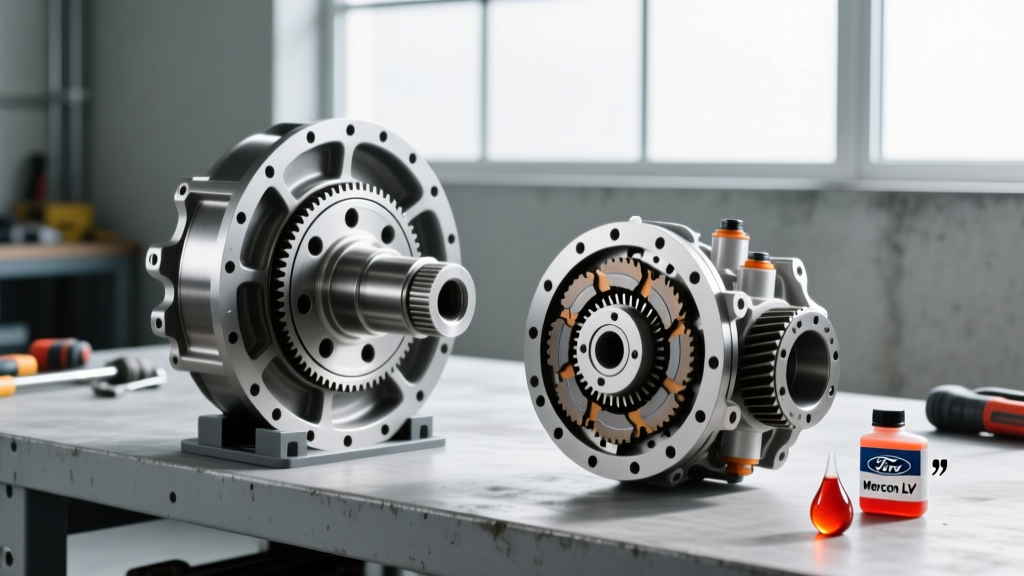
If your Ford rear differential is equipped with a clutch-type Traction-Lok, you must add Motorcraft Additive Friction Modifier (Part Number: XL-3, Spec: EST-M2C118-A). The clutch packs require this specific chemical additive to allow the plates to slip smoothly during low-speed, tight-radius turns. Without it, the clutches will grab and release rapidly, causing a violent shudder that feels like the rear suspension is breaking. The standard dosage is 4 oz per axle, mixed directly into the gear oil.
Note: Helical units like the Truetrac and open differentials do not require XL-3. Adding it to an open diff won't harm it, but it is a waste of money and slightly reduces the gear oil's film strength.
Viscosity and Capacity Specifications
Ford's factory fill and service recommendations vary heavily by axle size and application. Always verify your specific RPO code, but general 2026 service guidelines dictate:
- Ford 8.8-Inch (Mustang/Explorer): 75W-90 Premium Synthetic. Capacity: ~3.75 pints (1.8L).
- Ford 9.75-Inch (F-150 HD/Raptor): 75W-140 Synthetic. Capacity: ~5.5 pints (2.6L). The 75W-140 is mandatory here to handle the increased heat and shear forces of the larger ring gear and heavier truck loads.
- Ford 10.5-Inch (Super Duty): 75W-140 Synthetic. Capacity: ~6.9 pints (3.25L).
For severe-duty towing or off-road use, upgrading to a high-zinc, ester-based 75W-140 synthetic from brands like Amsoil or Red Line provides superior shear stability, protecting your ring and pinion teeth under extreme thermal loads.
Cost Analysis: OEM Replacement vs. Aftermarket Upgrades
When a differential fails or you decide to upgrade, budget allocation is key. Rebuilding an OEM Ford Traction-Lok is labor-intensive. A complete master rebuild kit (clutches, steels, S-spring, shims) costs around $120, but the machine shop labor to measure and set the clutch pack preload with a torque wrench typically adds $250 to $400 to the bill.
Conversely, dropping in an Eaton Truetrac (e.g., part number 913A475 for a 31-spline 8.8-inch) costs between $650 and $750 for the unit itself. While the upfront parts cost is higher, the installation is often faster because there is no clutch pack preloading required. You simply transfer your ring gear, set your carrier bearing preloads, and verify your gear backlash. Over a 100,000-mile lifespan, the Truetrac is vastly more cost-effective due to zero internal maintenance.
Torque Specs & Installation Realities
Whether you are servicing an open carrier or installing a new limited slip, adhering to precise torque specifications is non-negotiable. Drivetrain components experience massive rotational and shear forces. According to ARP (Automotive Racing Products) and Ford factory service manuals, standard torque baselines include:
- Ring Gear to Carrier Bolts: Factory Ford 8.8 and 9.75 ring gear bolts are typically torque-to-yield (TTY). If reusing OEM bolts (not recommended), the spec is generally 85 lb-ft + 90 degrees. Most builders discard OEM bolts and use ARP 200,000 PSI ring gear bolts, torqued to 70-85 lb-ft with a drop of red Loctite (242 or 271) to prevent backing out under reverse-torque loads.
- Differential Carrier Bearing Caps: The 8.8-inch carrier bearing caps must be torqued to 85 lb-ft. Crucially, these caps are line-bored with the specific housing. They are not interchangeable between different axle housings, and installing them backwards or on the wrong side will crush the carrier bearings and destroy your ring gear pattern.
- Pinion Nut: If you are pulling the carrier, you shouldn't disturb the pinion nut unless you are replacing the crush sleeve. The pinion nut torque on a Ford 8.8 is notoriously high, often requiring 200 to 250+ lb-ft to crush the sleeve and achieve the correct 8-14 in-lb of rotational preload. Always use a new crush sleeve and a staking tool to lock the nut.
Final Verdict: Which Ford Rear Differential Setup Wins?
For the vast majority of Ford truck and car owners in 2026, the helical limited slip differential (Eaton Truetrac) is the undisputed champion. It eliminates the weak S-spring of the open differential, removes the maintenance burden and chatter issues of the clutch-based Traction-Lok, and provides seamless, progressive traction in rain, snow, and off-road scenarios.
If you are retaining an open differential for a dedicated drag car (using a spool) or a low-budget daily driver, ensure you inspect the spider gears for wear and use the correct 75W-90 or 75W-140 fluid. However, if you demand reliability and traction from your Ford rear differential, skip the clutch packs, invest in a helical gear carrier, and enjoy a maintenance-free drivetrain for the life of the vehicle.