The Economics of Differential Gearing Protection
When enthusiasts and fleet managers upgrade their ring and pinion sets, the focus is almost entirely on the metallurgy and precision of the new differential gearing. However, the financial survival of those gears relies entirely on the microscopic fluid film separating them under extreme shear. As of 2026, with synthetic base stock prices fluctuating and heavy-duty towing demands increasing, understanding the exact cost breakdown of differential gear oil specifications is no longer just a maintenance chore—it is a critical financial strategy.
Replacing a destroyed ring and pinion set, including labor and setup, routinely costs between $1,800 and $3,200. In stark contrast, a premium synthetic fluid service costs between $45 and $110. This guide breaks down the real-world costs of gear oil specifications, viscosity grades, friction modifiers, and the hidden financial risks of using the wrong API rating on your differential gearing.
SAE Viscosity Grades: Pricing and Application Breakdown
The Society of Automotive Engineers (SAE) J306 standard dictates the viscosity classification for axle and manual transmission lubricants. Choosing the right viscosity for your specific differential gearing setup directly impacts both your upfront fluid cost and your long-term fuel economy.
According to the SAE J306 standard documentation, the 'W' (winter) rating measures low-temperature fluidity, while the second number measures kinematic viscosity at 100°C. Here is how the market prices these specifications in 2026:
| Viscosity Grade | Base Type | Avg. Cost Per Quart | Primary Application & Gearing Type |
|---|---|---|---|
| 80W-90 | Conventional | $6.50 - $8.00 | Standard open diffs, light-duty street driving (e.g., GM 8.6", Ford 7.5") |
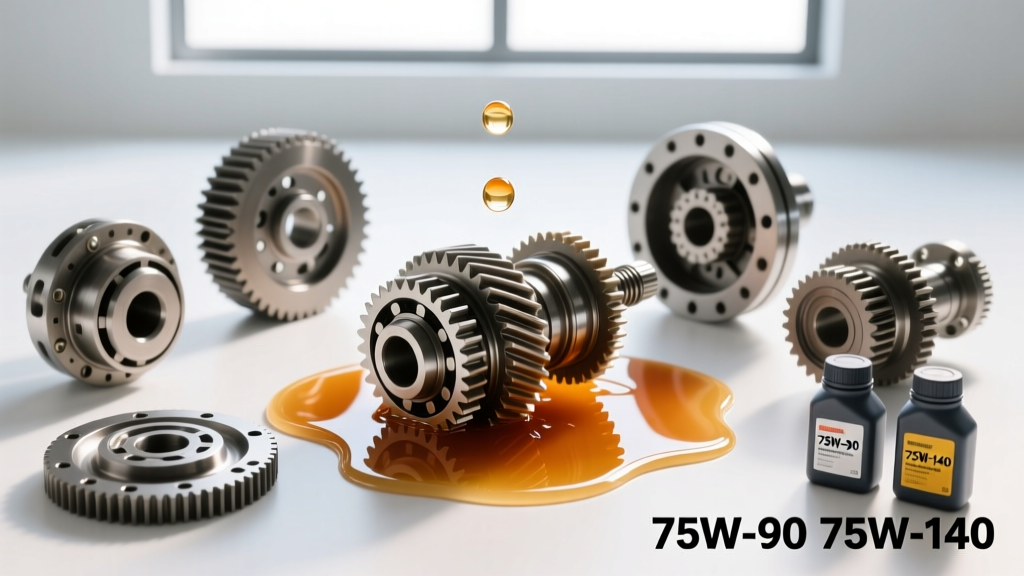
| 75W-90 | Full Synthetic | $10.50 - $13.00 | OEM spec for most modern SUVs/trucks, performance street differential gearing |
| 75W-140 | Full Synthetic | $17.00 - $22.00 | Heavy towing, off-road, high numerical ratio gearing (e.g., Dana 60, AAM 11.5") |
| 85W-140 | Conventional/Blend | $9.00 - $11.50 | Legacy heavy-duty commercial axles, extreme heat environments |
While 75W-140 synthetic oils (like Mobil 1 Synthetic Gear Lube or Red Line Heavy ShockProof) carry a premium price tag, they are mandatory for vehicles with altered differential gearing (such as 4.56:1 or 4.88:1 ratios) used in rock crawling or heavy towing. The lower numerical gearing generates immense localized heat at the tooth contact patch, which will rapidly shear down a conventional 80W-90 oil, leading to catastrophic metal-on-metal contact.
The True Cost of Friction Modifiers
If your vehicle is equipped with a clutch-type Limited Slip Differential (LSD)—such as the Ford Traction-Lok, GM Gov-Lok, or Dana Trac-Lok—the gear oil specification must include a friction modifier. This additive alters the coefficient of friction between the clutch packs, preventing the notorious 'chatter' or 'hopping' sensation during low-speed turns.
Additive Pricing and Part Numbers
- Motorcraft XL-3 Friction Modifier: ~$9.50 per 4 oz. bottle (Part # XL-3). Required for Ford 8.8" and 9.75" axles.
- GM ACDelco Limited Slip Axle Lubricant Additive: ~$11.00 per 4 oz. bottle (Part # 88900338). Required for GM 9.5" and 10.5" 14-bolt axles.
- Red Line Limited Slip Friction Modifier: ~$12.50 per 4 oz. bottle (Part # 70104). Universal synthetic-compatible modifier.
The Financial Risk of Skipping Modifiers: Some budget 75W-90 synthetic oils claim to be 'Limited Slip Compatible' right out of the bottle. While they contain a baseline level of modifiers, heavily worn clutch packs often require an additional 2 to 4 ounces of dedicated additive. Skipping this $10 bottle to save money will result in clutch pack glazing and chatter within 500 miles. Rebuilding an LSD clutch pack (e.g., an Eaton Performance carbon-fiber clutch kit, Part # 19588-01) costs roughly $140 in parts, plus 3 hours of shop labor at $150/hr, turning a $10 oversight into a $590 repair.
Real-World Differential Service Cost Scenarios
To understand the total cost of ownership, we must look at complete service scenarios, including fluid capacities, sealing materials, and exact torque specifications. Proper torque on differential cover bolts is critical; overtightening will warp the stamped steel cover and cause leaks, while undertightening leads to fluid loss and gear starvation.
Scenario A: Standard Daily Driver (Ford 8.8" Open Differential)
- Fluid Capacity: 2.5 to 3.0 pints (approx. 1.5 quarts).
- Fluid Spec: 75W-140 Synthetic (Ford updated WSS-M2C192-A spec for heavy loads, but 75W-90 is standard for street).
- Sealing: Fel-Pro RDS 55023 Gasket ($12.00) OR Permatex Ultra Black RTV ($8.50).
- Hardware: 12 cover bolts, torqued to 28-38 lb-ft.
- Total DIY Cost: $26.00 (using 2 qts of Valvoline SynPower 75W-90 + RTV).
Scenario B: Heavy Duty Towing (GM 10.5" 14-Bolt with Gov-Lok)
- Fluid Capacity: 4.0 pints (approx. 2.0 quarts).
- Fluid Spec: 75W-90 Synthetic GL-5.
- Additive: GM Friction Modifier 88900338 ($11.00).
- Sealing: Reusable rubber gasket or RTV. Cover bolts torqued to 25 lb-ft.
- Total DIY Cost: $47.00 (using 2 qts Mobil 1 75W-90 + GM Additive + RTV).
Scenario C: Off-Road / Re-Gearing (Dana Spicer 60 with 4.88 Gears)
- Fluid Capacity: 3.5 to 4.0 pints (approx. 2.0 quarts).
- Fluid Spec: 75W-140 Full Synthetic GL-5 (Mandatory for low-ratio differential gearing heat management).
- Sealing: Dana Spicer cover gasket or high-temp RTV. Cover bolts torqued to 30-40 lb-ft (verify with Dana Spicer service manuals for specific housing variations).
- Total DIY Cost: $54.00 (using 2 qts Red Line 75W-140 + RTV).
Failure Modes: The Hidden Cost of Incorrect API Specifications
The most expensive mistake in differential maintenance is confusing API GL-4 and API GL-5 specifications. Modern differential gearing in axles almost universally requires API GL-5, which contains high levels of sulfur-phosphorus extreme pressure (EP) additives. These additives sacrifice themselves under high-shear loads to protect the hypoid gear teeth.
Expert Warning: Never use GL-5 gear oil in manual transmissions or transaxles that specify GL-4 unless explicitly approved by the OEM. The aggressive sulfur compounds in GL-5 will chemically corrode the 'yellow metals' (brass, bronze, and copper) used in transmission synchronizers. Conversely, using GL-4 in a hypoid differential axle will result in rapid gear pitting, spalling, and total failure within 10,000 miles under load.
When incorrect fluid is used, the initial failure mode is often micro-pitting on the drive side of the ring gear teeth. This manifests as a high-pitched 'whine' that changes pitch with vehicle speed. Once pitting begins, the differential gearing is permanently compromised. No fluid change will reverse the damage. The only remedy is a complete teardown, bearing replacement, and a new matched ring and pinion set—a job that requires specialized dial indicators, inch-pound torque wrenches for pinion depth setup, and a hydraulic press, easily pushing shop bills past $2,500.
Conclusion: Investing in Specifications
Maintaining your differential gearing is an exercise in preventative economics. By spending an extra $15 on a true full-synthetic 75W-140 fluid for heavy-duty applications, and an additional $10 on an OEM-specific friction modifier for limited-slip axles, you effectively insure thousands of dollars worth of hardened steel. Always cross-reference your owner's manual viscosity requirements with your actual driving conditions, adhere strictly to cover bolt torque specifications, and never compromise on API GL ratings.