The Traction Hierarchy: Selecting Locking Differentials for 2026 Builds
As the 2026 off-road racing season and heavy-duty overlanding trends push axle assemblies to their absolute limits, selecting the correct locking differential is no longer just about gaining traction—it is about managing thermal loads, fluid dynamics, and mechanical shock. Whether you are building a dedicated Ultra4 rock racer, a high-speed desert truck, or a heavy-tow diesel rig, understanding the mechanical nuances of locker types and their associated fluid requirements is critical for drivetrain survival.
Unlike standard open differentials or clutch-based limited-slip differentials (LSDs), locking differentials force both axle shafts to rotate at the exact same speed. This eliminates wheel slip but introduces massive torque spikes into the ring and pinion, carrier bearings, and axle shafts. Choosing the right actuation method—mechanical, pneumatic, electric, or hydraulic—dictates not only your installation process but also your differential fluid strategy and cooling requirements.
Core Locking Differential Types
- Automatic Mechanical (e.g., Detroit Locker): Utilizes a cross-shaft and side gear design with internal springs and thrust washers. Locks under load and unlocks during turns via internal ratcheting. Ideal for heavy towing and dedicated trail rigs where manual actuation is unnecessary.
- Selectable Pneumatic (e.g., ARB Air Locker): Uses an onboard air compressor to push a piston that engages a locking collar. Requires routing air lines through the axle housing and carrier bearing cap. Offers 100% lockup on demand and operates as an open diff when disengaged.
- Selectable Electric (e.g., Eaton E-Locker): Employs a 12V electromagnetic solenoid to shift a locking collar. Eliminates the need for air lines but requires robust wiring and a stable electrical system to prevent partial engagement failures.
- Selectable Cable/Mechanical (e.g., OX Locker): Uses a physical shift cable and internal fork. Highly reliable in extreme cold or mud where pneumatic seals might fail, but requires periodic cable tension adjustments.
Performance Locker Comparison Matrix
| Locker Type | Model / Part Number | Application | Avg. Cost (USD) | Carrier Cap Torque |
|---|---|---|---|---|
| Detroit (Auto) | 225SL19B | Dana 60 Front/Rear | $650 - $750 | 60 lb-ft |
| ARB (Pneumatic) | RD116 | Toyota 8" Front | $900 - $1,050 | 45 lb-ft |
| Eaton (Electric) | 19969-01 | GM 14-Bolt 10.5" | $850 - $950 | 85 lb-ft |
| OX (Cable) | OX-LK-D60-F35 | Dana 60 (35 Spline) | $1,100 - $1,300 | 60 lb-ft |
Fluid Dynamics: Matching Gear Oil to Your Locker
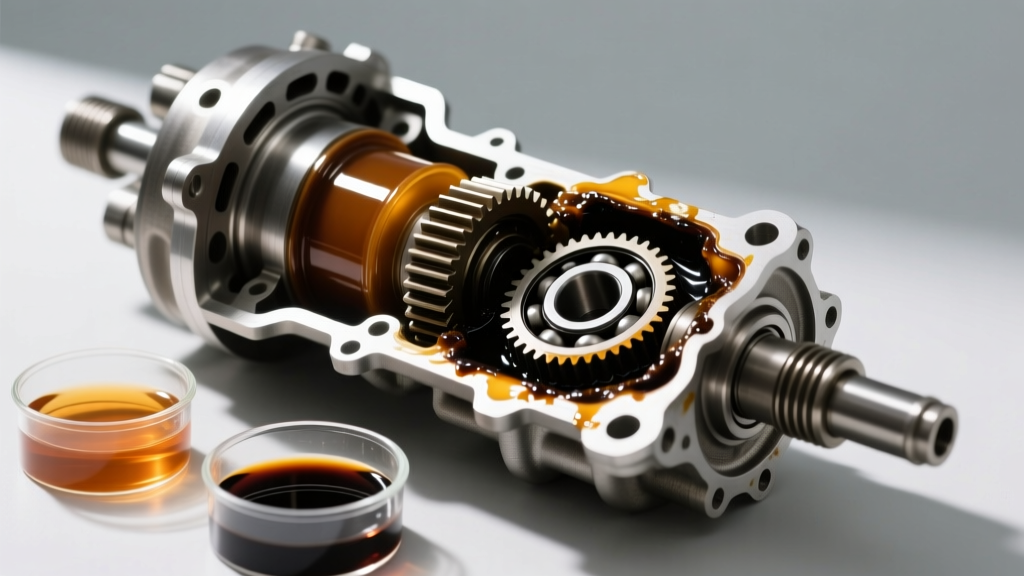
A common and catastrophic mistake in differential upgrades is treating a locking differential like a clutch-based limited-slip differential. Clutch-type LSDs (like the Ford 8.8 Trac-Lok or Eaton Posi) require friction modifiers (typically 4-6 oz of additive) to prevent clutch chatter and binding. Locking differentials do not use friction clutches. Adding friction modifier to a Detroit, ARB, or Eaton E-Locker reduces the fluid's film strength, promotes foaming under high-shear conditions, and accelerates wear on the locking collar's dog teeth.
For high-performance locking differentials, you must use a straight synthetic gear oil without friction modifiers. For severe-duty applications, a 75W-140 viscosity is preferred over 75W-90 due to its superior resistance to thermal breakdown when the ring and pinion are subjected to shock loads. Products like Amsoil Severe Gear 75W-140 or Red Line 75W140 NS (Non-Slip) provide the necessary extreme pressure (EP) additives to protect the hypoid gear cut of the ring and pinion without compromising the mechanical engagement of the locker.
Fluid Capacities and Fill Procedures
Always verify fill levels at the centerline of the axle tube, not just the fill plug, especially if your vehicle has been lifted or the axle has been rotated for caster correction.
- Dana 60: ~3.5 pints (1.65 Liters)
- GM 14-Bolt 10.5": ~4.2 pints (2.0 Liters)
- Ford 9-Inch: ~3.0 pints (1.4 Liters) - varies heavily by housing depth
High-Volume Cooling and the Orange Research Differential Pressure Gauge
In elite motorsport environments like the 2026 Ultra4 championship or unrestricted desert racing, the heat generated by a locking differential and a high-stall ring and pinion can easily exceed 350°F, causing standard gear oil to oxidize and lose viscosity. To combat this, engineers utilize external scavenge pumps, remote reservoirs, and forced-lube differential coolers. However, pumping thick 75W-140 synthetic fluid through long lines and heat exchangers introduces a new variable: pressure drop.
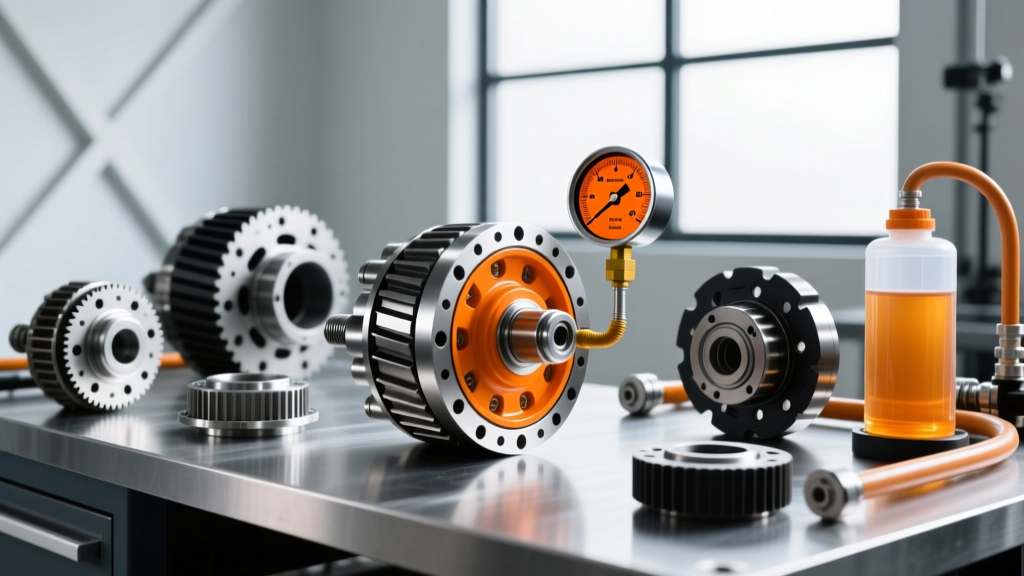
Monitoring the health of your external differential cooling loop is where industrial instrumentation meets off-road engineering. By installing an Orange Research differential pressure gauge across the inline filtration system, builders can monitor the delta-P (pressure differential) between the fluid entering and exiting the filter housing.
If the Orange Research differential pressure gauge indicates a spike in delta-P (typically exceeding 15-20 PSI depending on the filter's bypass valve rating), it provides an immediate, real-time warning that the filter is clogged with metallic debris. This debris could be the result of normal ring and pinion break-in wear, or more alarmingly, the shearing of the locking collar's engagement teeth or carrier bearing failure. Without this gauge, a clogged filter would trigger the bypass valve, sending unfiltered, abrasive fluid directly back into the differential housing, effectively lapping the gears and destroying the locker assembly within miles.
Furthermore, for custom hydraulic locking differentials used in specialized independent suspension (IFS) setups where air lines are impractical, the Orange Research differential pressure gauge can be adapted to monitor the hydraulic actuation circuit's pressure drop, ensuring the solenoid valves are opening fully and the hydraulic fluid is not cavitating under extreme G-loads.
Installation Torque Specs and Setup Tolerances
The shock load transferred through a locked axle will instantly exploit any weak points in your gear setup. When installing a selectable or automatic locker, the carrier bearing preload and ring gear mounting must be flawless.
Ring Gear Bolt Specifications
Never reuse ring gear bolts. The cyclic loading of a locked axle will stretch standard hardware, leading to ring gear runout and catastrophic tooth shearing.
- Clean Threads: Use brake cleaner to remove all oil from the carrier and bolt threads.
- Threadlocker: Apply Loctite 271 (Red) or Loctite 242 (Blue) depending on manufacturer spec. (Note: Eaton E-Lockers often specify Red 271 due to the electromagnetic torque spikes).
- Torque Sequence: Torque in a star pattern. For a GM 14-bolt, the spec is typically 85 lb-ft. For a Dana 60, it is usually 75-85 lb-ft. Always refer to the specific OEM axle manual.
Backlash and Pattern Verification
Locking differentials do not absorb the same harmonic vibrations as open differentials. Your gear backlash must be dialed in precisely to prevent binding under full lockup.
- Target Backlash: 0.006" to 0.008" for most aftermarket 8620 steel alloy ring and pinions.
- Carrier Bearing Preload: Use a dial indicator and inch-pound torque wrench to verify a drag torque of 15-25 in-lbs (varies by axle) above the pinion bearing drag.
Summary: Engineering for the Extremes
Selecting the right locking differential requires a holistic view of the entire axle assembly. From choosing the correct friction-modifier-free 75W-140 synthetic fluid to ensuring precise ring gear torque specs, every detail matters in high-horsepower, heavy-load applications. For those pushing the boundaries of motorsport and extreme overlanding, integrating advanced monitoring tools like an Orange Research differential pressure gauge into your cooling or hydraulic actuation loops transforms a fragile drivetrain into a data-monitored, bulletproof system capable of surviving the harshest environments on the planet.