Intermittent drivetrain faults are the bane of modern automotive diagnostics. Unlike a completely shredded friction disc that slips predictably in every gear, or a snapped pressure plate diaphragm that results in a total loss of engagement, intermittent faults in modern car clutches manifest as ghostly anomalies. A vehicle might exhibit perfect clutch engagement on a cold morning commute, only to suffer severe chatter, pedal sponginess, or RPM flaring after sitting in stop-and-go traffic for forty minutes. As we navigate the 2026 automotive landscape, where high-torque turbocharged four-cylinder engines and aggressive stop-start systems place unprecedented cyclic stress on manual drivetrains, understanding the thermal and hydraulic variables of clutch systems is mandatory for accurate diagnosis.
The Hygroscopic Threat: Hydraulic Fluid and Vapor Lock
The vast majority of modern manual transmissions utilize a hydraulic actuation system relying on DOT 3, DOT 4, or DOT 5.1 brake fluid. These fluids are inherently hygroscopic, meaning they actively absorb moisture from the atmosphere through microscopic pores in rubber hoses and the master cylinder reservoir vent. According to SAE International Automotive Standards, new DOT 4 fluid has a dry boiling point of 446°F (230°C). However, once the fluid absorbs just 3% to 4% water by volume, its wet boiling point plummets to roughly 311°F (155°C).
Thermal Expansion and Intermittent Sponginess
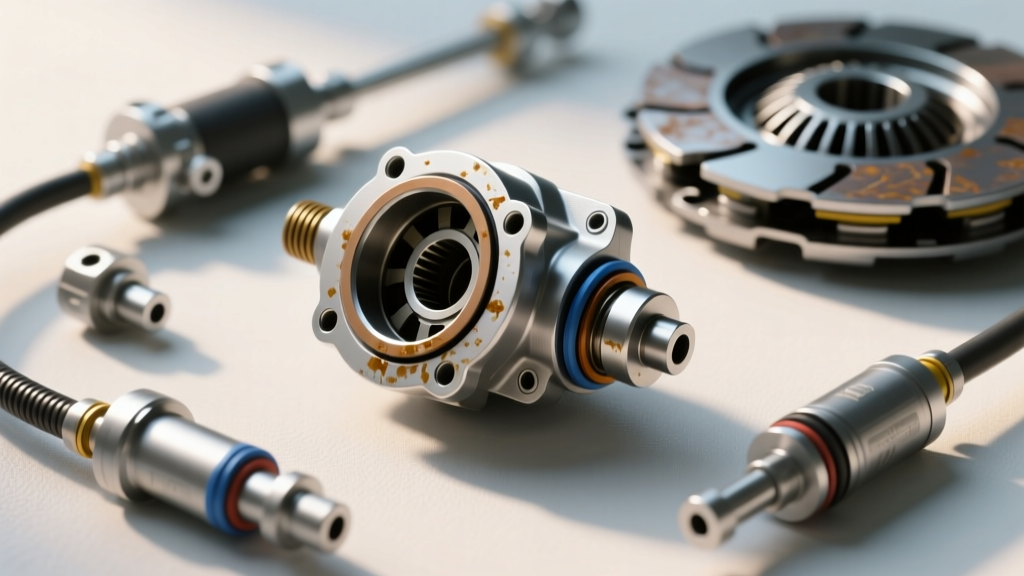
When a vehicle is driven hard or subjected to heavy traffic, the exhaust tunnel and transmission bell housing radiate immense heat. This heat soak transfers to the hydraulic lines and the Concentric Slave Cylinder (CSC). If the fluid is contaminated with moisture, localized boiling occurs, creating compressible vapor bubbles in the hydraulic circuit. The driver experiences an intermittent, spongy pedal that may sink to the floor, only to regain normal pressure once the vehicle is parked and the fluid cools. Diagnosing this requires checking the fluid's moisture content with a specialized electronic brake fluid tester; any reading above 2% water content mandates an immediate flush and bleed.
Master Cylinder Internal Bypassing
Intermittent clutch slip is frequently misdiagnosed as a worn friction disc when the true culprit is the clutch master cylinder (CMC). Inside the CMC, the primary cup seal is responsible for building hydraulic pressure. Over time, exposure to contaminated fluid and microscopic scoring on the cylinder bore causes the seal's lip to degrade.
Expert Diagnostic Tip: If a driver reports that the clutch pedal slowly sinks to the floor while holding the vehicle stationary at a red light, but the pedal returns to normal if they pump it rapidly, the master cylinder is internally bypassing fluid past the cup seal. This is a classic intermittent failure that mimics a slipping clutch because the hydraulic system fails to fully apply the pressure plate.
Dual-Mass Flywheel (DMF) Heat Soak and Chatter
To combat the low-frequency torsional vibrations generated by modern, high-compression turbo engines, engineers rely heavily on Dual-Mass Flywheels (DMFs). A DMF utilizes an internal planetary gearset and heavy-duty arc springs dampened by specialized high-temperature grease. Intermittent clutch chatter—often felt as a violent shuddering through the chassis during takeoff in first gear—is a hallmark of DMF internal failure, but it is highly temperature-dependent.
When the internal grease degrades or separates due to extreme thermal cycling, the arc springs bind. This binding is often most pronounced when the transmission is moderately hot (around 180°F to 210°F) but before the components have fully expanded. Schaeffler Aftermarket DMF Diagnostics emphasizes that a DMF can pass a cold visual inspection and a cold rotational free-play test, yet fail catastrophically under load once the internal friction plates heat up. If intermittent chatter is suspected, measuring the radial and axial play with a dial indicator while the bell housing is at operating temperature is the only definitive verification method. Replacement requires a complete kit (e.g., LuK RepSet Pro), typically costing between $450 and $800 for the parts alone.
Diagnostic Decision Matrix: Intermittent Clutch Faults
Use the following structured matrix to isolate the root cause of ghostly clutch symptoms based on thermal states and specific engagement behaviors.
| Symptom Manifestation | Temperature Dependency | Probable Root Cause | Verification Test / Action |
|---|---|---|---|
| Pedal sinks slowly at stops; normal when pumped | Aggravated by heat | Master Cylinder internal cup seal bypass | Hold pedal under constant pressure for 60 seconds; monitor for sink rate. |
| RPM flaring (slipping) in 3rd/4th gear under load | Occurs only after 30+ mins of driving | CSC micro-leak contaminating friction disc | Inspect bell housing inspection cover for wet, dark residue on the disc perimeter. |
| Violent chassis shudder during 1st gear takeoff | Cold or moderately warm; disappears when fully hot | DMF internal arc spring binding / grease separation | Check DMF rotational free-play and axial runout with a dial indicator. |
| Difficulty engaging 1st or Reverse (grinding) | Worse in cold ambient weather, improves as cabin warms | Clutch hydraulic fluid viscosity too high / moisture freezing | Test fluid moisture content; perform reverse pressure bleed with DOT 5.1. |
| Pedal feels "sticky" or hangs at the floor intermittently | Random; often related to humidity | Pedal return spring fatigue or pivot bushing binding | Disconnect CMC pushrod; cycle pedal manually to isolate mechanical bind. |
Concentric Slave Cylinder (CSC) Micro-Leaks and Friction Contamination
In modern transaxle and rear-wheel-drive layouts, the throw-out bearing and slave cylinder are combined into a single Concentric Slave Cylinder (CSC) mounted directly on the transmission input shaft. When a CSC develops a microscopic weep, it does not always result in a visible puddle of fluid on the ground. Instead, centrifugal force throws the weeping DOT fluid outward onto the friction surface of the clutch disc.
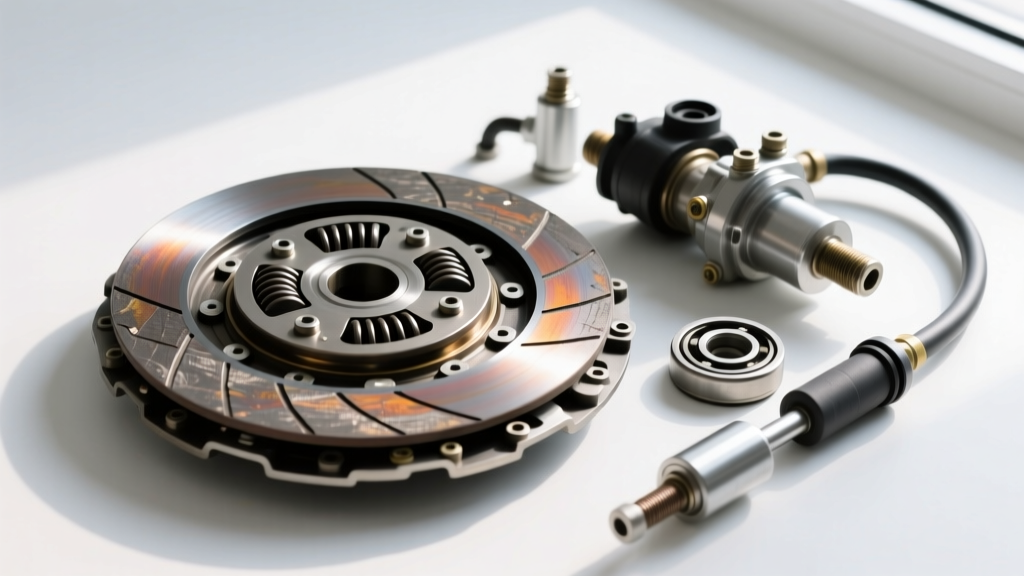
Because organic friction materials are highly porous, they absorb the glycol-based fluid. This causes an intermittent slip: the clutch will hold torque perfectly when cold and dry, but as the friction surface heats up, the trapped hydraulic fluid vaporizes and acts as a microscopic lubricant between the disc and the flywheel. This is particularly common in high-torque applications like the GM LS/Tremec platforms (using OEM part # 24264182 or equivalent aftermarket Sachs units). If you pull the transmission and find a clutch disc with localized, dark, glazed patches that smell faintly sweet or burnt, the CSC is the culprit. A standard organic replacement disc costs $150-$250, but labor to drop the transmission ranges from $600 to $1,200, making accurate diagnosis critical.
Reassembly Torque Specifications: Preventing Induced Intermittency
If your diagnosis leads to a clutch replacement, improper reassembly is a primary cause of newly induced intermittent problems. A pressure plate that is torqued unevenly will warp as it cycles through heat expansion and contraction, leading to intermittent grabbing. Always use a calibrated torque wrench and tighten the pressure plate bolts in a strict star pattern, stepping up in 5 lb-ft increments until reaching the final specification.
- GM LS-Series (5.3L/6.2L) Flywheel to Crank: 74 lb-ft + 90 degrees of rotation (using new torque-to-yield bolts).
- Ford Modular (4.6L/5.0L) Flywheel to Crank: 59 lb-ft (verify specific year, some Coyote 5.0L require 65 lb-ft).
- Standard 10.5" Pressure Plate to Flywheel: 15 to 18 lb-ft (always consult the specific manufacturer insert, as heavy-duty aftermarket units like McLeod or Centerforce may require up to 25 lb-ft).
- Hydraulic Line Banjo Bolts: 12 to 15 lb-ft (over-torquing cracks the soft aluminum master cylinder housings).
Furthermore, when bleeding the system, traditional gravity bleeding is insufficient for modern layouts with complex routing and integrated delay valves (designed to mimic the engagement feel of older cable clutches). Utilizing a reverse-pressure bleeder, such as the Motive 0103 or equivalent, forces fluid upward from the slave cylinder, pushing trapped air bubbles naturally toward the master cylinder reservoir. For comprehensive hydraulic system service procedures, refer to ZF Aftermarket Technical Documentation, which provides exact bleeding volumes and stroke requirements for Sachs hydraulic actuators.
Final Diagnostic Directives
Intermittent clutch issues demand a methodical, data-driven approach. Never assume a slipping clutch requires a new friction disc until the hydraulic system's integrity, fluid boiling point, and master cylinder seal health have been definitively ruled out. By understanding the thermal dynamics of hygroscopic fluids, the mechanical fatigue of dual-mass flywheels, and the precise torque tolerances of modern drivetrains, technicians and enthusiasts alike can banish the "ghosts" from their manual transmissions and restore predictable, mechanical engagement.