Introduction to Differential Acoustics and Economics
When a customer complains of a rear-axle howl or a drivetrain clunk, the difference between a minor service and a catastrophic failure hinges entirely on early, accurate diagnosis. As drivetrain specialists, we do not just listen to gears; we interpret the acoustic signatures of metallurgical stress. However, diagnosing the noise is only half the battle. The other half is explaining the financial reality to the vehicle owner. In automotive service management, the strict definition of differential cost refers to the financial variance between two distinct repair pathways—such as catching and replacing a failing pinion bearing early versus waiting until it destroys the ring gear, carrier, and housing. Understanding this definition is critical for both shop profitability and customer trust.
Understanding the Definition of Differential Cost in Drivetrain Repair
Before tearing into a Dana 44 or a GM 8.5-inch 10-bolt, a master technician must evaluate the economic landscape of the repair. If a pinion bearing is caught early (indicated by a subtle high-frequency whine on deceleration), the repair might only require a pinion seal, a new pinion bearing, and a solid spacer kit. The parts cost is roughly $85, and labor is under three hours.
Conversely, if that same noise is ignored, the bearing cage will disintegrate, allowing the pinion gear to hammer against the ring gear. This alters the gear contact pattern, chips the teeth, and gouges the bearing bores in the differential housing. The definition of differential cost in this delayed scenario shifts from a $450 targeted repair to a $2,200+ complete overhaul, potentially requiring a replacement axle housing if the bearing bores are scored beyond the tolerances of a line-boring fix. Recognizing these cost differentials allows service writers to communicate the urgency of immediate intervention.
Acoustic Profiling: Mapping Noise to Internal Geometry
Differential noise is rarely random; it is a direct translation of load, gear geometry, and bearing health. Use the following diagnostic matrix to isolate the failure point before ever unbolting the differential cover.
| Acoustic Signature | Load Condition | Probable Culprit | Estimated Repair Cost (Parts + Labor) |
|---|---|---|---|
| High-Pitch Whine | Deceleration (Coast) | Coast-side gear tooth wear or loose pinion bearing preload | $400 - $700 (Bearing/Seal Kit) |
| Low-Frequency Howl | Acceleration (Drive) | Drive-side gear wear, insufficient backlash, or overloaded axle | $900 - $1,500 (Ring & Pinion) |
| Rumble / Grind | Constant above 20 MPH | Carrier or pinion bearing brinelling (spalling) | $600 - $1,100 (Master Bearing Kit) |
| Metallic Clunk | Load Reversal (Shift) | Excessive backlash, worn cross-pins, or stripped spider gears | $250 - $500 (Posi Clutches/Pins) |
Step-by-Step Troubleshooting: Beyond the Stethoscope
While an automotive stethoscope can help isolate a bearing noise from wheel hub assemblies, true differential diagnosis requires physical measurement. According to technical guidelines from Spicer/Dana, visual and tactile inspections are mandatory before condemning a gear set.
1. Yoke Play and Preload Verification
With the vehicle safely lifted and the axle in neutral, attempt to move the driveshaft yoke up and down. Any vertical deflection greater than 0.005 inches indicates severe pinion bearing wear. Next, use an inch-pound torque wrench on the pinion nut to measure rotating torque. For a Ford 8.8-inch axle, rotating torque should be 8-14 in-lbs with used bearings, and 16-29 in-lbs with new bearings. If the torque reads below 5 in-lbs, your pinion preload is gone, and the gears are hammering each other with every revolution.
2. Dial Indicator Setup and Backlash Measurement
Gear backlash is the clearance between the mating teeth of the ring and pinion. Mount a magnetic dial indicator to the axle housing and position the plunger perpendicular to a ring gear tooth. Rotate the ring gear back and forth while holding the pinion yoke stationary.
- Target Spec: Most street-driven differentials (like the GM 10-bolt 8.5" or Dana 44) require a backlash between 0.008" and 0.012".
- Too Tight (< 0.006"): Generates excessive heat, leading to gear seizure and rapid 75W-90 fluid breakdown.
- Too Loose (> 0.015"): Causes the clunking noise on load reversal and accelerates wear on the spider and side gears.
Fluid Forensics: The Cheapest Diagnostic Tool
Draining the differential fluid is the equivalent of pulling a dipstick on an engine. The condition of the gear oil tells a vivid story of internal health. As highlighted in drivetrain diagnostic resources like AA1Car, the drain plug magnet is your primary evidence collector.
Expert Tip: Fine, metallic "gold dust" or a light grey paste on the drain plug is normal wear from the clutch packs in a limited-slip differential and the synchro materials. However, silver flakes indicate bearing cage degradation, and actual chunks of metal mean a gear tooth has sheared. If you find chunks, a simple fluid change will not save the axle; a teardown is mandatory.
The Friction Modifier Variable in LSDs
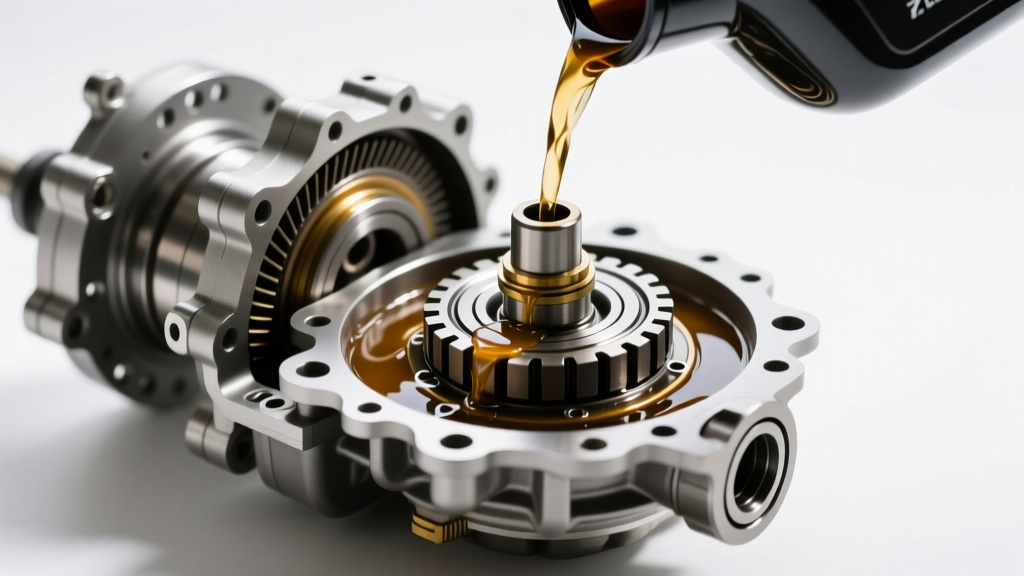
If a customer complains of a "chattering" or "hopping" sensation during tight, low-speed turns, do not immediately condemn the differential. In clutch-type limited-slip differentials (like the Auburn or Eaton Truetrac), this is often a lubrication issue, not a mechanical failure. The clutches require a specialized friction modifier to slip smoothly.
Before tearing into the carrier, drain and refill the axle with high-quality 75W-90 synthetic gear oil (such as Amsoil Severe Gear) and add the OEM-specific friction modifier. For Ford axles, use XL-3 (EST-M2C118-A); for GM axles, use 1052358. Perform ten figure-eight turns in a parking lot. If the chatter disappears, you just saved the customer $1,200 by correctly applying the definition of differential cost to avoid an unnecessary teardown.
Rebuild vs. Remanufactured Assembly: The Final Calculation
When internal damage is confirmed, the final application of the definition of differential cost comes down to rebuilding the existing unit versus installing a remanufactured drop-in assembly.
- The Rebuild Path: A master rebuild kit from Timken or Yukon Gear & Axle (including bearings, seals, shims, and a new crush sleeve eliminator like the Ratech 4110) costs between $250 and $400. A new ring and pinion set adds another $250 to $450. However, labor is intensive. Setting pinion depth, bearing preload, and backlash can take 6 to 10 hours of highly skilled labor ($900 - $1,500).
- The Reman Path: A drop-in third member or complete bare axle assembly from a reputable supplier like Motive Gear or Sterling costs between $1,500 and $2,800. Installation takes only 2 to 3 hours, as the critical gear geometry has been set on a factory machine.
For fleet vehicles or daily drivers where downtime is expensive, the remanufactured route often presents the most favorable differential cost definition. For rare, classic, or heavily modified off-road axles (like a custom Dana 60), a precision rebuild by an expert using Yukon Gear technical resources remains the gold standard for longevity and performance.
Conclusion
Mastering differential noise diagnosis requires an ear for acoustic anomalies, a steady hand with a dial indicator, and a deep understanding of drivetrain economics. By accurately identifying the root cause of a whine, rumble, or clunk, technicians can leverage the true definition of differential cost to provide repairs that are both mechanically sound and financially logical. Whether you are setting the backlash on a Ford 8.8 to a precise 0.010" or simply adding the correct friction modifier to cure an LSD chatter, expert best practices always dictate that precision in diagnosis prevents waste in the wallet.