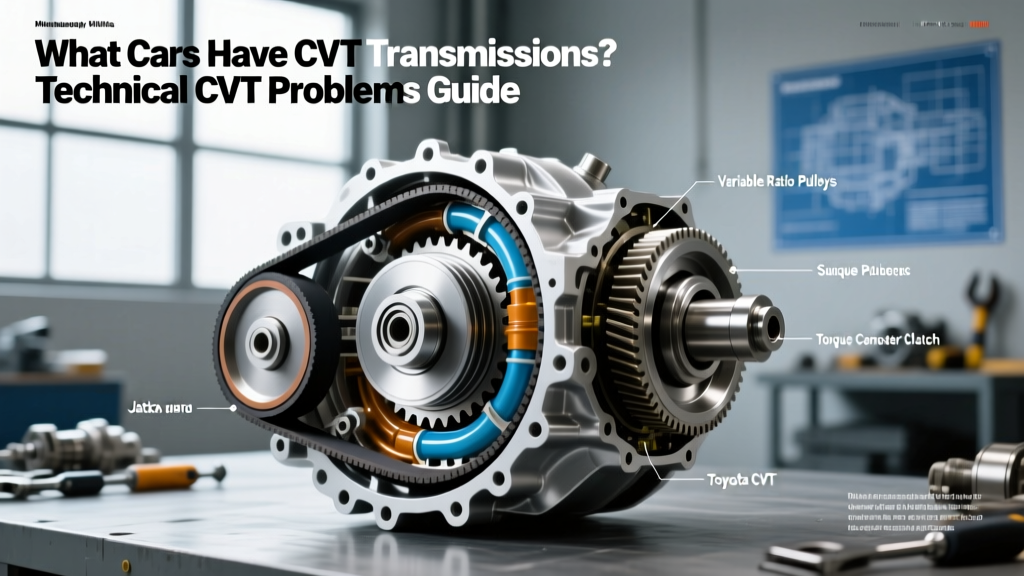
The Diagnostic Dilemma: Geared Automatic vs. CVT
For automotive diagnostic technicians and savvy used-car buyers, distinguishing between a failing traditional automatic transmission and a normally operating Continuously Variable Transmission (CVT) is a critical skill. The service drive is frequently plagued by customers complaining of "slipping," "weird engine noises," or "delayed shifting." In many cases, these are not failures at all, but rather the inherent operational characteristics of a push-belt or chain-driven CVT. Conversely, when a traditional geared automatic exhibits torque converter shudder or clutch pack flare, it requires immediate mechanical intervention.
When a frustrated buyer or owner asks us what car does not have a CVT transmission, they are usually trying to avoid the notorious reliability pitfalls of early push-belt systems, or they are attempting to verify the drivetrain layout of a vehicle before committing to a purchase. From a troubleshooting perspective, identifying the transmission type dictates your entire diagnostic strategy, fluid selection, and scan tool PID analysis. In this 2026 diagnostic guide, we break down the mechanical, hydraulic, and electronic differences between CVTs and traditional planetary automatics to help you accurately diagnose drivetrain symptoms.
Symptom Translation Matrix: CVT Characteristics vs. Automatic Failures
The most common diagnostic error is misinterpreting CVT pulley-ratio hunting as a traditional automatic "shift flare." Below is a diagnostic matrix comparing the Jatco JF016E (commonly found in Nissan/Chrysler applications) and the ZF 8HP45 (found in BMW, Chrysler, and Jaguar applications).
| Symptom Reported | CVT (Jatco JF016E) Diagnosis | Geared Auto (ZF 8HP45) Diagnosis |
|---|---|---|
| Highway RPM Flaring | Normal pulley ratio adjustment under load, or low CVTF fluid level causing belt slip. | Failing clutch pack (usually Clutch C or D) or leaking piston seal in the valve body. |
| Low-Speed Shudder (15-30 mph) | Stepper motor failure (P1777) or start-clutch calibration loss. | Torque Converter Clutch (TCC) friction material degradation or mechatronic sleeve leak. |
| "Rubber Band" Engine Drone | Normal operation: Engine held at peak torque RPM while pulleys alter ratio. | Abnormal: Indicates severe torque converter slip or transmission limp mode (3rd gear default). |
| Harsh Engagement (Park to Drive) | Line pressure solenoid sticking or degraded CVTF friction modifiers. | Accumulator piston wear or excessive main line pressure from faulty pressure switch. |
Case Study 1: The Highway On-Ramp Flare
A customer brings in a 2018 Nissan Rogue equipped with the JF016E CVT, complaining that the transmission "slips" when merging onto the highway. A technician accustomed to planetary gearsets might immediately suspect internal seal failure. However, in a CVT, the engine RPM will naturally surge to the optimal power band (often around 4,000-5,500 RPM) and hold there while the primary and secondary pulleys adjust their hydraulic pressure to change the drive ratio. If the RPMs surge but vehicle speed does not increase proportionally, then you have a true slip condition, usually caused by a failing high-pressure pump or a worn push-belt. According to Nissan TechInfo, verifying the target vs. actual pulley ratio via OBD-II is mandatory before condemning the unit.
Case Study 2: Low-Speed Torque Converter Shudder
Now consider a 2016 BMW 328i with the ZF 8HP45. The driver reports a violent shudder between 1,200 and 1,800 RPM during light throttle application. Unlike a CVT, the ZF 8-speed relies on a complex lock-up torque converter that can operate in controlled slip mode. Over time, the friction material on the TCC degrades, and the mechatronic unit's adapter sleeve (a known failure point costing roughly $850-$1,200 to replace) develops micro-leaks. This causes rapid apply/release oscillation of the TCC, felt as a shudder. The fix requires a specialized flush using high-detergent ATF and, in severe cases, a mechatronic sleeve replacement, not a full rebuild.
Fluid Chemistry and Hardware: The Ultimate Telltale Signs
If visual identification or VIN decoding is unavailable, the fluid itself provides undeniable proof of the transmission type. The tribology (friction science) of CVTF is fundamentally opposed to traditional ATF.
- CVTF (e.g., Nissan NS-3): Engineered with high-friction modifiers designed to allow the steel push-belt to grip the pulley cones without slipping under extreme clamping pressure. It lacks the aggressive detergents found in geared ATF because CVTs do not have paper-based clutch packs that shed friction material.
- Traditional ATF (e.g., ZF LifeguardFluid 8 or Dexron ULV): Formulated with specific friction modifiers to allow smooth, controlled micro-slip during clutch pack apply and torque converter lock-up. It contains high levels of dispersants to hold clutch wear material in suspension.
Diagnostic Hardware Check: Drop the transmission pan. If you find a traditional valve body with multiple accumulator bores, solenoid packs, and a paper/clutch friction filter, you are working on a geared automatic. If you find two massive hydraulic stepper motors (or linear solenoids), a chain/push-belt residue, and a cartridge-style spin-on filter (like Nissan Part # 31377-31X0A), you are inside a CVT. Crucial Torque Spec Note: When reinstalling a Nissan CVT drain plug with a new crush washer, torque to exactly 31 Nm (23 lb-ft). Over-torquing will crack the fragile aluminum CVT oil pan casing. Conversely, ZF 8HP plastic oil pan bolts must be torqued to a precise 10 Nm in a specific crisscross pattern to prevent warping the integrated filter housing.
2026 Market Breakdown: What Car Does Not Have a CVT Transmission?
For buyers actively seeking to avoid CVTs due to historical reliability concerns (such as the early Jatco JF011E overheating issues), understanding the current automotive landscape is vital. While Honda and Toyota have largely standardized on CVTs for their front-wheel-drive economy cars (with Toyota utilizing a physical 1st gear "launch gear" in their Direct Shift-CVTs), several major manufacturers have completely rejected the CVT architecture in favor of traditional automatics and Dual-Clutch Transmissions (DCTs).
If you are verifying a vehicle's drivetrain, here is a definitive list of brands and powertrains that do not use CVTs:
- Mazda: Mazda remains the staunchest defender of the traditional automatic. Their entire lineup, from the Mazda3 to the CX-90, utilizes their proprietary Skyactiv-Drive 6-speed, 8-speed, or inline-6 hybrid automatics, featuring a robust torque converter and planetary gears.
- Hyundai and Kia: The Hyundai Motor Group avoids CVTs in their core lineup, opting instead for highly reliable 6-speed and 8-speed planetary automatics (e.g., the 8F24W), and wet/dry Dual-Clutch Transmissions (DCTs) for their turbocharged models.
- General Motors (Trucks/SUVs): While GM uses CVTs in some small crossovers (like the Chevy Trailblazer), their truck and large SUV lineup (Silverado, Tahoe, Suburban) relies exclusively on the robust 10L80 and 10L90 10-speed traditional automatics.
- Ford (RWD/Trucks): Ford's F-150, Mustang, and Explorer lineups utilize the 10R80 traditional automatic, a joint-development planetary gearset known for its high torque capacity and distinct shift mapping.
- BMW, Mercedes-Benz, and Audi: The European luxury segment abandoned CVTs years ago, relying on ZF 8-speed, Mercedes 9G-Tronic, and Audi's S-Tronic DCTs. For deeper technical service bulletins on these European units, technicians frequently reference ZF Aftermarket documentation.
OBD-II PID Analysis: Proving the Drivetrain Layout
When a vehicle is on the lift and you need to definitively prove whether a slipping sensation is a CVT ratio hunt or an automatic clutch failure, your bidirectional scan tool is your best asset. Navigate to the Transmission Control Module (TCM) live data stream and locate the Gear Ratio PIDs.
In a Geared Automatic: You will see discrete, fixed gear ratios. For example, a ZF 8HP will show ratios like 4.71 (1st), 3.14 (2nd), 2.10 (3rd), and 1.00 (8th). If the PID reads 2.10, but the calculated RPM-to-speed ratio indicates a 2.40 ratio, you have confirmed clutch pack slip or a blown piston seal.
In a CVT: You will not see discrete gears. Instead, you will see a "Target Pulley Ratio" and an "Actual Pulley Ratio" sweeping continuously. Under hard acceleration, the ratio might smoothly sweep from 2.63:1 down to 0.38:1 without any steps. If the "Actual" ratio deviates from the "Target" ratio by more than 0.15 under load, the TCM will typically set a P0868 (Secondary Pressure Low) or P1778 (Stepper Motor Function) code, confirming a hydraulic failure rather than a friction failure.
Summary for the Diagnostic Professional
Accurately answering the question of "what car does not have a CVT transmission" requires more than just memorizing brand lineups; it requires a fundamental understanding of how these two distinct power transfer systems behave under stress. By analyzing fluid chemistry, monitoring continuous vs. discrete OBD-II PIDs, and understanding the unique mechanical failure points of push-belts versus planetary clutch packs, you can confidently diagnose drivetrain complaints, save customers from unnecessary transmission replacements, and guide buyers toward the exact powertrain architecture they desire.