The High-Stakes Game of Clutch Noise Diagnosis
When a customer complains about clutch noise, the immediate instinct for many novice technicians is to pull the transmission and replace the clutch kit. In 2026, with average shop labor rates exceeding $160 per hour, a misdiagnosis that leads to an unnecessary bellhousing removal can easily result in a $1,500 mistake. Before you reach for the transmission jack, you must understand the intricate relationship between hydraulic pressure, fluid dynamics, and mechanical wear. Specifically, the condition of the DOT 3 clutch fluid in the hydraulic actuation system is often the hidden culprit behind symptoms that mimic catastrophic mechanical failure.
While DOT 3 clutch fluid itself does not lubricate the throwout bearing or the pilot bearing, its chemical integrity dictates how the clutch fork and slave cylinder apply force to the pressure plate fingers. When this hydraulic link degrades, it creates a cascade of secondary symptoms—including grinding, chirping, and uneven squealing—that can easily fool an untrained ear.
The Hygroscopic Threat: Why DOT 3 Degrades
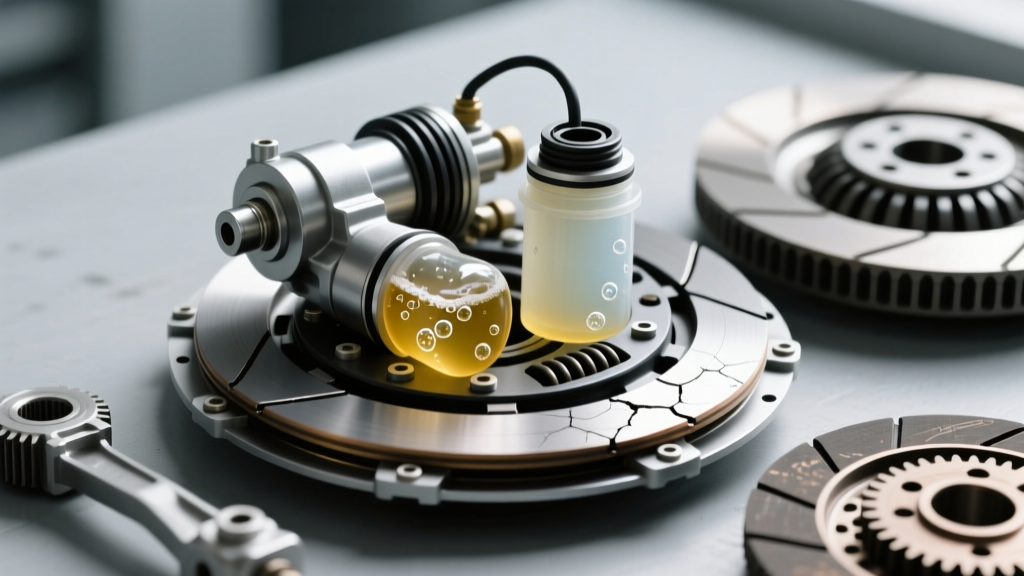
To diagnose noise accurately, you must first understand the fluid moving through your master and slave cylinders. DOT 3 fluid is a polyalkylene glycol ether-based compound. By its very nature, it is highly hygroscopic, meaning it actively absorbs moisture from the atmosphere through microscopic pores in rubber hoses and reservoir caps. According to the FMVSS 116 federal standards, fresh DOT 3 fluid must have a dry boiling point of at least 401°F (205°C). However, once it absorbs just 3% water by volume—a common occurrence after 24 months of service—its wet boiling point plummets to roughly 284°F (140°C).
Why does this matter for noise diagnosis? In rear-wheel-drive applications, the hydraulic slave cylinder is often mounted inside or directly adjacent to the bellhousing, inches away from a catalytic converter or exhaust manifold. When the fluid boils under heavy stop-and-go traffic, it creates vapor lock (cavitation). This compressible vapor prevents the slave cylinder from fully extending, resulting in incomplete clutch disengagement. This incomplete release is the primary root cause of severe gear grinding during shifts.
Decoding the Sounds: Grinding vs. Squealing vs. Chirping
A systematic approach to auditory diagnostics requires isolating exactly when the noise occurs: at rest, during pedal depression, or during gear engagement.
1. Gear Grinding (The Hydraulic Link)
If the vehicle grinds going into first or reverse while stationary, or grinds during upshifts under load, you are experiencing gear clash. The synchronizers in the transmission cannot match shaft speeds if the input shaft is still being driven by the engine. Before condemning the synchronizers or the clutch disc, test the hydraulic system. A spongy pedal or a pedal that slowly sinks to the floor indicates aerated or boiled DOT 3 clutch fluid, or a bypassing master cylinder cup. If the clutch does not disengage 100%, the transmission will grind.
2. Squealing (The Bearing and Finger Interface)
A high-pitched squeal that occurs only when the clutch pedal is depressed halfway usually points to the throwout bearing (TOB) riding dry against the pressure plate diaphragm fingers. However, if the hydraulic system is suffering from severe cavitation or a sticking slave cylinder rod, the fork may apply uneven, oscillating pressure to the TOB. This erratic hydraulic pressure can cause the bearing to chirp and squeal as it skips across the rotating fingers rather than applying smooth, constant force.
3. Chirping and Rattling (Mechanical Pivot Wear)
A metallic chirp that changes pitch with engine RPM, often heard at idle with the pedal out, is typically a worn clutch fork pivot ball or a dry input shaft bearing sleeve. While not directly caused by fluid degradation, a poorly bled system can cause the TOB to constantly ride the fingers (zero free-play), accelerating wear on these mechanical pivot points. For reference, a standard GM LS-series hydraulic TOB (e.g., LuK part number 510012010) requires exact hydraulic preload; improper fluid volume during bleeding will destroy the bearing in under 5,000 miles.
Diagnostic Matrix: Noise vs. Root Cause
| Observed Noise | Pedal State | Probable Root Cause | Diagnostic Action |
|---|---|---|---|
| Heavy Gear Grind | Depressed to floor | Vapor lock / Aerated DOT 3 fluid / Bypassing Master Cylinder | Check fluid moisture content; pressure bleed system; measure slave travel. |
| High-Pitch Squeal | Mid-travel depression | Worn Throwout Bearing / Erratic Slave Cylinder Pressure | Inspect slave rod for scoring; listen with chassis ear; verify hydraulic smoothness. |
| Metallic Chirp | Released (Idle) | Dry Fork Pivot Ball / Worn Pilot Bearing / Zero Free-Play | Measure pedal free-play (should be 1-1.5"); adjust master pushrod if applicable. |
| Whirring / Growl | Depressed to floor | Input Shaft Bearing / TOB Internal Failure | Remove inspection cover; visually inspect bearing cage and shaft surface. |
Expert Diagnostic Workflow: Fluid First, Bellhousing Second
As outlined in comprehensive guides on hydraulic clutch system diagnostics, you must eliminate the hydraulic variable before authorizing mechanical teardowns. Follow this 2026 standard operating procedure:
- Test the Fluid Moisture: Use an electronic brake fluid moisture tester. If the DOT 3 clutch fluid registers over 2% moisture content, a flush is mandatory regardless of other symptoms.
- Measure Pedal Free-Play: Use a steel ruler to measure from the pedal pad to the firewall. Most modern manual transmissions require 0.5 to 1.0 inches of free-play before the master cylinder pushrod engages. Lack of free-play causes the TOB to spin constantly, generating heat and noise.
- Perform a Slave Cylinder Travel Test: Have an assistant depress the pedal while you measure the slave cylinder pushrod travel at the bellhousing. Typical travel should be between 12mm and 18mm (consult OEM specs). If travel is less than 10mm, you have internal hydraulic bypass or a blockage.
- Pressure Bleed the System: Gravity bleeding is insufficient for modern clutch lines with complex routing and anti-rattle loops. Use a motive pressure bleeder set to 15 PSI. Forcing fresh fluid through the system at this pressure dislodges trapped air pockets in the slave cylinder bore that cause spongy engagement and subsequent gear grind.
Best Practices for DOT 3 Service and Torque Specifications
When servicing the hydraulic system to cure noise and disengagement issues, precision is paramount. Stripping a bleeder screw or cross-threading a flare nut turns a $120 fluid service into a $600 parts replacement nightmare.
- Bleeder Screw Torque: Most 8mm and 10mm hydraulic clutch bleeder screws are made of soft brass or plated steel. Torque them to exactly 5 to 8 Nm (44 to 70 in-lbs). Anything higher risks snapping the head off inside the slave cylinder casting.
- Line Fitting Torque: The 10mm or 12mm flare nuts connecting the hard line to the slave cylinder should be torqued to 14 to 18 Nm (10 to 13 ft-lbs). Use a crowfoot wrench to ensure accurate torque application and prevent rounding the soft metal nuts.
- Master Cylinder Pushrod Nut: When adjusting pedal free-play at the firewall, the pushrod locknut is typically secured at 18 to 22 Nm.
- Fluid Selection Warning: Never substitute DOT 5 (silicone-based) fluid in a system designed for DOT 3 or DOT 4. Silicone fluid does not absorb water; instead, water pools in the low points of the slave cylinder, causing rapid localized corrosion and seal failure, which will guarantee a return visit for clutch noise and failure.
Expert Insight: If you are diagnosing a chirping noise on a high-mileage truck and the DOT 3 clutch fluid looks dark and cloudy, flush the system first. In 30% of cases, the erratic hydraulic pressure caused by contaminated fluid is forcing the clutch fork to vibrate against a worn pivot ball. A $90 hydraulic flush and pushrod adjustment can sometimes silence a noise that would have otherwise triggered a $1,400 transmission removal.
Conclusion
Clutch noise diagnosis is rarely as simple as "replace the bearing." Grinding, squealing, and chirping are symptoms of a system out of balance. By understanding the hygroscopic nature of DOT 3 clutch fluid, measuring exact hydraulic travel, and applying proper torque specifications during fluid service, you can accurately separate hydraulic failures from mechanical wear. This expert-level diagnostic approach saves time, protects the customer's wallet, and preserves your shop's reputation for getting the fix right the first time.