Introduction: The Intersection of Mechanics and Calculus
As we navigate the automotive landscape of 2026, the line between mechanical engineering and software calibration has completely blurred. For DIY mechanics, rebuilders, and automotive students, understanding basic transmission terminology is no longer just about knowing what a sun gear or a torque converter does. Modern powertrain diagnostics require an understanding of how Transmission Control Modules (TCMs) manipulate hydraulic pressure using advanced mathematics. One of the most critical, yet rarely discussed, concepts in modern shift calibration is the differentiability of a function. In this step-by-step how-to guide, we will decode essential transmission terminology by bridging the gap between physical hardware and the mathematical functions that control them.
Step 1: Decode the Mechanical Geartrain Lexicon
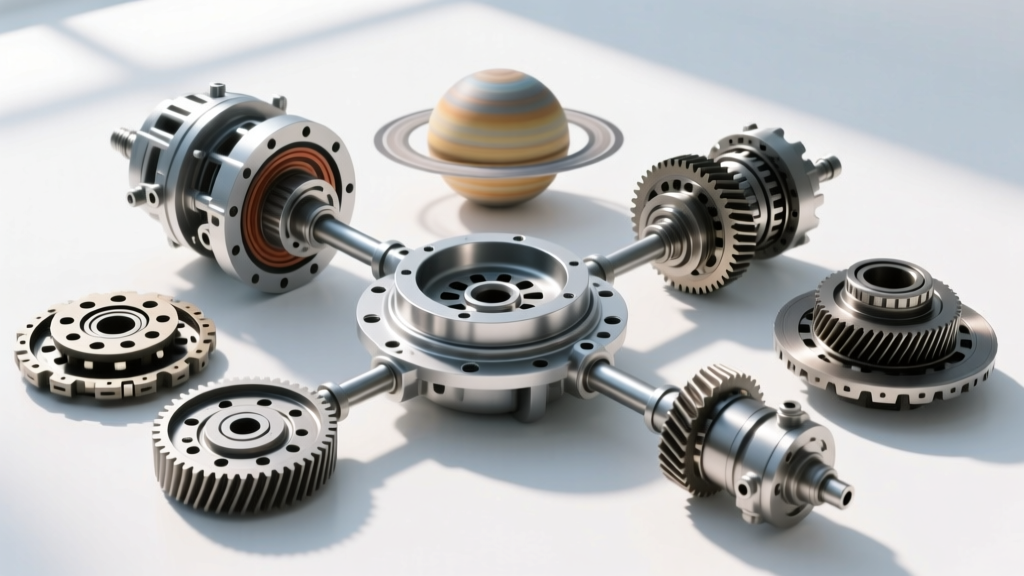
Before we can understand how a computer controls a shift, we must define the physical components it is actuating. The foundation of most traditional automatics (like the legendary GM 4L60E or the robust 6L80) is the planetary gearset.
- Sun Gear: The central gear in a planetary set. In a 6L80, holding the sun gear stationary while driving the ring gear dictates specific underdrive ratios.
- Planetary Carrier: The assembly holding the planet gears. It can act as an input, output, or reaction member depending on which clutches are applied.
- Ring Gear (Annulus): The outer gear with internal teeth.
- Reaction Clutch vs. Driving Clutch: A driving clutch connects two rotating members to spin at the same speed. A reaction clutch holds a member stationary against the transmission case.
Real-World Wrenching Spec: When dropping the pan on a GM 4L60E to inspect these components via the valve body, remember that the pan bolts are relatively small (M6 thread). The factory torque spec is just 97 lb-in (11 Nm). Over-torquing to 20 ft-lbs will strip the aluminum case threads, requiring a helicoil repair that costs roughly $40 in parts and an hour of labor.
Step 2: Master Hydraulic and Solenoid Terminology
The TCM cannot move metal clutches directly; it uses hydraulic fluid as a messenger. Understanding the terminology of hydraulic control is vital for diagnosing shift complaints.
PWM and VFS Solenoids
Older transmissions used simple on/off shift solenoids. Modern units, like the ZF 8HP70 found in countless BMW and FCA vehicles, use Variable Force Solenoids (VFS) and Pulse Width Modulation (PWM). PWM rapidly cycles a solenoid on and off (often at 300 Hz) to create a precise, averaged hydraulic pressure. If you are scanning live data and see a 'PWM Duty Cycle' reading of 65%, the TCM is keeping the solenoid energized 65% of the time to modulate clutch apply pressure.
Diagnostic Tip: If a ZF 8HP exhibits harsh downshifts, the issue is frequently not the clutches themselves, but degraded adapter seals or a cracked mechatronic sleeve. The ZF mechatronic sleeve (Part # 24117571217) costs around $150-$250 and is a known failure point that causes internal pressure leaks, fooling the TCM's adaptive pressure tables.
Step 3: Apply the Differentiability of a Function to Shift Calibration
This is where mechanical terminology meets advanced control theory. When a transmission executes a gear change, it goes through distinct phases: the Fill Phase, the Torque Phase, and the Inertia Phase. To make these phases imperceptible to the driver, calibration engineers rely heavily on the differentiability of a function.
What Does This Mean for Transmissions?
In calculus, a function is 'differentiable' if its derivative exists at every point in its domain, meaning the curve is smooth and has no sharp corners or abrupt spikes. In transmission calibration, the clutch apply pressure over time is represented as a mathematical function, P(t).
- Velocity (First Derivative): The rate at which pressure builds.
- Acceleration (Second Derivative): The rate of change of the pressure build.
- Jerk (Third Derivative): The rate of change of acceleration. This is what the human body feels as 'shift shock'.
If the pressure mapping function lacks continuous differentiability (for example, if a solenoid sticks and causes a sudden, linear spike in pressure rather than a smooth S-curve), the third derivative (jerk) approaches infinity for a microsecond. The result? A bone-jarring shift clunk. According to SAE technical papers on shift quality, ensuring the continuous differentiability of the torque handover function is the primary method engineers use to eliminate shift shock during the inertia phase.
The CVT Connection: Continuous Differentiability
This concept is even more critical in Continuously Variable Transmissions (CVTs). Unlike stepped gearboxes, a CVT uses a pushbelt and variable pulleys to provide infinite ratios. As detailed in Bosch's CVT pushbelt engineering documentation, the TCM must calculate a continuous, differentiable function to adjust the primary and secondary pulley clamping pressures simultaneously. If the ratio sweep function is not perfectly differentiable, the belt will slip or the engine RPM will 'rubber-band' erratically. The smoothness of a modern Toyota Direct Shift-CVT is a direct result of flawless mathematical differentiability in its clamping pressure algorithms.
Step 4: Diagnose Torque Converter and Lockup Terminology
The final piece of the terminology puzzle is the torque converter, specifically the TCC (Torque Converter Clutch).
- Slip RPM: The difference between engine speed (impeller) and transmission input shaft speed (turbine). Modern TCMs use 'controlled slip' (often maintaining 20-40 RPM of slip) to dampen engine vibrations.
- Apply Pressure vs. Release Pressure: The TCC is applied hydraulally. The TCM modulates a dedicated PWM solenoid to bleed off release pressure while increasing apply pressure, effectively locking the engine to the transmission for 1:1 efficiency.
Real-World Scenario: On a GM 6L80, a common issue is TCC shudder. This is often diagnosed by looking at the TCC slip RPM on a bi-directional scan tool. If the slip oscillates wildly instead of holding a steady 20 RPM, the torque converter clutch material is degraded, or the TEHCM (Transmission Electro-Hydraulic Control Module) pressure regulator is worn. A remanufactured 6L80 TEHCM will cost between $400 and $600 in 2026, plus a mandatory reflash using GM's GDS2 software.
Reference Table: Essential Specs for Popular Transmissions
To bridge the gap between theory and the shop floor, keep this reference table handy for common modern and legacy transmissions.
| Transmission Model | Common Applications | Dry Fill Capacity | Pan Bolt Torque Spec | Common Failure Point |
|---|---|---|---|---|
| GM 4L60E | 1990s-2010s GM Trucks/Corvettes | 11.2 Quarts (10.6L) | 97 lb-in (11 Nm) | 3-4 Clutch pack burnout |
| GM 6L80 | 2006-2020 GM Trucks/Camaros | 10.0 Quarts (9.5L) | 97 lb-in (11 Nm) | TEHCM solenoid wear / TCC shudder |
| ZF 8HP70 | BMW, Dodge, Jaguar, Aston Martin | ~9.0 Liters (Varies) | 8 Nm (Pan to Mechatronic) | Mechatronic sleeve leaks |
| Jatco CVT8 (JF017E) | Nissan/Infiniti V6 Applications | 10.6 Quarts (10.0L) | 70 lb-in (8 Nm) | Step motor / Pushbelt slip |
Summary: Speaking the Language of Modern Drivetrains
Mastering transmission terminology in the modern era requires looking past the physical gears and understanding the software that commands them. Whether you are measuring the 8 Nm torque spec on a ZF 8HP mechatronic pan or analyzing the PWM duty cycle on a scan tool, you are witnessing physics and calculus in real-time. The next time you experience a perfectly imperceptible gear change in a modern vehicle, you will know it is the result of a calibration engineer meticulously ensuring the differentiability of a function, eliminating jerk, and delivering seamless power to the pavement. For further reading on stepped automatic architectures, the ZF 8HP technical overview remains an industry-standard resource for understanding how mechanical hardware and mathematical logic combine to create the modern drivetrain.