Demystifying the Drivetrain: What Is an Automatic Transmission?
When beginners or DIY enthusiasts ask the fundamental question, 'what is automatic transmission,' they are usually wondering how a vehicle seamlessly shifts through multiple gears without the driver ever pressing a clutch pedal. At its core, an automatic transmission is a highly complex hydraulic, mechanical, and electronic system designed to multiply engine torque and transfer it to the drive wheels at varying speed ratios. Unlike a manual transmission that relies on a friction disc and driver input, an automatic uses fluid dynamics and computer-controlled hydraulic pressure to manage power delivery.
While modern 10-speed automatics and continuously variable transmissions (CVTs) dominate the 2026 automotive landscape, the foundational architecture of the traditional stepped automatic remains largely unchanged. To truly understand how these systems operate, we must break down the primary components that make autonomous shifting possible.
The Fluid Coupling: The Torque Converter
The torque converter is the bridge between the engine's crankshaft and the transmission's input shaft. It replaces the mechanical clutch found in manual vehicles, utilizing transmission fluid to transfer rotational energy. A torque converter consists of three main internal elements:
- The Impeller (Pump): Bolted directly to the engine's flexplate, the impeller spins at engine speed, flinging transmission fluid outward via centrifugal force.
- The Turbine: Connected to the transmission input shaft, the turbine catches the fluid thrown by the impeller, causing it to spin and drive the transmission.
- The Stator: Situated between the impeller and turbine, the stator redirects returning fluid to multiply torque during initial acceleration. This is what gives automatics their characteristic 'off-the-line' punch.
Expert Insight: Modern torque converters feature a Torque Converter Clutch (TCC). Once the vehicle reaches cruising speed (usually between 35-45 mph), the TCC physically locks the impeller and turbine together, eliminating fluid slippage and improving fuel economy by 5% to 10%. In high-performance applications, aftermarket converters with higher stall speeds (e.g., 3,000 RPM) are used to keep the engine in its peak power band before lock-up.
The Mechanical Core: Planetary Gearsets
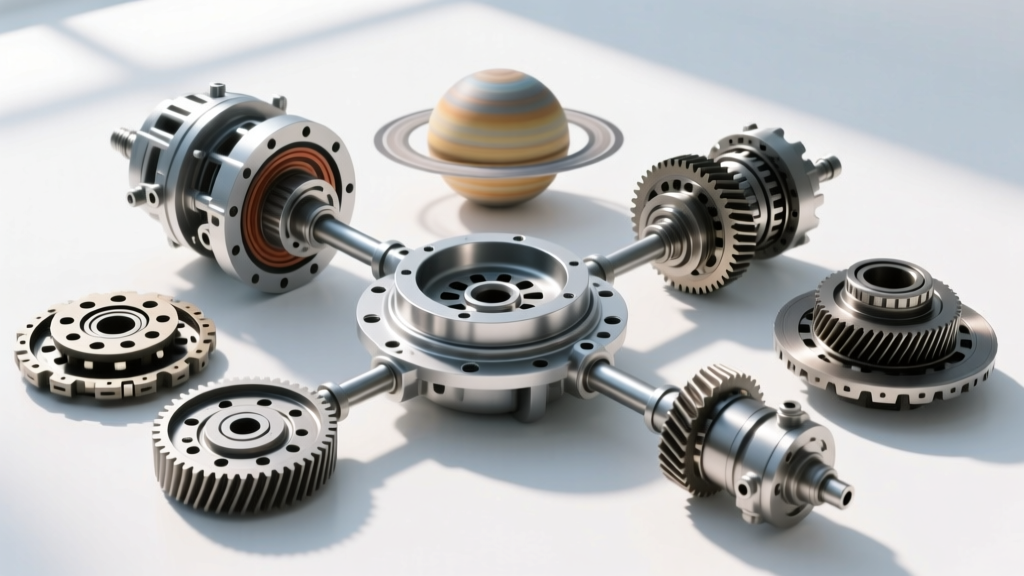
If you are learning what is automatic transmission hardware, the planetary gearset is the mechanical heart of the system. Instead of sliding gears on parallel shafts like a manual gearbox, automatics use compound planetary gearsets to achieve different gear ratios. A standard planetary set consists of three components:
- The Sun Gear: The central gear.
- The Planet Carrier: Holds multiple smaller 'planet' gears that orbit the sun gear.
- The Ring Gear: The outer gear with internal teeth that meshes with the planet gears.
By holding one component stationary, driving a second component, and using the third as the output, the transmission can achieve forward gears, reverse, and neutral. For example, the legendary GM 4L60E uses a combination of Simpson and Ravigneaux gearsets to achieve four forward speeds. Modern transmissions, like the ZF 8HP, utilize four simple planetary gearsets and five shift elements to create eight distinct ratios, offering a massive ratio spread for both aggressive acceleration and relaxed highway cruising.
The Lepelletier Gearset Innovation
Introduced in the early 2000s and widely adopted in transmissions like the GM 6L80 and Ford 6R80, the Lepelletier layout combines a simple planetary gearset with a Ravigneaux gearset. This ingenious design allows for six forward speeds using fewer components than older designs, significantly reducing weight and internal rotational mass.
The Grip: Clutch Packs and Bands
To hold or drive the various components of the planetary gearsets, the transmission uses hydraulic clutch packs and friction bands. A clutch pack consists of alternating friction discs (splined to the inside of a drum) and steel separator plates (splined to the outside hub). When hydraulic fluid is directed into the clutch piston cavity, it squeezes the pack together, locking the components and transferring torque.
Real-World Specifications: In a heavy-duty application, friction materials are often composed of high-energy cellulose or Kevlar-based composites designed to withstand immense thermal loads. During a rebuild of a GM 6L80, a transmission specialist must meticulously measure clutch pack clearance using feeler gauges. The 3-5-R clutch pack, for instance, typically requires a precise clearance of 0.040 to 0.070 inches. Too tight, and the clutches will drag and burn; too loose, and the transmission will slip and flare during shifts.
The Brain: Valve Body and Mechatronics
The valve body is the hydraulic control center of the transmission. It is a maze of channels, valves, and solenoids that direct pressurized fluid to the appropriate clutch packs at the exact right millisecond. In older, purely hydraulic transmissions, shift points were governed by mechanical governor pressure and throttle valves.
Today, the valve body is controlled by a Transmission Control Module (TCM). In cutting-edge designs like the ZF 8-speed automatic, the TCM, solenoids, and valve body are integrated into a single 'Mechatronic' unit housed directly inside the transmission oil pan. This reduces wiring harness complexity and allows for incredibly fast shift times (under 200 milliseconds). According to industry data published by Transmission Digest, electro-hydraulic solenoids now operate using Pulse Width Modulation (PWM) at frequencies exceeding 300 Hz, allowing for seamless, imperceptible gear changes.
The Lifeblood: Transmission Fluid and the Oil Pump
None of these components can function without the hydraulic pump and Automatic Transmission Fluid (ATF). The pump, usually driven by the torque converter hub, generates the baseline hydraulic pressure (often between 120 and 180 PSI at operating temperature) required to actuate clutches and lubricate bearings.
ATF is not just a lubricant; it is a highly engineered hydraulic medium containing friction modifiers, anti-wear additives, and detergents. Using the wrong fluid can lead to catastrophic failure. For instance, filling a ZF 8HP with standard Dexron VI instead of the specific ZF LifeguardFluid 8 will result in severe shudder and clutch degradation due to incompatible friction modifiers.
Component Specifications: A Comparative Data Table
To provide actionable, real-world data for enthusiasts and DIY mechanics, the table below outlines the specific component specs, fluid capacities, and torque requirements for three of the most common automatic transmissions on the road today.
| Transmission Model | Gearset Layout | Service Fill Capacity | Pan Torque Spec | Filter Part / Note |
|---|---|---|---|---|
| GM 6L80 (6-Speed) | Lepelletier | 6.3 Quarts (Dexron VI) | 106 in-lbs (8.8 ft-lbs) | ACDelco TF289 |
| ZF 8HP70 (8-Speed) | 4 Simple Planetary | ~5.5 Quarts (Lifeguard 8) | 10 Nm (88 in-lbs) | Integrated into Plastic Pan |
| GM 4L60E (4-Speed) | Simpson / Ravigneaux | 5.0 Quarts (Dexron VI) | 115 in-lbs (9.6 ft-lbs) | ACDelco TF289 (Deep Pan) |
Note: Service fill capacity refers to the amount of fluid required after dropping the pan and replacing the filter. Dry fill capacities (after a complete rebuild) are significantly higher, often exceeding 11 quarts for the 6L80.
Practical Maintenance Advice for Longevity
Understanding what is automatic transmission architecture is only half the battle; maintaining it is the other. Many manufacturers market their modern transmissions as having 'lifetime' fluid. From a professional mechanic's perspective, 'lifetime' simply means the lifetime of the warranty. To ensure a transmission survives past 150,000 miles, adhere to the following actionable maintenance framework:
- Interval: Perform a drain, filter replacement, and fill every 60,000 miles under normal driving conditions, or every 30,000 miles if you frequently tow or drive in stop-and-go traffic.
- Temperature Management: Heat is the number one enemy of ATF. If your vehicle's transmission temperature regularly exceeds 220°F (104°C), install an auxiliary transmission cooler. For every 20-degree drop in fluid temperature, the lifespan of the ATF and internal clutch materials effectively doubles.
- Pan Bolt Caution: When servicing the filter, never use an impact wrench on the transmission pan bolts. The aluminum cases of modern transmissions strip easily. Always use a calibrated inch-pound torque wrench set to the manufacturer's exact specification (e.g., 106 in-lbs for the GM 6L80).
Pro-Tip: When replacing the filter on a ZF 8-speed, remember that the filter is permanently molded into the plastic transmission pan. You cannot buy just the filter; you must purchase the entire pan assembly, which includes the integrated filter, gasket, and new mounting bolts. Sourcing OEM or high-quality aftermarket pans from ZF's official parts distributors is critical to avoid fluid leaks and internal pressure drops.
Conclusion
So, what is automatic transmission technology at its core? It is a symphony of hydraulic pressure, planetary mechanics, and electronic precision working in unison. From the fluid coupling of the torque converter to the intricate friction materials inside the clutch packs, every component plays a vital role in translating engine power into forward motion. By understanding these basic components and adhering to strict, data-driven maintenance schedules, you can ensure your vehicle's drivetrain remains reliable, efficient, and responsive for hundreds of thousands of miles.